[.blog-callout]
✨ TL;DR:
- AI handles repetitive content marketing tasks (drafting, editing, repurposing, SEO) so teams can focus on high-impact, human-driven work.
- The best results come from using AI across the entire content lifecycle—strategy, production, and distribution—not just for writing.
- Softr lets you build a full content marketing system with databases, automated workflows, and AI-powered apps in one place.
[.blog-callout]
By now it’s pretty much a given that AI has spread into every area of business operations. But while it’s easy for a manager to tell their team to “use AI,” putting it into practice (and getting real results) is decidedly less easy.
This is as true for content marketing as it is for HR, customer service, or sales. Seeing strong ROI from AI really comes down to knowing how to use it, not from adding more tools to your stack or shelling out for extra tokens.
So, how do you use AI to scale content efforts across strategy, production, and distribution? This guide breaks it down, showing you the top use cases for AI in content marketing and how platforms like Softr can help you operationalize them.
What is AI in content marketing?
AI in content marketing is the use of AI tools to assist with planning, producing, and distributing business content. It involves the full content lifecycle: from researching and outlining articles, to drafting and editing copy, to repurposing assets across channels, to measuring results.

It may also be helpful to quickly define content marketing here, just so we know what it is that we’re applying AI to. Content marketing is the practice of creating and distributing media to attract and engage a target audience. Types of content include blog posts, data reports, case studies, videos, social media, newsletters, and whitepapers, to name some common examples.
Why use AI for content marketing?
If you worked in content marketing before AI, you’ll know just how time-consuming it is to manually prepare and ship content at scale. AI doesn’t do away with all of the work involved, but it does dramatically reduce the time you have to spend on repetitive, low-creativity tasks.
Even non-writers can understand the tedium involved in building an outline for dozens (or hundreds) of blog posts and product updates. The same goes for drafting meta descriptions, writing 12 variations of a social caption, generating alt text for every image, or condensing a 2,000-word article into a newsletter blurb.
If AI can handle tasks like these, it leaves more time for teams to create the kind of high-impact, human-produced content that LLMs can’t replace (like the article you’re reading now).
To be more specific, these are some of the tangible benefits of adopting AI for content marketing:
- Maintain consistency across writers and channels: When you’re managing multiple contributors (in-house, freelance, or a mixture), AI helps you maintain a unified tone and structure.
- Research complex topics faster: Deep research—think competitor and trend analysis, data sourcing, subject matter exploration—can now be done with AI in a matter of minutes or hours.
- Lower the barrier to experimentation: AI makes testing variants or new ideas way more cost-effective. You can generate two dozen subject line variants or outline a new content format in seconds.
- Personalize at scale. AI lets you ditch the “one and done” approach to content and generate custom variants for different industries, roles, or lifecycle stages.
- Speed up the editorial process: Human-led review is still important, but AI is excellent for a quick editorial pass, flagging typos and inconsistencies and even suggesting improvements.
12 AI use cases for content marketing
Here are the highest-value ways content teams are using AI right now, organized across the three core phases of the content lifecycle.
Strategy and planning
If a team isn’t using AI tools for content strategy and research, they’re leaving endless value on the table. I’d even argue that AI is significantly better at planning and prep than it is at writing.
- Topic research and clustering: Feed AI a list of your existing posts, and ask it to identify keyword gaps, build clusters around your key topics, surface emerging subtopics in your industry, or flag blogs that are due for a revamp.
- Competitive analysis: Pull competitor blog posts, ad copy, or landing pages and ask AI to summarize their positioning, common talking points, and gaps.
- Audience research: Synthesize interview transcripts, support tickets, or community threads to extract recurring questions and pain points.
- Content briefs: Turn a topic and a few bullet points into a full brief with target keyword, target audience, key questions to answer, recommended structure, and internal linking suggestions.
Production
This may be the most obvious use case, but simply telling AI to “generate content” and then hitting publish won’t get you very far. Instead, treat AI as an accelerant and collaborator.
- Drafting: Use AI to generate schematic first drafts from a brief. Treat the output as a starting point, never a final version. The best teams use AI for structure and boilerplate, then spend their human time on brand positioning, examples, voice, and sourcing.
- Editing and proofreading: AI can be a very strong line editor. Use it to trim sentences, boost clarity, flag passive voice, and catch typos and grammatical errors.
- H1s, H2s, and meta descriptions: Use AI to generate 10+ variants of a header or meta description, then pick the one that fits best (or A/B test the two strongest options).
- Voice transcription: In recent years, AI has gotten really good at transcribing voice recordings. You can cut down on writing time by dictating ideas, notes, or streams of consciousness out loud and letting AI turn them into structured text.
Distribution, repurposing, and reporting
A single blog article can fuel additional social posts, newsletters, webinars, a sales enablement asset, and more. Using AI makes this kind of redistribution feasible even with a small headcount.
- Repurposing: Turn one blog into a LinkedIn post, a newsletter section, and a YouTube script. AI handles format adaptations very well.
- Social media distribution: Draft a week's worth of posts in minutes—pulled from content you’ve already written—with each one tuned to a specific platform.
- SEO optimization: Run drafts through AI to suggest internal links, identify missing keywords, and tighten meta tags before or after publishing.
- Performance analysis: Feed analytics data to AI and ask it to surface the content driving the most engagement, topics likely to correlate with conversions, and other insights relevant to the metrics you track.
AI tools for content marketing
Claude and ChatGPT are great, but they’re far from the only AI tools you can leverage for content marketing. Most content teams end up using some combination of the categories below.
- General-purpose LLMs: ChatGPT, Claude, and Gemini (and others) can be used for brainstorming, research, drafting, editing, and even vibe coding things like landing pages.
- App builders and automation platforms: An AI app builder like Softr lets you create custom content marketing apps and automated workflows from a single platform. Or you could use a standalone AI automation tool like Zapier to connect your existing stack.
- Specialized writing tools: Apps like Jasper, Writer, and Copy.ai are built for marketing-specific workflows and brand voice management. You can also use a specialized tool like Grammarly for AI-powered proofreading and edits.
- SEO platforms with AI built in: Platforms like Ahrefs, Semrush, and Surfer SEO offer AI-powered keyword research, content gap analysis, competitor insights, and optimization suggestions.
- Image and video generators: You can use tools like Midjourney, Runway, and Synthesia (or a general-purpose LLM) to concept visuals and infographics for blogs and other channels. Just be wary of publishing “slop” images that haven’t been worked on by human designers.
This doesn’t cover the full gamut of AI tools that can help with content marketing, just the most popular examples. Other options include vibe coding platforms, AI writing assistants built into software like Notion or HubSpot, transcription tools, and AI analytics platforms.
Build an AI-powered content marketing system with Softr
Most AI tools handle one piece of the content workflow — or, if you’re lucky, a handful of pieces. With Softr, you can use AI to build a full operational layer for content marketing, complete with apps, databases, automated workflows, and role-based access control for internal and external users.
A central content database
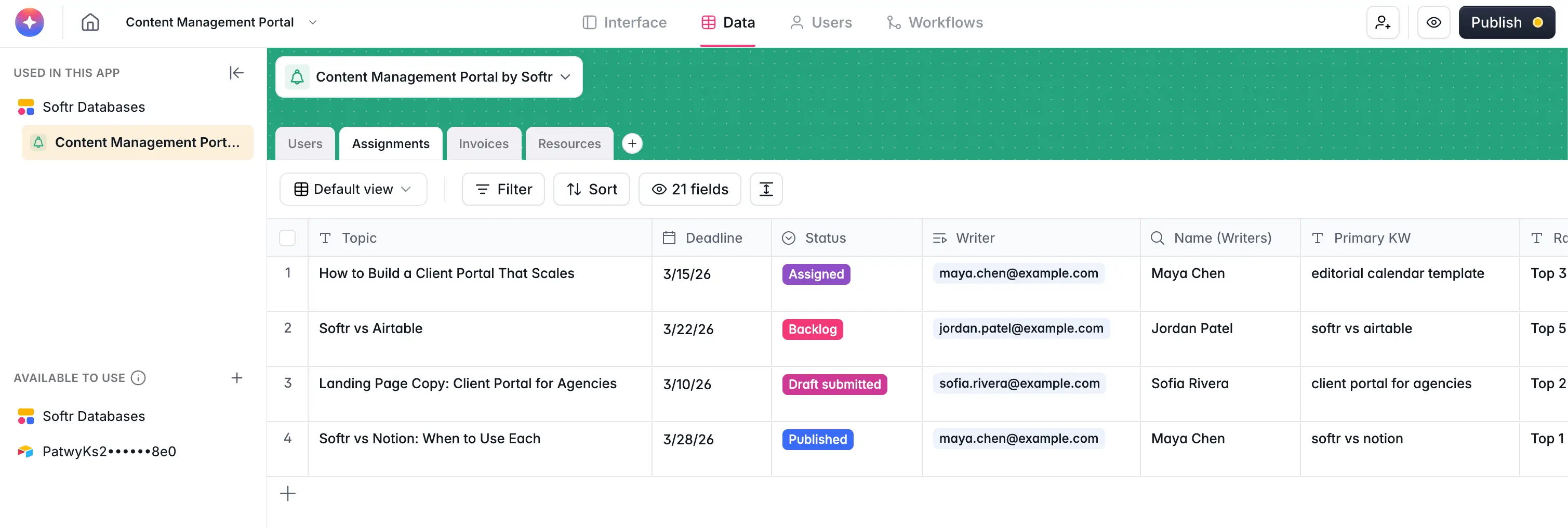
Start with a relational Softr Database to store every piece of business content in a structured way: topic, brief, status, owner, target persona, channel, publish date, and performance metrics. Each row in your database is a content asset that can power your workflows.
Use database AI agents to enrich your records automatically. For example, an AI agent can read a draft and generate a meta description, suggest a headline variant, or classify content by funnel stage. This way, the database becomes self-enriching, allowing writers and editors to spend less time on metadata and more time on the work itself.
Workspaces for internal and external users
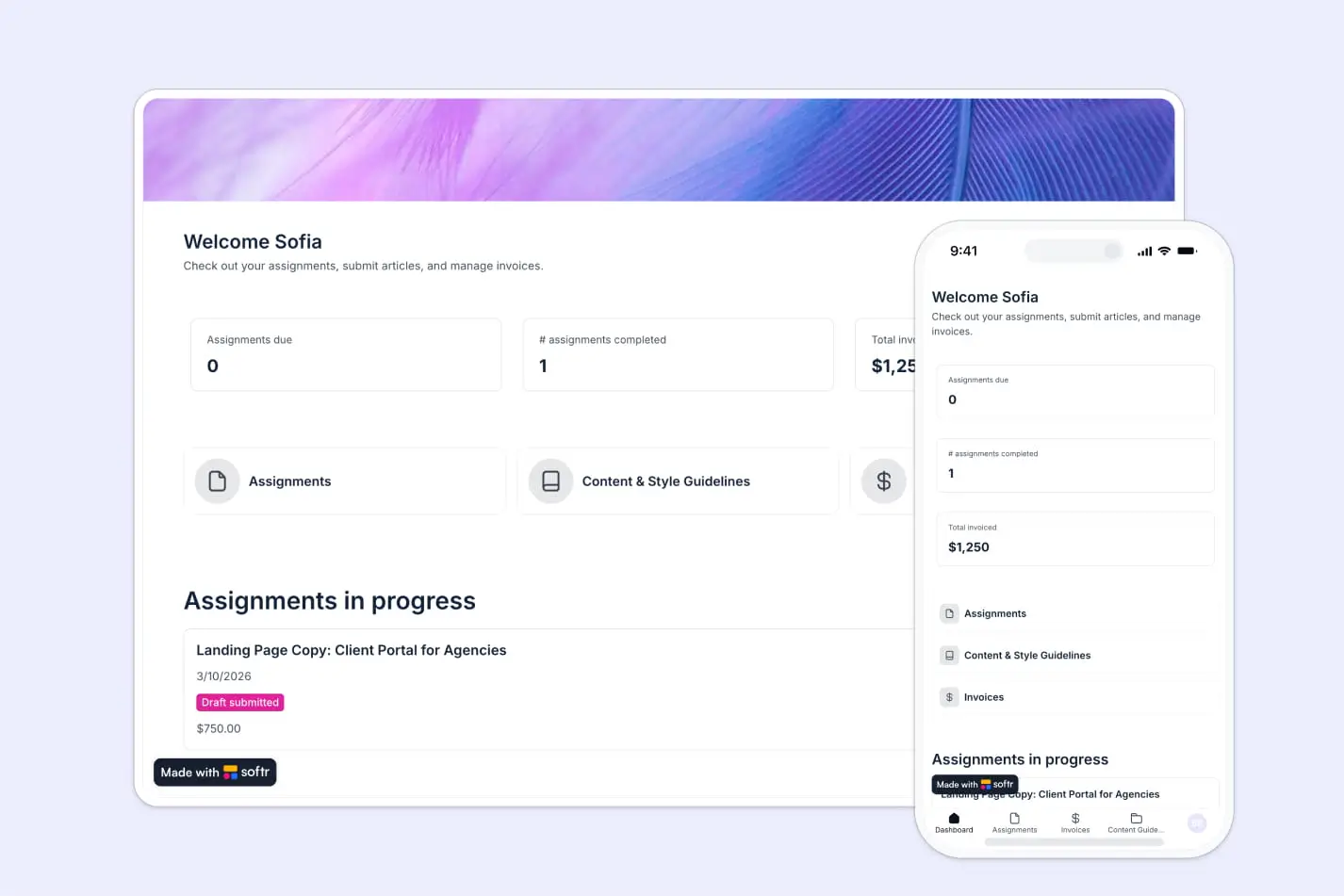
Use the AI Co-Builder to create a custom content marketing management portal with built-in workflows. Writers see their assigned drafts, editors see what's awaiting review, and managers see the full pipeline and performance dashboard.
You can even share the portal externally with freelancers and set visibility so they only have access to their current assignments. All of this is configured visually with user and permission settings, which means the right people see the right content without manual gatekeeping.
Automated content workflows
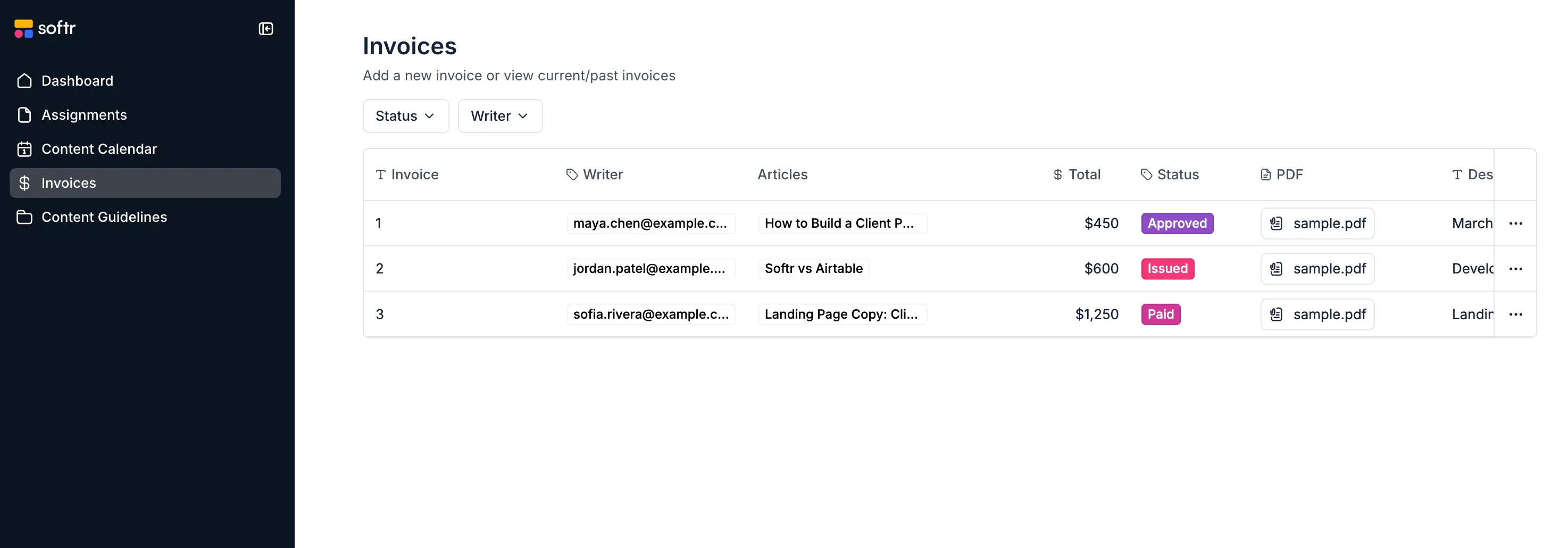
Use Softr Workflows to go hands-off with repetitive coordination and channel maintenance tasks. Here are some automation examples:
- When a draft moves to "Ready for review," post a Slack notification and assign an editor.
- When a piece is published, auto-generate repurposed copy for LinkedIn, X, and your newsletter using AI steps in the workflow.
- When 30 days pass after publication, trigger a freshness pass that asks AI to update key sections or check for outdated information.
- When a freelancer submits an invoice tied to a piece, route it through the approval process automatically.
These workflows can chain conditional logic, call external APIs (like your CMS, analytics tools, or social schedulers), and include AI steps that process content mid-flow.
Custom AI tools when you need them
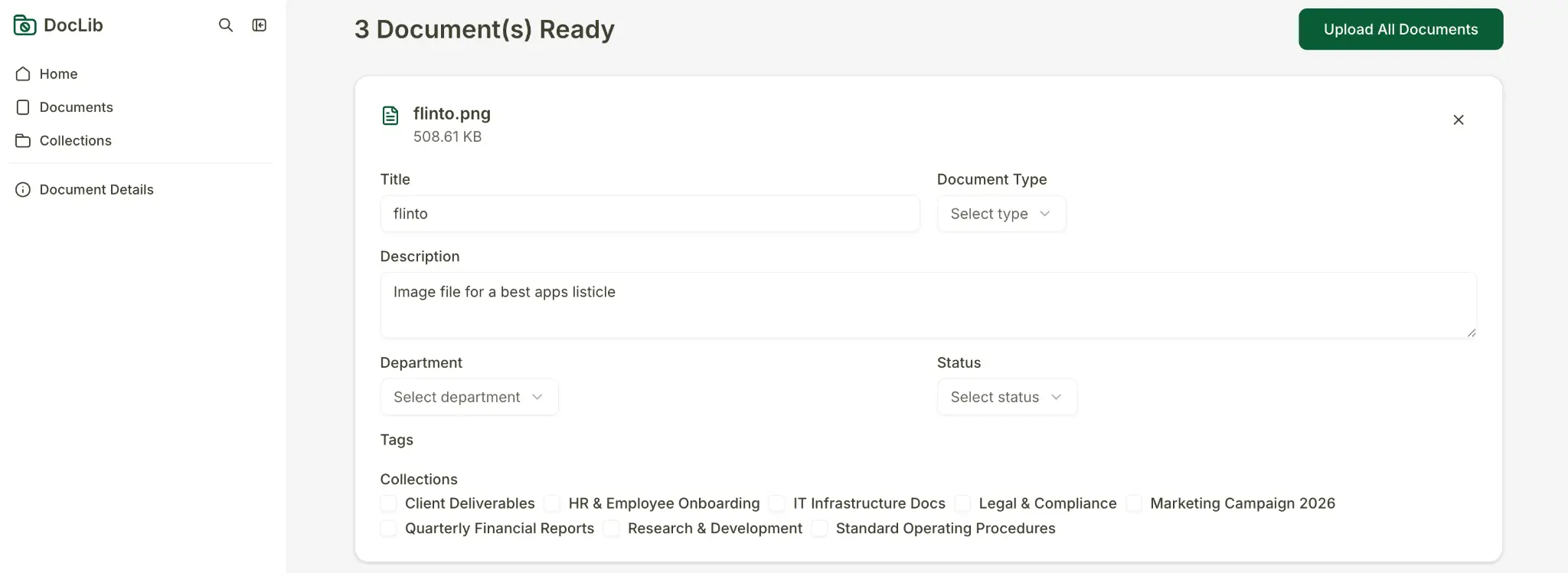
For workflows that don't fit Softr’s standard blocks, the Vibe Coding block lets you generate custom UI components from a prompt. Below are examples we've seen content teams build:
- A bulk document importer that can pull in existing articles from a CMS export
- A document diff viewer that generates a side-by-side view of the two text versions
- A content repurposing tool where an editor pastes in a published article and gets back tailored social posts
Each of these vibe-coded tools inherits your app's permissions, theme, and database connections automatically, so they feel just like native features.
Bring AI to your content marketing workflows today
If this guide has shown you anything, it should be that you don’t have to overhaul your entire process to adopt AI for content marketing. It’s more about utilizing AI for repetitive, labor-intensive steps, freeing up time for the writing and strategizing you’re already doing.
If you’re currently using an LLM to help you with the basics, the next step is trying out agents, automation, and AI content marketing apps. Softr gives you access to all three — plus structured databases, vibe coding tools, and infrastructure that’s secure from day one.
👉 Try Softr for free and start building an AI-powered content marketing system today.
Frequently asked questions
Does using AI for content marketing mean lower quality content?
What AI tools do content marketers actually need?
Where's the best place to start with AI in content marketing?