Softr vs Claude Code: Which is best for building apps in 2026?


If you're comparing Softr and Claude Code, you're likely trying to answer one question: should AI build your app inside a managed platform that handles the infrastructure for you, or should AI write custom code that you own, host, and maintain yourself?
Both tools use AI to turn plain-language descriptions into working software, but they sit at very different points on the control-versus-convenience spectrum. Softr generates a hosted, permissioned business app you can put in front of users the same day. Claude Code produces source code in your own repository, with all the flexibility and responsibility that comes with code ownership.
To help you decide which one to use, I spent the last five days testing Softr and Claude Code to see how they perform for building software, covering their pros and cons, their costs, and when it's better to use both in conjunction.
Softr vs Claude Code at a glance
| Softr | Claude Code | |
|---|---|---|
| Best for | Teams that need client portals, internal tools, CRMs, dashboards, or directories live quickly, without managing infrastructure | Developers and technical teams building custom software, scripts, and integrations inside their own codebase |
| What it produces | A hosted, working app with login, permissions, and a database included | Source code in your own repository that you host and deploy yourself |
| How you build | Describe the app to the AI Co-Builder or Vibe Coding block, or assemble visual blocks connected to your data | Prompt an AI agent in your terminal or IDE; it reads, writes, and edits code, runs tests, and uses git |
| Coding required | None; custom logic can be described in plain language | Enough technical skill to review, test, and maintain the code it produces |
| Hosting & infrastructure | Included, with SOC 2 and GDPR compliance handled | Set up and managed separately by you |
| Database | Built-in Softr Databases, plus connections to Airtable, Google Sheets, HubSpot, SQL databases, and more | Any database you choose, configure, and connect yourself |
| User accounts & permissions | Built-in login, user groups, and granular record-level permissions | Built from scratch, if your project needs them |
| Time to first working version | Minutes to hours | Depends on project scope and your existing setup |
| Customization ceiling | High within Softr's app model, extended further by the Vibe Coding block | Unlimited, since it's full custom code |
| Pricing model | Free plan available; flat subscription plans that include hosting and app users | Included with Anthropic subscription plans or billed by API usage; hosting paid separately |
| Main tradeoff | Not built for fully bespoke software | You own every architectural, security, and maintenance decision |
What is Softr?
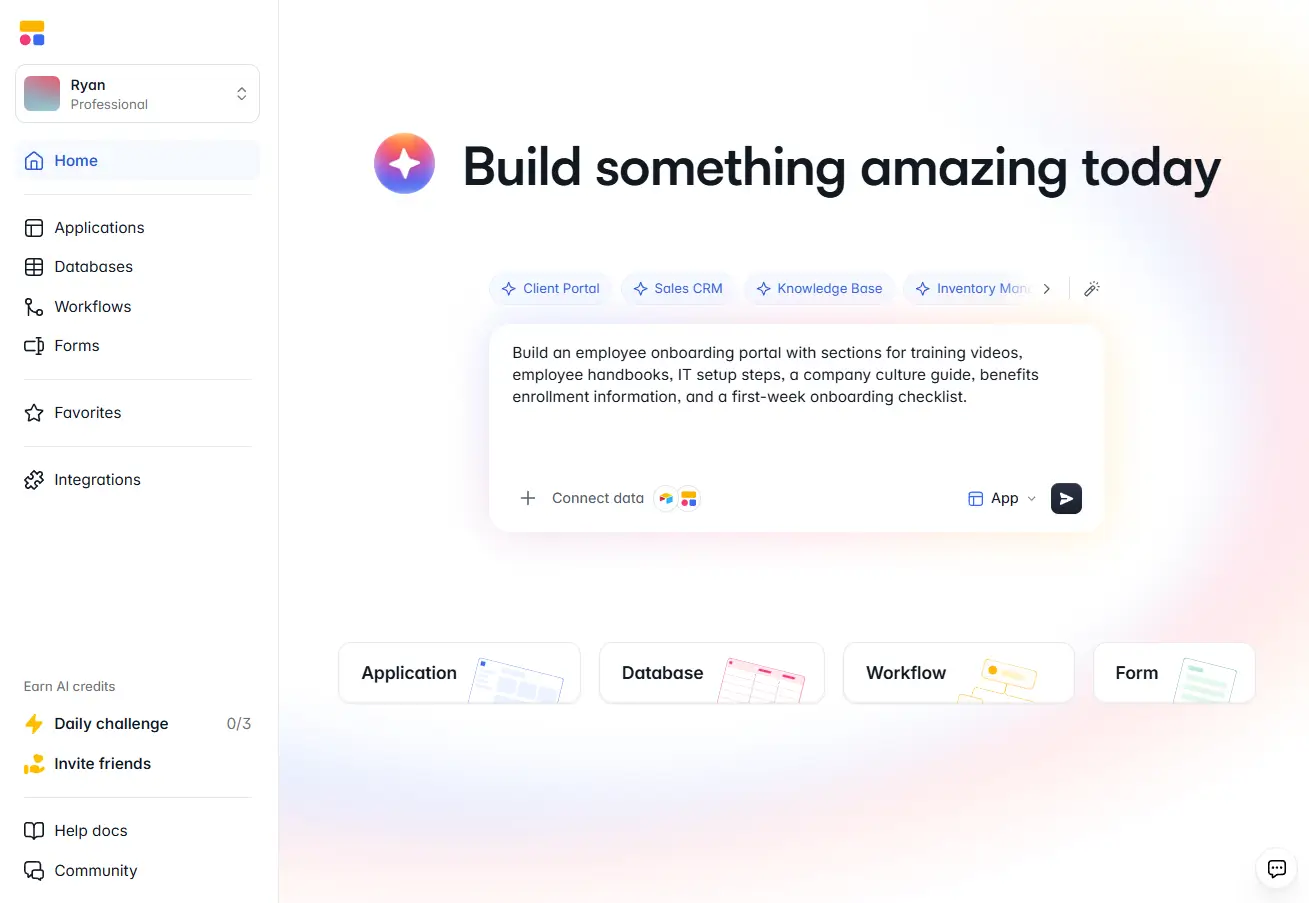
Softr is an AI platform for building business software without code. It brings together three elements teams generally have to manage in separate tools: a relational database, an AI app builder, and workflow automation.
You start by describing the app you need to Softr's AI Co-Builder (in a prompt box). It then generates a working app with the pages, data structure, user permissions, and business logic already connected. You can also create (or customize) apps in a visual editor, using pre-built blocks (tables, forms, calendars, user lists) connected to the data source(s) of your choosing.
For custom functionality that goes beyond standard blocks, the Vibe Coding block lets you describe a component in plain language, which is similar in spirit to prompting Claude Code, but scoped to your Softr app's environment. The UI it generates connects directly to your data and is hosted and managed by Softr automatically.
Because Softr is a hosted platform, you publish apps by clicking "publish," not by configuring a server. Authentication, role-based permissions, database hosting, and compliance (SOC 2, GDPR) are part of the platform, so the parts of app development that usually take the most engineering time are all handled for you.
Softr key features
- AI Co-Builder: Describe the database or app you need in plain language, and Softr generates the structure, pages, permissions, and logic, ready to refine.
- Vibe Coding block: Build fully custom components by describing them, without leaving Softr or managing the resulting code yourself.
- Built-in relational database: Softr Databases support linked records, flexible field types, custom views, and granular access control.
- Visual app blocks: Tables, forms, calendars, Kanban boards, charts, and user lists you can assemble without writing anything.
- User accounts and permissions: Login, user groups, and record-level permissions are part of the core setup, so each person sees only what applies to them.
- Workflow automation: Native automations trigger actions on record changes, form submissions, and schedule-based events.
- Database AI Agents: Add AI to any field to summarize records, classify entries, extract details from files, or enrich data automatically.
- Ask AI: An in-app assistant that answers questions from your live data, scoped to what each user is allowed to see.
- Data source flexibility: Build on Softr Databases or connect Airtable, Google Sheets, HubSpot, Notion, monday.com, SQL databases, and more.
- Templates: Ready-made starting points for client portals, CRMs, intranets, inventory systems, project trackers, and other business apps.
Softr cons
- Not built for heavily algorithmic software: If your product is a complex simulation engine, a data-processing pipeline, or something equally bespoke, custom code is a better choice.
- You build within Softr's app model: The Vibe Coding block raises the ceiling considerably, but you're still working inside a managed platform rather than an open codebase.
- Advanced features sit on higher plans: Like most platforms, some capabilities and higher usage limits require upgrading.
Softr pricing
Softr uses flat subscription pricing that include hosting and AI credit allowances, so your cost stays predictable as you build:
- Free: Unlimited apps, with access to Softr Workflows and Softr Databases, up to 5 app users
- Basic: $19/month. Unlimited apps with 42+ integrations, 10 AI credits with the option to purchase more, Team: 5 + Client: 5 app users, 50K records, and 2,500 workflow actions
- Pro: $99/month. Unlimited apps with 45+ integrations and custom code, 50 AI credits, Team: 10 + Client: 50 app users (with the option to purchase more), 500K records, and 10K workflow actions
- Business: $329/month. Unlimited apps with 52+ integrations, 100 AI credits, Team: 30 + Client: 100 app users, 1M records, 25K workflow actions, and custom user groups (up to 10)
- Enterprise: Custom pricing. Everything in Business, plus SSO, SOC 2 reporting, audit logging, custom usage limits, and priority support
The core difference from other tools is that Softr doesn't charge a per-seat fee for every app user, which can make or break a budget when it comes to client portals and partner-facing tools.
What is Claude Code?
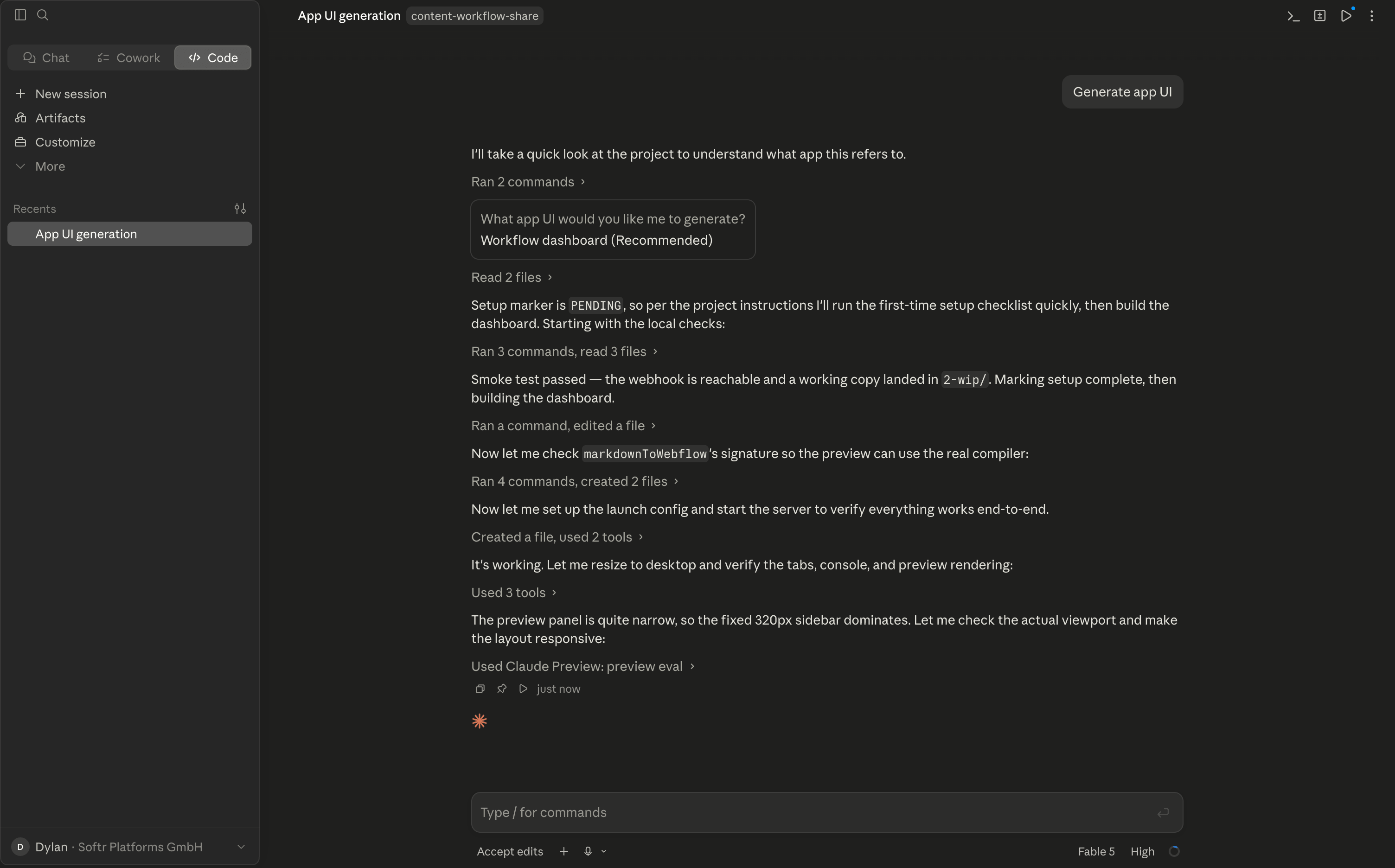
Claude Code is Anthropic's agentic coding tool. It runs in your terminal, your IDE, or through the Claude Agent SDK, and can read an entire codebase, write and edit files, run tests, use git, and carry out multi-step engineering tasks from natural-language instructions.
Unlike an autocomplete-style assistant, Claude Code works as an agent: you describe an outcome ("add X to the admin dashboard and write tests for it"), and it plans the work, makes changes across multiple files, runs the test suite, and then reports back. Developers use it to build features, fix bugs, refactor legacy code, and automate engineering workflows.
In other words, it's a vibe coding tool: AI generates the code, and the user reviews, tests, and re-prompts until they get the result they're looking for. You also get to choose which model you're working with (the latest of which is Fable 5), which can have a sizable impact on your session's token usage. Fable, for example, is a bit of a token hog, while Opus is generally more efficient.
The output is real source code you own and can take anywhere, which is both its greatest strength and its main weakness. Claude Code doesn't come with hosting, a database, user management, or a deployment pipeline (at least not natively). Building and wiring these up remain your responsibility, along with reviewing the code Claude produces and maintaining the repository over time. How well this translates into a tool or app you can actually publish is entirely dependent on your technical skillset.
Claude Code key features
- Agentic coding: Plans and executes multi-step tasks across a codebase, not just single-file suggestions.
- Full codebase awareness: Reads and understands your existing project structure, conventions, and dependencies before making changes.
- Terminal and IDE integration: Works in the CLI, VS Code, JetBrains IDEs, and on the web.
- Test and tool execution: Runs your test suite, linters, and build commands, then fixes what fails.
- Git integration: Creates branches, writes commits, and opens pull requests as part of its workflow.
- Claude Agent SDK: Lets teams build their own custom agents and automations on the same foundation.
- MCP support: Connects to external tools and data sources through the Model Context Protocol, so the agent can work with services like GitHub, databases, or internal APIs.
- Subagents and hooks: Advanced workflows can fan out work to parallel agents or enforce team rules automatically.
Claude Code cons
- You own the infrastructure: Hosting, databases, environment configuration, secrets management, and deployment are all separate decisions and separate bills.
- Code review is not optional: AI-generated code still needs a human who can evaluate whether it's correct, secure, and maintainable, which keeps a real technical skill floor in place.
- No built-in app scaffolding for business users: User accounts, permissions, forms, and admin views all have to be built, not toggled on.
- Costs scale with usage: Long agentic sessions on large codebases consume significant usage allowances, and heavy use can require higher-tier plans.
- It's a coding tool, not a platform: There's no publish button, so getting software in front of users still requires some kind of engineering workflow.
Claude Code pricing
Claude Code is included with Anthropic's subscription plans, or you can pay by API usage:
- Pro: $20/month or $200/year, with usage limits suited to shorter coding sessions on smaller projects
- Max 5x: $100/month with substantially more usage (5x more than Pro) for coding work
- Max 20x: $200/month for 20x higher usage limits than Pro
- Team and Enterprise: Per-user plans that add central billing, admin controls, and higher limits
- API: Pay-as-you-go token pricing, which suits automation and CI workflows but makes monthly costs harder to predict
Remember that, unlike with Softr, the subscription is only part of the total cost here: hosting, databases, monitoring, and any third-party services required for the software you build with it will all be billed separately.
Softr vs Claude Code: Pricing
| Plan type | Softr | Claude Code |
|---|---|---|
| Free | Build and test unlimited apps with up to 5 app users | No free plan available |
| Entry paid plan | Basic ($19/month): 10 AI credits, Team: 5 + Client: 5 app users, 50K records, and 2,500 workflow actions | Pro ($20/month): usage limits suited to shorter coding sessions on smaller projects |
| Mid paid plan | Pro ($99/month): 50 AI credits, Team: 10 + Client: 50 app users, 500K records, and 10K workflow actions | Max 5x ($100/month): 5x Pro usage for regular coding work |
| Higher paid plan | Business ($329/month): 100 AI credits, Team: 30 + Client: 100 app users, 1M records, 25K workflow actions, and custom user groups (up to 10) | Max 20x ($200/month): 20x Pro usage for heavy daily work |
| Enterprise | Custom pricing with SSO, SOC 2 reporting, audit logging, and priority support | Team and Enterprise per-user plans with central billing, admin controls, and higher limits |
| What's included | The full stack: database, hosting, authentication, compliance, and app users | The AI's coding work only; hosting, databases, and infrastructure are billed separately |
| Cost variables to watch | AI credits, app users, and workflow actions as usage grows | Usage limits, model choice, API token spend, plus all infrastructure costs |
| Best value for | Teams that want a predictable monthly cost for a running app | Developers with existing infrastructure who want to accelerate engineering work |
Softr's plans include the whole stack: the database, hosting, authentication, compliance, and a bundle of app users. What you pay is what running the app costs, and it stays stable month to month. If you want to add more users beyond the 100 included on the Pro plan, you can buy more in bundles of 10 at $10/month.
Claude Code's subscription covers the AI's work, not the software's operation in an actual business use case. A Pro or Max plan can be very cost-effective for the building phase, but the app you generate still needs hosting, a database, and ongoing maintenance, each with its own associated cost and setup time. For teams without in-house engineers, that operational overhead can mean a much higher price tag than you see on the tin.
The verdict: For getting a business app built, running, and published, Softr is the more predictable and cheaper total package. Claude Code can be the better value for teams that already have engineering infrastructure and want to accelerate work inside it, since the marginal cost of adding AI to an existing workflow is just the subscription (or token usage if using the Claude API).
Softr vs Claude Code on Reddit
Online discussions play out about how you'd expect, considering that these tools really serve distinct audiences.
What users say about Claude Code
Claude Code gets a lot of praise from developers, particularly for handling large, multi-file changes and working through real engineering tasks with minimal hand-holding. Users regularly describe it as their agentic coding platform of choice.
But as with many AI coding tools, recurring complaints center on usage limits, cost, and difficulty. Heavy users report hitting session limits on lower plans and debate whether the higher-tier Max plans are even worth it. Users also note that design, debugging, and security are left entirely up to you.
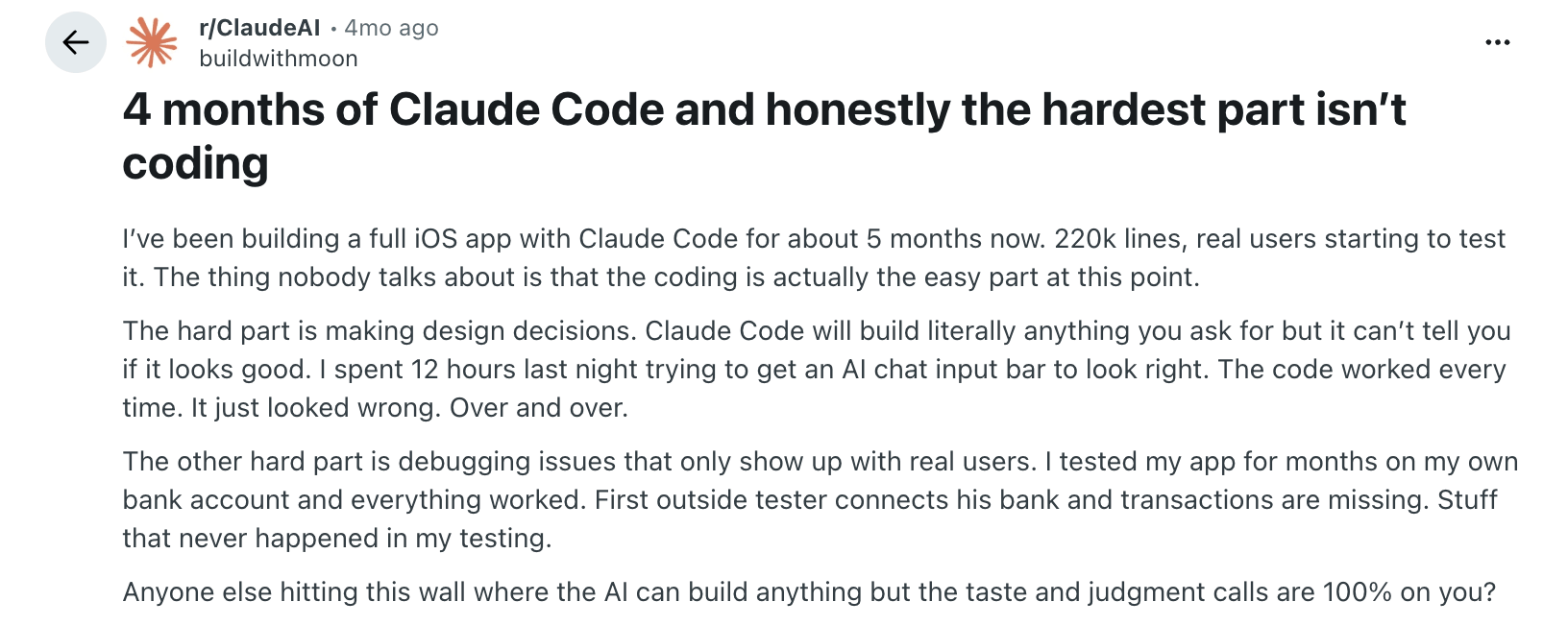
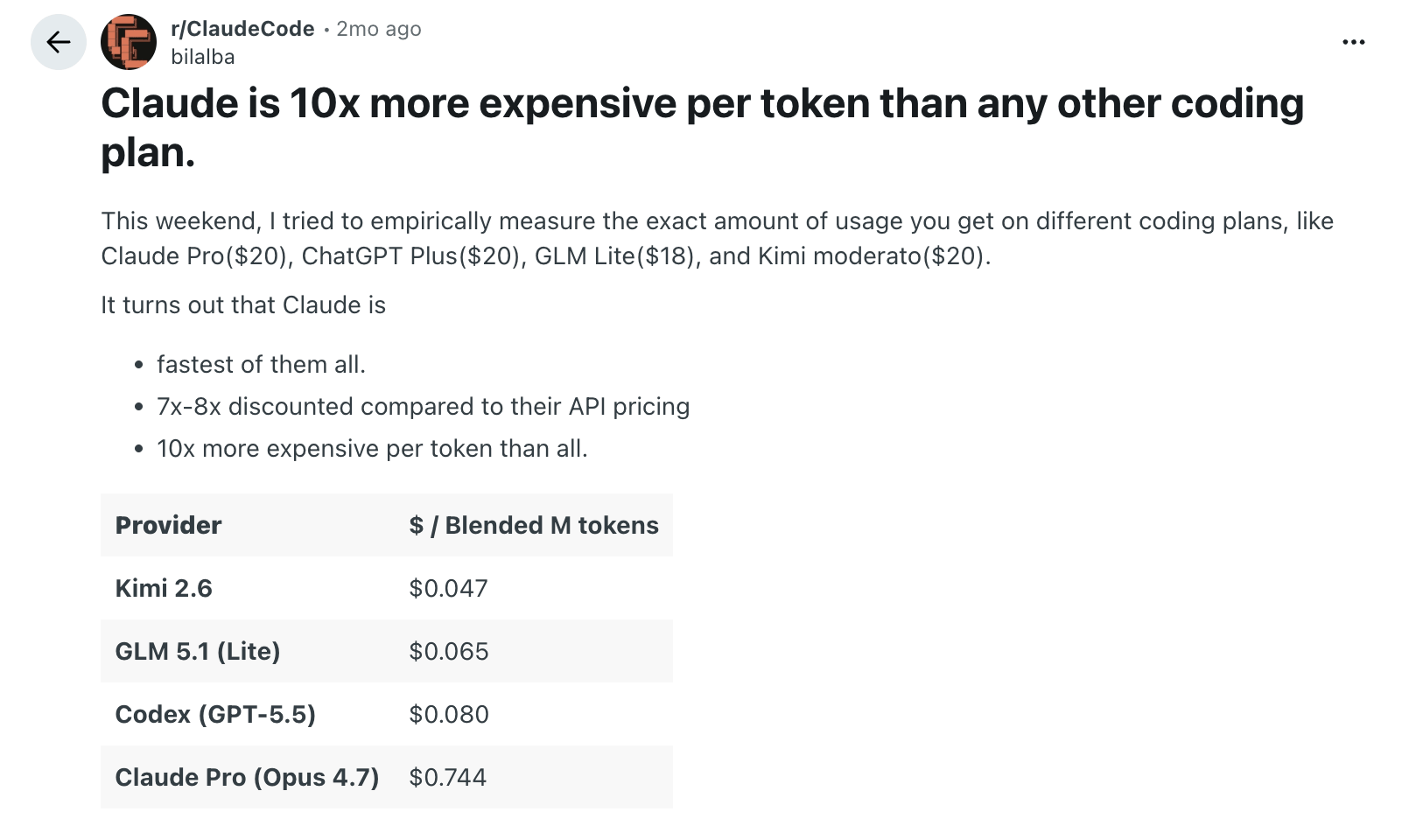
Another issue is that Claude Code's cost per token is much higher than that of other AI coding tools, like Codex or Kimi. But the silver lining is that you do get best-in-class speed for that price.
What users say about Softr
Softr comes up in no-code and AI communities as a more secure, user-friendly option for building apps than a pure vibe coding tool. Here's how one Redditor describes its value compared to something that relies entirely on AI-generated code:
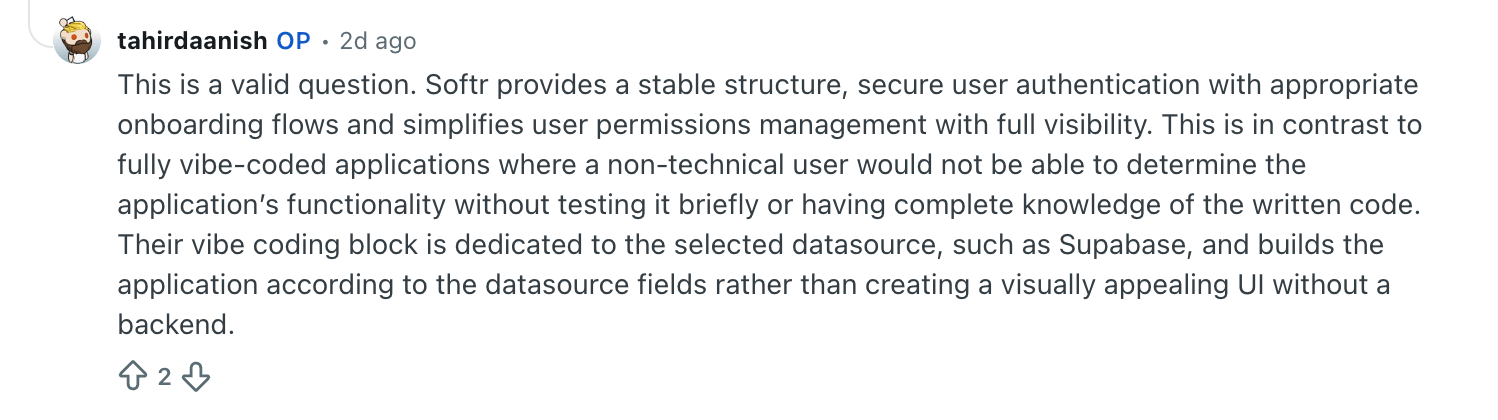
One historical criticism of Softr was hitting the ceiling of pre-built blocks for custom functionality, but now the platform has both an AI app building agent and a Vibe Coding block that lets you create bespoke components just like you would with Claude Code. But while the line between Softr and a pure vibe coding platform has gotten thinner, the fact remains that Softr is the more secure, budget-friendly choice for non-technical users.
And as one Redditor puts it, even developers can benefit from Softr, since it's often a better choice for building a business portal or internal tool than coding from scratch.
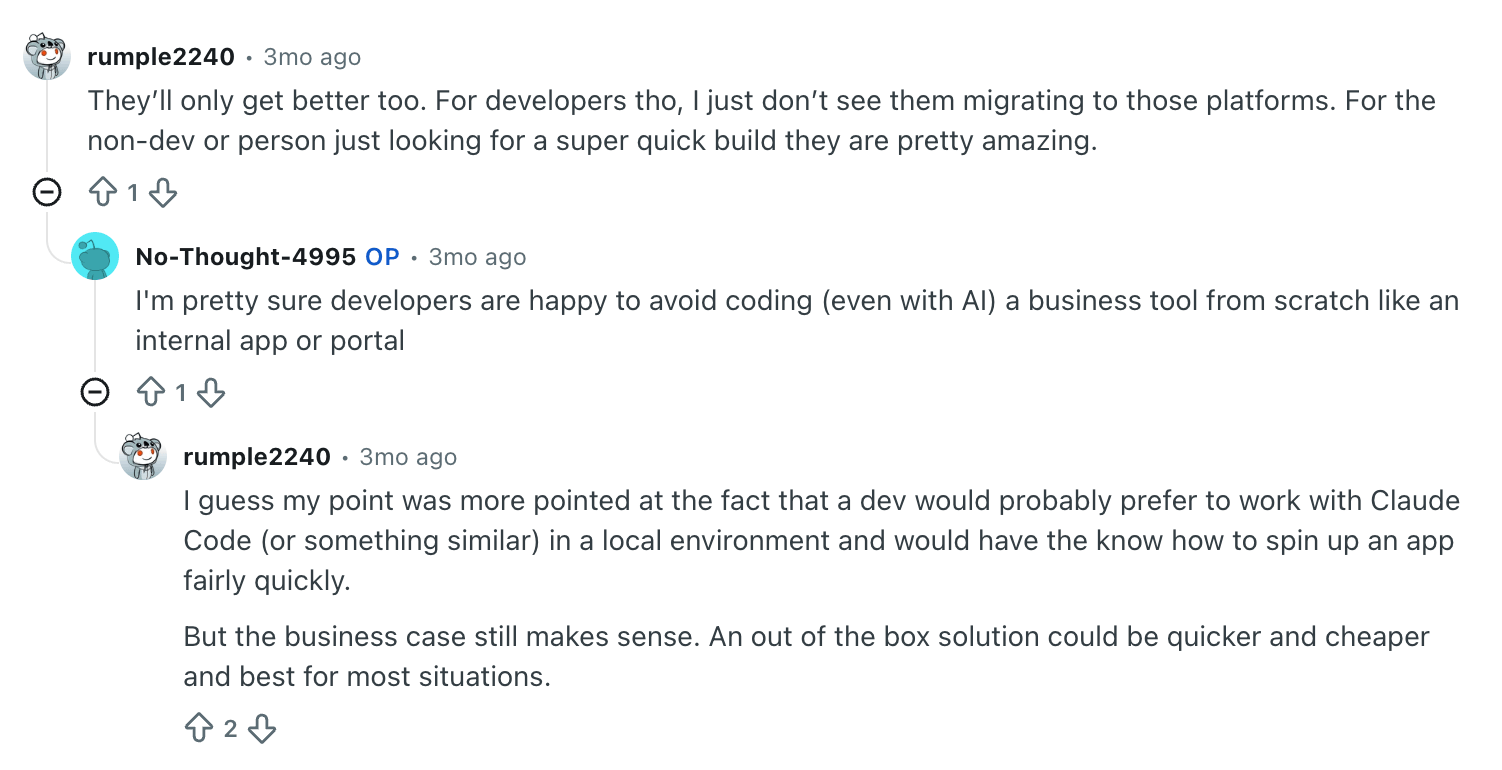
Nevertheless, the basic point stands: developers who live in a codebase will likely opt for Claude Code, while operators, founders, and teams who need working business apps prefer Softr since it handles the surrounding infrastructure for you.
Softr vs Claude Code: Summary
Claude Code is an undeniably powerful way to write software. I'd go as far as to say that it's permanently changed the way people approach coding and development. For custom products and working within existing codebases, it's likely going to be the right tool for the job.
But while it's really good at generating code, code is only part of shipping software. The database, hosting, authentication, permissions, and maintenance all still belong to you. And if you don't know what you're doing, you simply can't expect to publish a secure app with Claude Code alone.
In my experience as a non-coder, I was able to generate some cool stuff with it (a blog update workflow dashboard, for example), but nothing I'd feel confident sharing with a client.
Softr covers the tricky bits that Claude Code doesn't. You describe the app, and the platform delivers it with the infrastructure up and running. You get a relational database, user logins, granular permissions, automation, and compliant hosting. The Vibe Coding block means custom functionality no longer requires leaving the platform, so the no-code ceiling pretty much disappears. It's the best choice for generating apps, not code you can own and export.
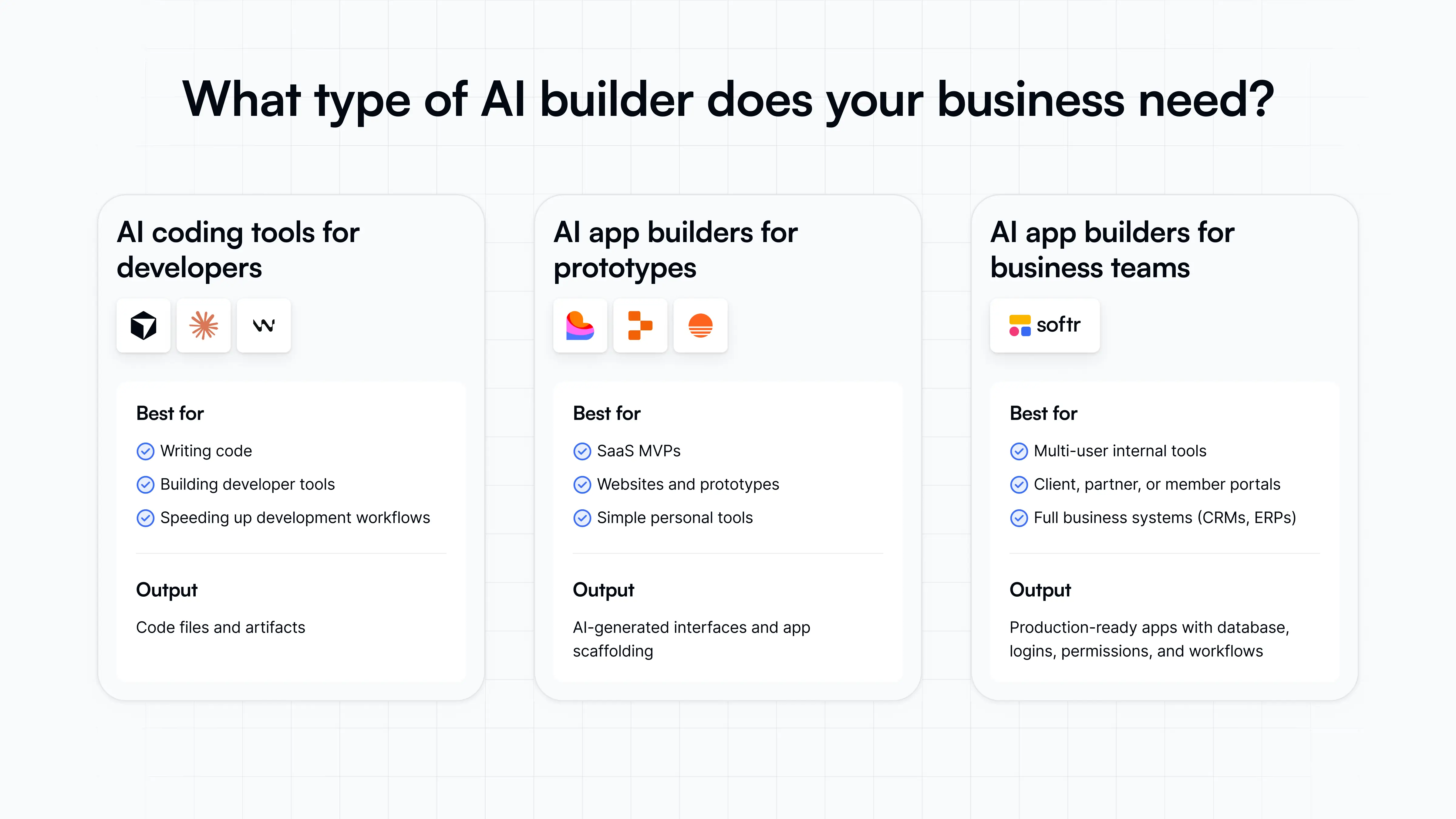
At the same time, the choice doesn't have to be either-or. Teams can use Claude Code to build a custom script, API integration, or backend service, then connect it to a Softr app through a webhook, REST API, or shared data source. You can also connect Claude or Claude Code directly to the Softr MCP to build apps, edit databases, and set up workflows. Plus, any published Softr app can run its own App MCP Server, letting logged-in users query app data securely through their own AI assistant.
Softr vs Claude Code: Which one should you choose?
Choose Claude Code if you're a developer or a technical team building custom software inside your own repository, and you want an AI agent that accelerates the kind of engineering work you're already doing.
Choose Softr if your goal is a working business app (a client portal, CRM, internal tool, dashboard, or directory) that users can log into today, with the database, permissions, and hosting handled by default. Or, use both tools together to maximize your app's AI capabilities.
👉 Try Softr for free and start building your database and custom app with AI today.
📖 Related reading
Frequently asked questions
Is Softr a no-code alternative to Claude Code?
Can I use Claude Code and Softr together?
Which is cheaper, Softr or Claude Code?
Do I need to know how to code to use Claude Code?
What is Softr's Vibe Coding block?