Softr vs Airtable pricing: Which is the better value in 2026?


If you're weighing Softr vs Airtable pricing, the two tools charge for completely different things. Airtable bills per editor seat. Softr bills a flat price for your workspace plus the number of people who log into the apps you build.
While Airtable can be affordable for small teams that just need a database, Softr is cheaper as soon as you add external users (clients, partners, contractors) or build apps and portals for many people.
Softr vs Airtable pricing at a glance
If you're in a hurry, here's a quick breakdown of how Softr and Airtable's pricing models compare:
| Softr | Airtable | |
|---|---|---|
| Free | 5 app users, 5K records, 5 AI credits, 500 workflow actions | 5 editors, 1K records/base, 100 automation runs |
| Entry paid | Basic $19/mo: Team 5 + Client 5 app users, 50K records, 10 AI credits | Team $20/seat/mo: 50K records/base, 25K automations |
| Mid tier | Pro $99/mo: Team 10 + Client 50 app users, 500K records, 50 AI credits | Business $45/seat/mo: 125K records/base, 100K automations |
| Top tier | Business $329/mo: Team 30 + Client 100 app users, 1M records, 100 AI credits | Enterprise Scale (custom): 500K+ records/base |
| Enterprise | Enterprise (custom pricing, contact sales): SSO, audit logs, SOC 2, SLAs | Custom: SSO, audit logs, SCIM, DLP |
| Billing model | Flat per workspace + app users | Per editor seat |
To sum up: Softr's prices are flat monthly fees, while Airtable's are multiplied by every editor. Softr's Pro tier alone matches Airtable's Enterprise Scale record ceiling (500K) for a flat $99/month.
How does Airtable pricing work?
Airtable charges per editor seat, so the model is budget-friendly when you're small but cost-prohibitive when you're not. Ten editors on the Team plan will run you $2,400/year (billed annually). The same ten on Business costs $5,400/year.
Here's a full rundown of Airtable's plans:
| Airtable plan | Price | What you get |
|---|---|---|
| Free | $0 | 5 editors, 1K records/base, 100 automation runs, 1 GB attachments |
| Team | $20/seat/mo | 50K records/base, 25K automation runs, Gantt and Timeline views, sync |
| Business | $45/seat/mo | 125K records/base, 100K automation runs, admin panel, SSO, two-way sync |
| Enterprise Scale | Custom | 500K+ records/base, 500K automation runs, audit logs, SCIM, DLP, app sandboxing |
Three other potential costs are easy to miss:
- Portals are an add-on, from $120/month (Team) or $150/month (Business).
- AI credits are capped on every tier, including Enterprise Scale; 50,000 extra credits runs $1,000/year.
- No mid-cycle refunds as of October 2025, so removing seats mid-period won't refund until the next cycle.
Airtable is an excellent database backend, but friction starts to show up when people need to interact with that data.
Will Airtable's pricing change due to the acquisition?
Bending Spoons completed its acquisition of Airtable on September 4, 2026, an all-cash deal first announced on August 4. Airtable has not announced any pricing change, and the rates above are current.
What we can point to is the buyer's track record. After Bending Spoons bought Evernote, prices rose in successive rounds, and the free plan was cut to 50 notes, with existing users moved onto the new limits rather than grandfathered in. WeTransfer's free tier was capped at 10 transfers per month, and Meetup's organizer costs more than doubled.
If your Airtable bill is already a concern, it's worth modelling what a 30% to 50% increase would mean at your current seat count. Softr connects directly to your existing Airtable base, so you can migrate your team's apps onto a platform you control without repricing every seat. Book a free migration consultation and our team will help you plan the move.
How does Softr pricing work?
Softr counts app users, the people who log into the app you've built, not internal editors (which are unlimited). You can start with the free-forever plan, or jump to one of four paid tiers:
| Softr plan | Price | What you get |
|---|---|---|
| Free | $0 | 5 users, unlimited apps, 5 AI credits, 5K records, 500 workflow actions |
| Basic | $19/mo | Team: 5 + Client: 5 app users, 10 AI credits, 50K records, 2.5K workflow actions |
| Pro | $99/mo | Team: 10 + Client: 50 app users, 50 AI credits, 500K records, 10K workflow actions |
| Business | $329/mo | Team: 30 + Client: 100 app users, 100 AI credits, 1M records, 25K workflow actions |
| Enterprise | Enterprise (custom pricing, contact sales) | SSO, audit logs, SOC 2 reporting, IP blocking, SLAs, dedicated success manager |
Because the plan price is fixed for your workspace, internal builders (or editors) never add to the bill. Your costs only scale as your external app-user count grows, and even these aren't billed on a per-user basis.
Softr vs Airtable pricing: Pros and cons
No tool is 100% upside. These are the benefits and trade-offs that tend to matter most as your team and user base grow.
Softr pros:
- Flat, predictable pricing: Plans don't scale with your internal team, only with app users.
- Generous free plan: Build unlimited apps for up to 5 app users at $0, with 5,000 database records.
- Built for external users: Client portals, permissions, and external or internal apps out of the box.
- Full application layer: Custom layouts, logic-based forms, PWA mobile apps, and AI app generation.
Softr cons:
- Higher entry price: The first paid plan is $19/month versus Airtable's $20/seat, so tiny internal teams may pay more.
- Usage caps per tier: App users, records, and workflow actions are capped and can push you to a higher plan.
Airtable pros:
- Powerful database: Flexible schemas, rich field types, and views like grid, Kanban, Gantt, and calendar.
- Low entry cost: Team starts at $20/seat/month, which is cheap for a small internal group.
- Strong automations and sync: Generous automation-run limits and native syncing across bases.
Airtable cons:
- Per-seat billing scales poorly: Every editor is a paid seat, so costs climb fast as your team or collaborator count grows.
- Paid add-ons: Portals cost an extra $120 to $150/month. AI credits are capped and expire monthly with no rollover.
- Internal-only interfaces: No true external-user access without Portals.
- No mid-cycle refunds: Seats removed partway through a billing cycle aren't refunded until renewal.
Is Softr or Airtable cheaper?
Let's say you run an operation with 5 internal builders and 80 external users who need to log in and update records.
On Airtable's Business plan, all 85 need editor access. 85 × $45 × 12 = $45,900/year, plus a portal add-on. If you want to avoid this cost, you'll need to restrict external users to read-only access.
On Softr's Business plan, your 5 builders work on the backend for free, and the 80 external users fall well within the plan's included Team: 30 + Client: 100 allowance, so none of them trigger extra per-user charges. You're looking at a flat $3,948/year, with interfaces, permissions, and external access included.
This approach to billing is how Arizona State University used Softr to serve curriculum data to 1,200+ users at a price that would've been prohibitive if using Airtable alone.
Softr vs Airtable hidden costs
With Airtable, the extras add up fast:
- Portals are a paid add-on, starting at $120/month (Team) or $150/month (Business).
- AI credits are capped on every tier, including Enterprise Scale, and topping up 50,000 credits costs $1,000/year.
- Every editor is billed whether they edit daily or just once a quarter.
- No mid-cycle refunds since October 2025, so over-provisioning is locked in until renewal.
With Softr, the main variable to watch is app users:
- App-user allowances are included per plan (Free: 5, Basic: Team 5 + Client 5, Pro: Team 10 + Client 50, Business: Team 30 + Client 100); extra users beyond that are billed per user, starting at $1/month on Pro and $2/month on Business.
- Records and workflow actions are capped per tier, so a high-volume automation workload may push you up a plan.
Can you use Softr and Airtable together?
Yes, although it can be a much better value to just use Softr, since it has its own relational database.
If needed, you can choose to keep Airtable as your backend database and use Softr as the frontend, giving you secure logins, granular permissions, and custom layouts (list, Kanban, calendar, charts) on top of your existing base. Your editors stay in Airtable; everyone else logs into Softr without needing a paid Airtable seat.
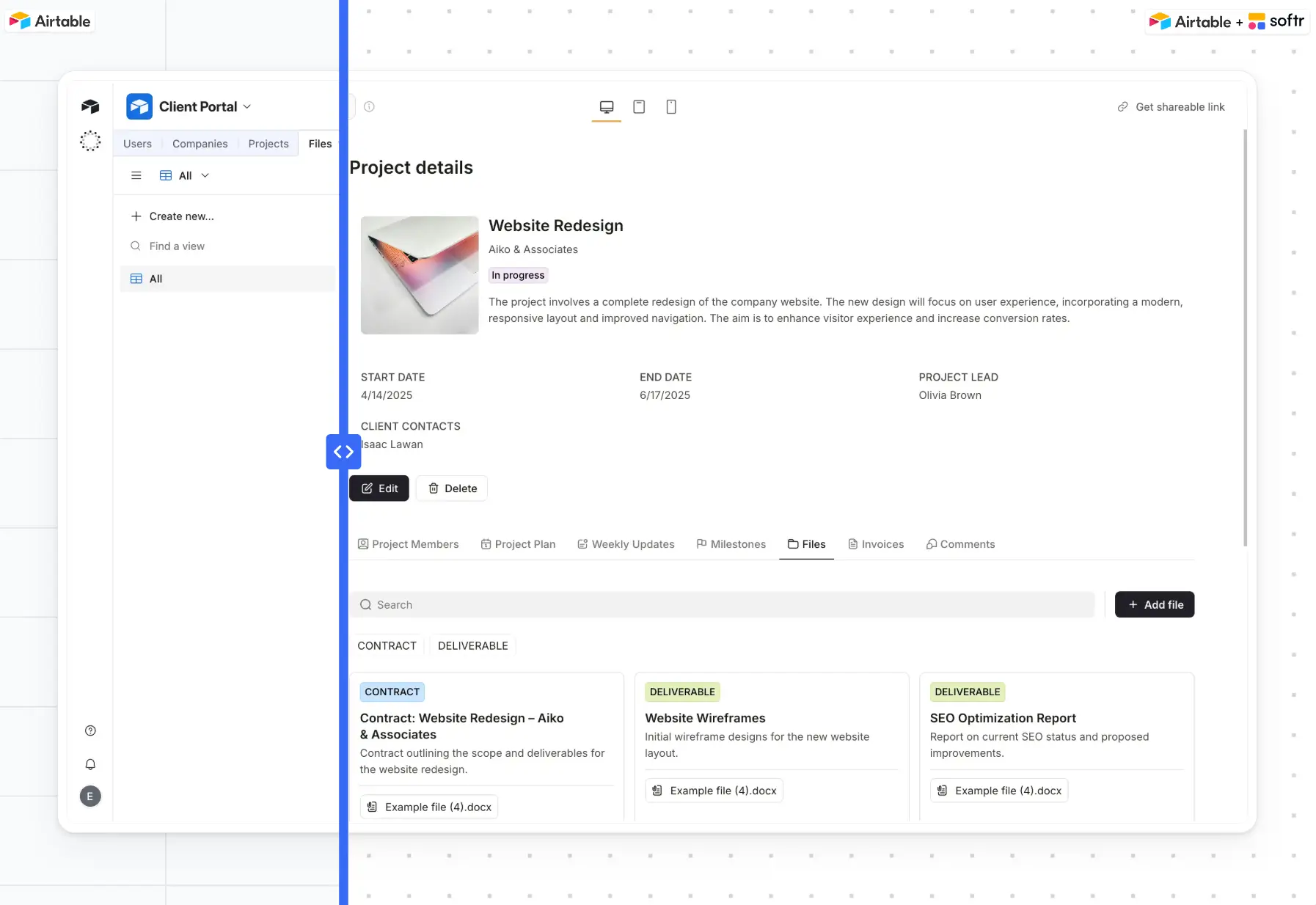
And if you'd rather consolidate, Softr's built-in database (up to 1M records on the Business plan) lets you migrate from Airtable entirely.
Softr vs Airtable pricing: Which should you choose?
Choose Airtable if your team is small, your core use case is data management, and everyone editing is internal. The Free or Team plan can provide a solid value at this scale.
Choose Softr (instead of or on top of Airtable) when you need external users, client portals, real permissions, a polished interface, and multiple editors working on the same apps and data.
Try Softr free and start building business apps, databases, and workflows with the AI Co-Builder today.
Frequently asked questions
Is Softr cheaper than Airtable?
Does Softr replace Airtable?
How does Softr count users versus Airtable seats?
Can I use Softr's free plan with Airtable?
Is it cheaper to migrate off Airtable entirely?