Appian pricing in 2026: Plans, estimated costs, and what you actually pay for


Appian doesn't publish prices. Its three plans, Standard, Advanced, and Premium, are each quoted per user, per month, per app. This guide covers what each plan includes, how per-app licensing works, and estimated costs for 50 and 500 users. It also explains what the Appian Guarantee covers. We checked every detail against Appian's pricing page on November 12, 2026.
Appian pricing at a glance
Appian has one free edition and three paid plans. The paid plans differ in included data sources, bots, portals, and AI features.
Appian listed prices on its website up until late 2023. At that time, its Application plan cost $75/user/month for standard users, $9 for infrequent users, and $2 for input-only users. The plan had a 100-user minimum.
Appian Standard vs Advanced vs Premium
All three plans include Appian's low-code app designer, integrations, mobile apps, and the Appian Cloud database. Here's how they differ:
Let's define a few key terms here:
- RPA bots: Software robots that repeat routine clicks and data entry in systems external to Appian.
- Portals: Public web pages built on an Appian app. Portals allow unlimited visitors who don't sign in.
- AI actions: The monthly allowance that every Appian AI feature draws from.
- Case Management Studio: Ready-made modules for apps that track a case from start to finish (cases are multi-step requests like insurance claims or loan applications).
The Standard plan can be used up until you need a second data source, over 5 bots, more than one portal per app, or AI agents. Standard includes only a few AI helpers, such as sample data generation and AI-written record type summaries.
Appian Cloud lists SOC 1, SOC 2, SOC 3, FedRAMP, and HIPAA compliance. You can also run Appian yourself, either in a hybrid cloud on AWS, Azure, or Google, or on premises. Some features are limited or unavailable when you take this route, however.
How "per user, per month, per app" adds up
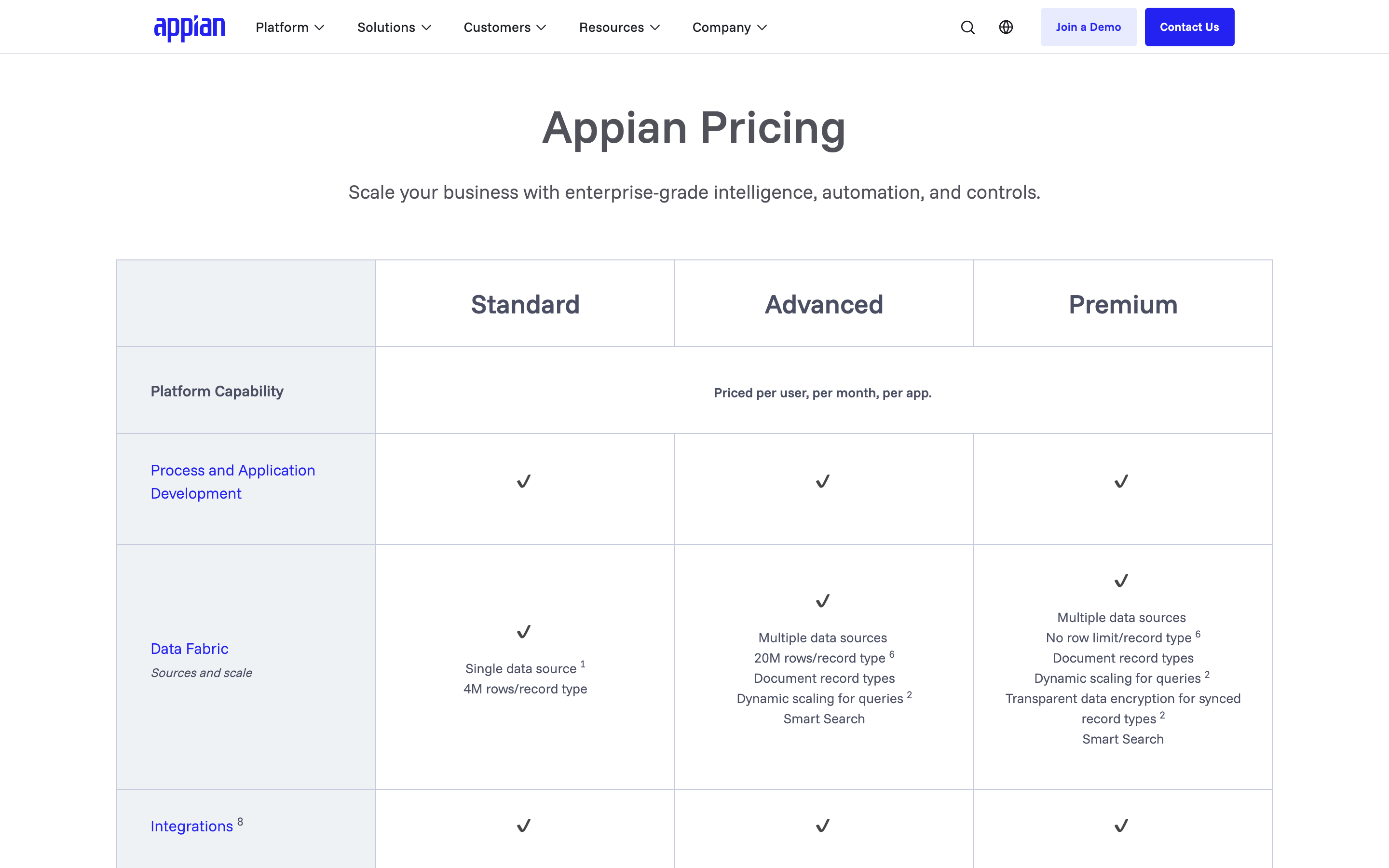
Appian's pricing page says every plan is "priced per user, per month, per app." A footnote on the same page states that Appian sells two kinds of user license:
- Application user licenses: Cover one app. Bot and portal limits apply to each app separately.
- Platform user licenses: Cover all your apps. Bot and portal limits are a total across every app.
Appian doesn't publish the price of either license. When it last listed prices in 2023, the one-app plan cost $75/user/month while the all-apps plan required a custom quote.
As you add apps inside Appian, you'll either need to add licenses for each one or move everyone to platform licenses. At the same time, not everyone who touches an app has to have a license, like Portal visitors who don't sign in.
Estimated Appian cost at 50 and 500 users
The table below estimates a year of Appian for one app, using the 2023 list prices. These are the most recent public figures, but they're still almost three years old, so it's best to treat them as a starting point. Actual pricing will require a conversation with someone at Appian.
At 50 users, you'd pay for 100 seats because of the minimum. At 500 users, the license mix matters more than overall headcount. Putting 350 occasional users on infrequent licenses cuts the estimate from $450,000 to $172,800.
But it's worth noting that Appian's current pricing page doesn't mention user types or a minimum, so double-check whether either still applies when you get a quote.
Hidden costs beyond the Appian license
If you're considering subscribing to Appian, plan for these costs too:
- Success plans: Appian sells three support plans, Foundation, Professional, and Signature, with no public prices. Every purchase includes limited support. 24/7 support starts at Professional.
- Uptime: The 99.8% to 99.99% SLA shown on the pricing page depends on your success plan. Foundation gets 99.8%, Professional 99.95%, and only Signature gets the full 99.99% uptime.
- Developers: Appian interfaces are built with SAIL (Appian's own framework). Custom extensions are Java plug-ins, which Appian says aren't supported parts of its software. You'll need Appian-skilled developers on staff or a partner.
- Training and certification: The Appian Developer learning path is free and takes about 34 hours online. The Associate Developer exam costs $250, and you're expected to have 1 to 3 months of Appian experience going into it.
- Implementation services: Appian Accelerate offers advisory work; Appian Delivery builds apps for you.
- Autoscale: Automatic scaling for process workloads requires additional licensing on top of the Advanced or Premium plan.
- Usage limits: AI actions, rows per record type, and bots are capped per plan. Higher limits come with upgrades.
- Self-managed hosting: Running Appian yourself adds your own infrastructure and operations costs.
Developer time can be another, and sometimes significant, cost. Per Appian's own learner journey, it will take a developer 6 to 18 months to reach the "practitioner" stage of using the platform.
What the Appian Guarantee covers
The Appian Guarantee is a service offered for your first Appian application. A dedicated Appian delivery team will guide your project to delivery in 8 weeks for a flat fee that they haven't made public.
According to Appian, the Guarantee includes documented guidelines, implementation best practices, and the joint app-build itself. It covers "full use of standard Appian features." When Appian launched the Guarantee in 2018, it applied to new customers on Appian Cloud.
Appian also doesn't publish what precisely counts as "delivered" or what happens if your project runs past 8 weeks. The scope mentions standard features, so ask whether custom plug-ins, integrations, and the like are included.
Who Appian is for, and who it isn't for
Appian can work well for large organizations with complex, highly regulated processes. Think of an insurer that handles thousands of claims, a government agency that needs FedRAMP, or a bank replacing old systems. These orgs most likely already have developers on staff, and the 100-user minimum won't be an issue for them.
For smaller teams, though, Appian poses a number of problems:
- Teams under 100 people: You have to pay for 100 seats whether or not you use them.
- IT teams with one or two developers: Appian skills take months to build, so don't expect to quickly clear a backlog of apps as soon as you sign up.
- Business teams that want to build their own apps: Appian's certification assumes software development experience, so developers will have to maintain the apps you build on the platform.
Vendor lock-in can be an issue, too, as apps built with SAIL and Appian plug-ins can only run on Appian. Moving to another platform later means rebuilding them.
Appian alternatives for smaller teams
Small teams with long request lists and a developer gap need a different model than Appian's. Look for a platform where business teams build and maintain their own apps while IT governs them. Pricing should also stay flat as you add additional apps to your stack.
With Softr, teams build apps from prompts and edit them in a no-code interface. Every plan (even Free) includes unlimited apps, and one user can sign in to as many of them as they need to.
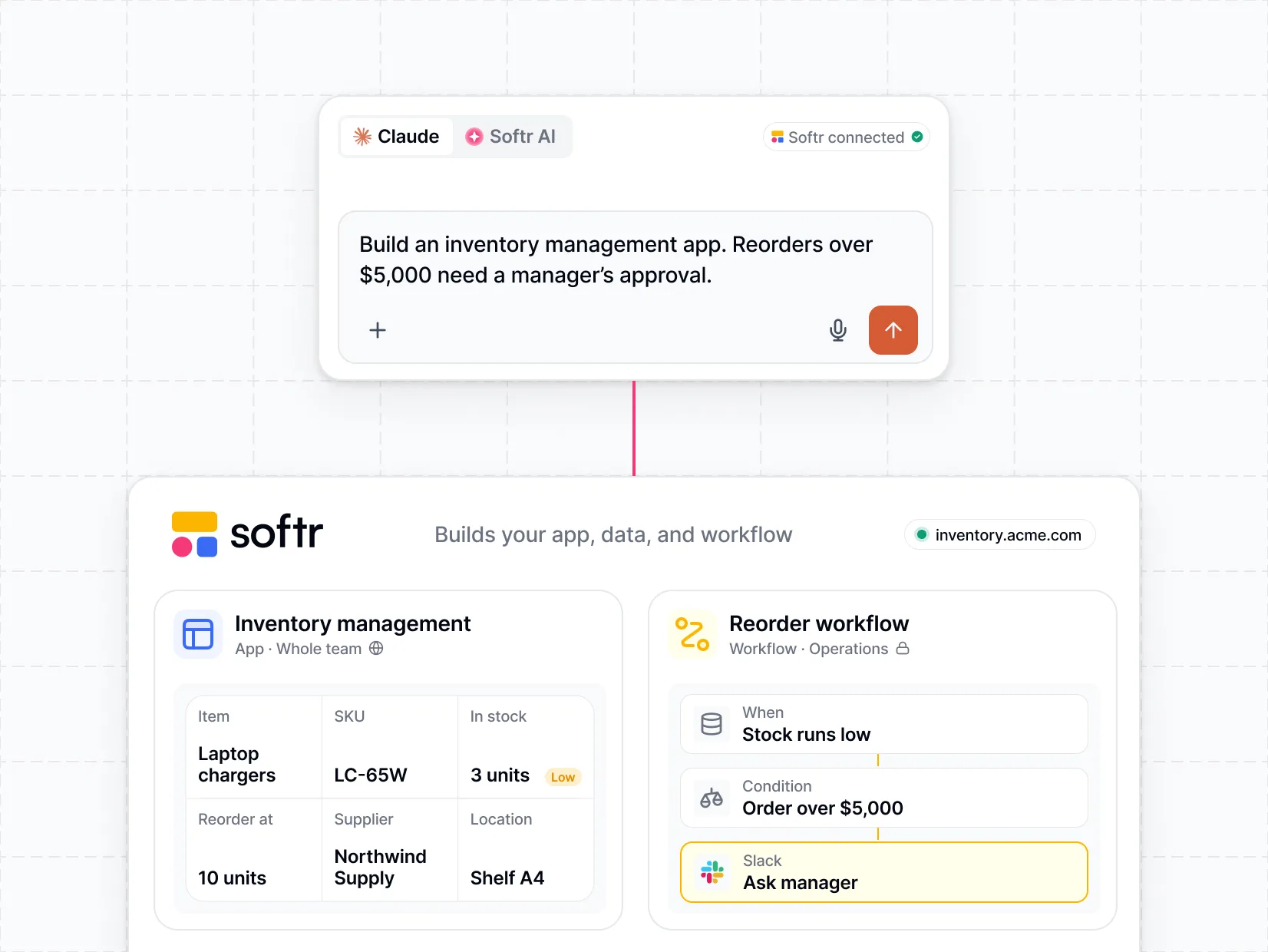
For IT, the Enterprise plan adds SSO, SCIM, audit logs, and a host of other features. See Softr pricing for details on every plan, or sign up for Softr for free and build your first app today.
Frequently asked questions
How is Appian priced?
Is Appian free to use?
Is Appian considered SaaS?
Does Appian require coding?
How long does it take to learn Appian?