Airtable is being acquired: Why and how to migrate to Softr



On August 4, 2026, Bending Spoons announced a definitive agreement to acquire Airtable in an all-cash deal. The response to this news online has been complicated, to say the least.
Our platform integrates with Airtable, so we have no interest in overselling the panic. But we do want to help clarify what exactly this deal means, how it could affect your business down the line, and how to prepare for a painless migration to Softr if (or when) the need arises.
What happened?
The deal places Airtable at a $1.285 billion enterprise value, which together with its net cash implies an equity value of around $2.25 billion. It's expected to close later this year, once it's gone through the required regulatory approvals and customary closing conditions. Until it closes, Airtable continues to operate as it does today.
What is Bending Spoons?
Bending Spoons is a Milan-based tech conglomerate founded in 2013. As of today, it has acquired more than 50 businesses, including some big names you'll definitely recognize: Evernote, WeTransfer, Vimeo, Eventbrite, Meetup, Komoot, StreamYard, and AOL. It listed on the Nasdaq on July 1, 2026, and Airtable is its first-ever acquisition as a publicly traded company.
When it comes to buying businesses, Bending Spoons' strategy is fairly explicit: acquire established software trading at a discount to its private valuation, trim staff, streamline the product and its pricing, and run it as a leaner, more profitable outfit.
Here are some of the post-purchase changes that have happened at the companies it already owns:
| Company | Acquired | What changed |
|---|---|---|
| Evernote | Closed Jan 2023 | 129 staff cut in February 2023, then 98 more that July when the Bay Area and Chile offices closed and operations moved to Italy. The free plan is now capped at 50 notes, one notebook, and one device, and existing free users were not grandfathered in. Forbes reports users who paid around $100 a year now face $249. |
| WeTransfer | Jul 2024 | Around three quarters of staff made redundant within two weeks of the acquisition. Free tier capped at 10 transfers per month, paid tiers consolidated upward. |
| Komoot | Mar 2025 | Roughly 80% of a 250-person team let go within weeks, leaving few of the original staff. New users were subsequently charged a subscription to sync routes to third-party devices. |
| Meetup | 2024 | Organizer subscription costs more than doubled following the takeover. |
| AOL, Eventbrite, Vimeo | 2025 to 2026 | More than $78.6 million in reorganization expenses recorded in 2025. Of roughly 1,830 full-time employees who joined through these deals, only a few hundred are expected to remain by the end of 2026. |
By this point in time, Bending Spoons' pattern has become consistent. The product they acquire keeps running, but the team behind it shrinks and pricing gets optimized toward the enterprise customers least likely to leave.
How could Airtable change after the acquisition?
Headcount numbers are just abstractions until they start to impact your own workflows. Below are a few core ways Airtable users could feel the effects of its new ownership once the deal closes.
Feature work slows down, and priorities change. The February 2023 Evernote cuts hit product design and engineering alongside sales and marketing. At Vimeo, reporting described layoffs that included the entire video team. Komoot's first significant update after the takeover shipped with few of the original team left to build it. Products in this portfolio do keep getting updates, but from a much smaller group with a different mandate, and long-running roadmap commitments are the first thing to become negotiable.
Support gets thinner, and institutional knowledge is lost. Customer service faced cuts in the first Evernote round. If your business depends on a complex Airtable setup, you don't want to lose the people who understood it: your account contact, the support engineer familiar with your automations, or the product manager who got your feature request pushed through to production. Layoffs make these kinds of losses a real possibility.
Pricing and packaging get revisited, and existing users aren't always protected. Evernote's free plan was cut to 50 notes and only one notebook and device, and existing users were moved onto the new limits rather than grandfathered in. WeTransfer's free tier was capped at 10 transfers per month. Meetup's organizer costs more than doubled. Not only will plan prices likely change across the board; features that used to be included in a certain tier may be moved to a higher one.
What Airtable users are saying
The reaction so far has been largely negative, though some are taking a "wait and see" approach since nothing about Airtable changes just yet. Underneath all the venting, three key concerns surface repeatedly:
- People mid-project feel exposed: One user described being in the middle of rolling Airtable out to their entire department this autumn. Another was at the planning stage of an Airtable CRM build and started evaluating alternatives the same day.
- Migration costs can be a trap: As one user put it, Airtable is "invaluable to me and would require massive amounts of work to port over my database to something else." At bottom, this is why the Bending Spoons playbook works; prices rise for the customers who can't practically leave.
- Price increases are being treated as a given: Whether or not this turns out to be true, it tells you how much benefit of the doubt the buyer has.
Alternatives named in Reddit threads discussing the news include Baserow, Grist, and Zenkit. But while many are quick to suggest jumping ship, moving all your databases, views, interfaces, and automations to a new platform is no easy task, especially if Airtable doesn't integrate with it natively.
What about the "wait and see" approach?
While many Airtable users have taken up an attitude of "doom and gloom" in response to the news, the two companies involved in the deal say positive change is coming. Bending Spoons CEO Luca Ferrari said the deal "will accelerate innovation even further" and that "we're committed to investing in Airtable for the long run." Airtable CEO Howie Liu said the partnership "gives us the resources and the long-term commitment Airtable needs."
One former Airtable employee made this argument in a Reddit thread: the changes will not be immediate, nobody knows what will change yet, and the safe response may be to simply watch how the platform develops over the next year.
It's also worth noting that Airtable is distinct from the rest of BS's portfolio, with a massive user base and consistent enterprise growth. Squeezing business customers with procurement processes and competitive alternatives is much harder than squeezing self-serve consumers on annual plans.
Still, for this to go well, Bending Spoons will need to decide Airtable's growth is worth more than its cost line. That's entirely possible, but it hasn't been the pattern with their other acquisitions.
Should you migrate from Airtable?
Not necessarily. Nothing about the platform changes today, and even once the deal goes through, you're unlikely to experience any negative consequences as a user until several months down the line.
At the same time, we have enough historical data to know what's (probably) coming with Bending Spoons helming the ship. So, the best move you can make today is to start evaluating your options to ensure you're prepared if or when migration becomes necessary. Below are some additional steps to consider.
Take a real export
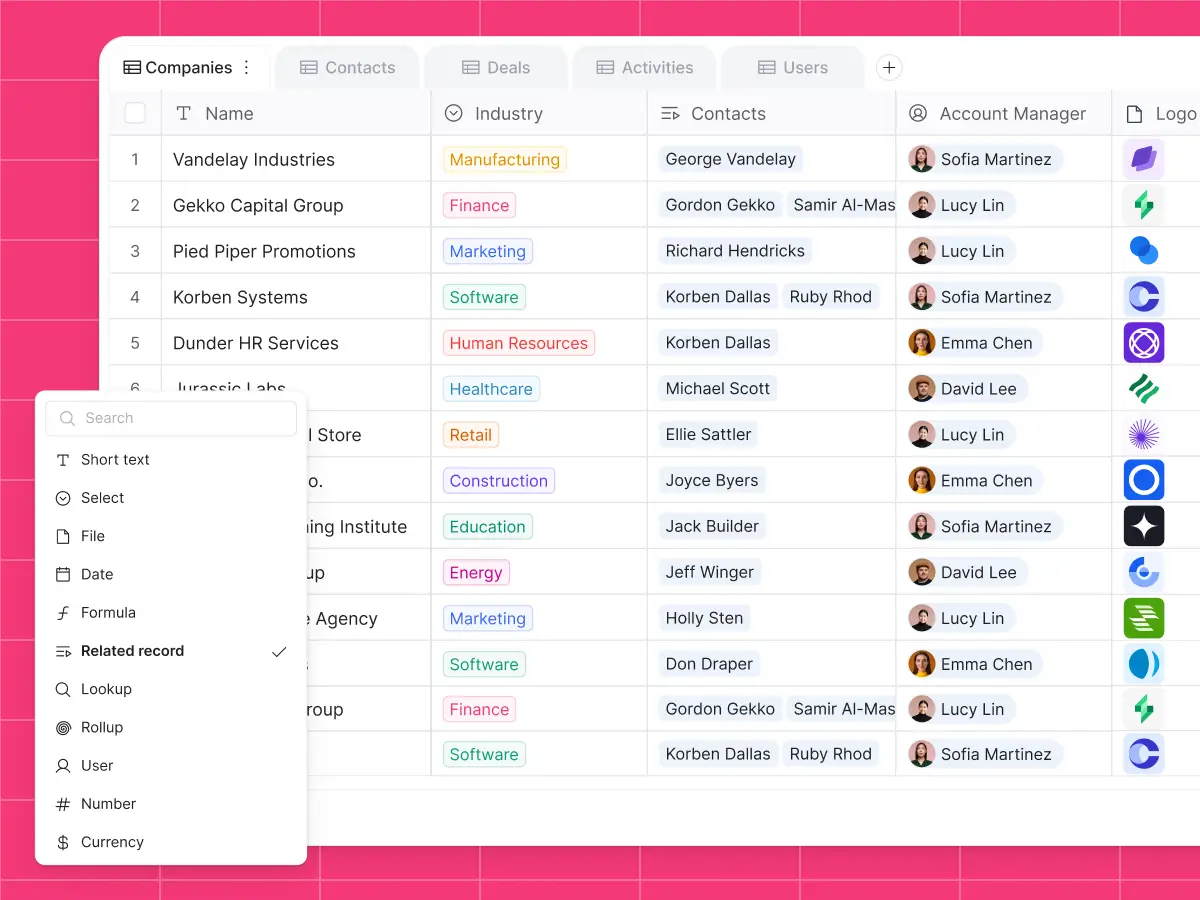
Export every base you depend on to CSV or another format and store it outside Airtable. If you want to keep your data's relational structure intact, consider importing your tables directly to Softr with our native integration. Data relationships are preserved automatically, so you can continue building with your existing structure in place.
Write down what's attached to your bases
Note any automations, Zapier or Make workflows, forms, API integrations, scripts, and connected tools syncing in or out. Migration involves more than just porting data, so you should think in terms of your overall tech stack and workflows when you think about switching platforms.
Price your renewal as if it's going up
Ask yourself: if your bill rose, say, 50% at your current seat count, how would that affect you? If it would be a serious problem, map your options before any renewal conversation rather than during or after.
Separate your interfaces from your database
Right now, it's possible that your Airtable base is your app: the data, views, and permissions deciding who sees what all live in the same place. If you do move platforms, what happens to the interfaces on top of your data? How much will rebuilding them cost you?
When you should consider migrating to Softr
Getting your data out of Airtable and into another platform is relatively simple. What isn't simple is keeping your linked records, well, linked. Or rebuilding a front-end interface your clients can log into. Or trying to recreate all your existing automations from scratch.
But if Airtable becomes prohibitively expensive, or the direction Bending Spoons takes doesn't align with your business, you'll likely still want to switch platforms.
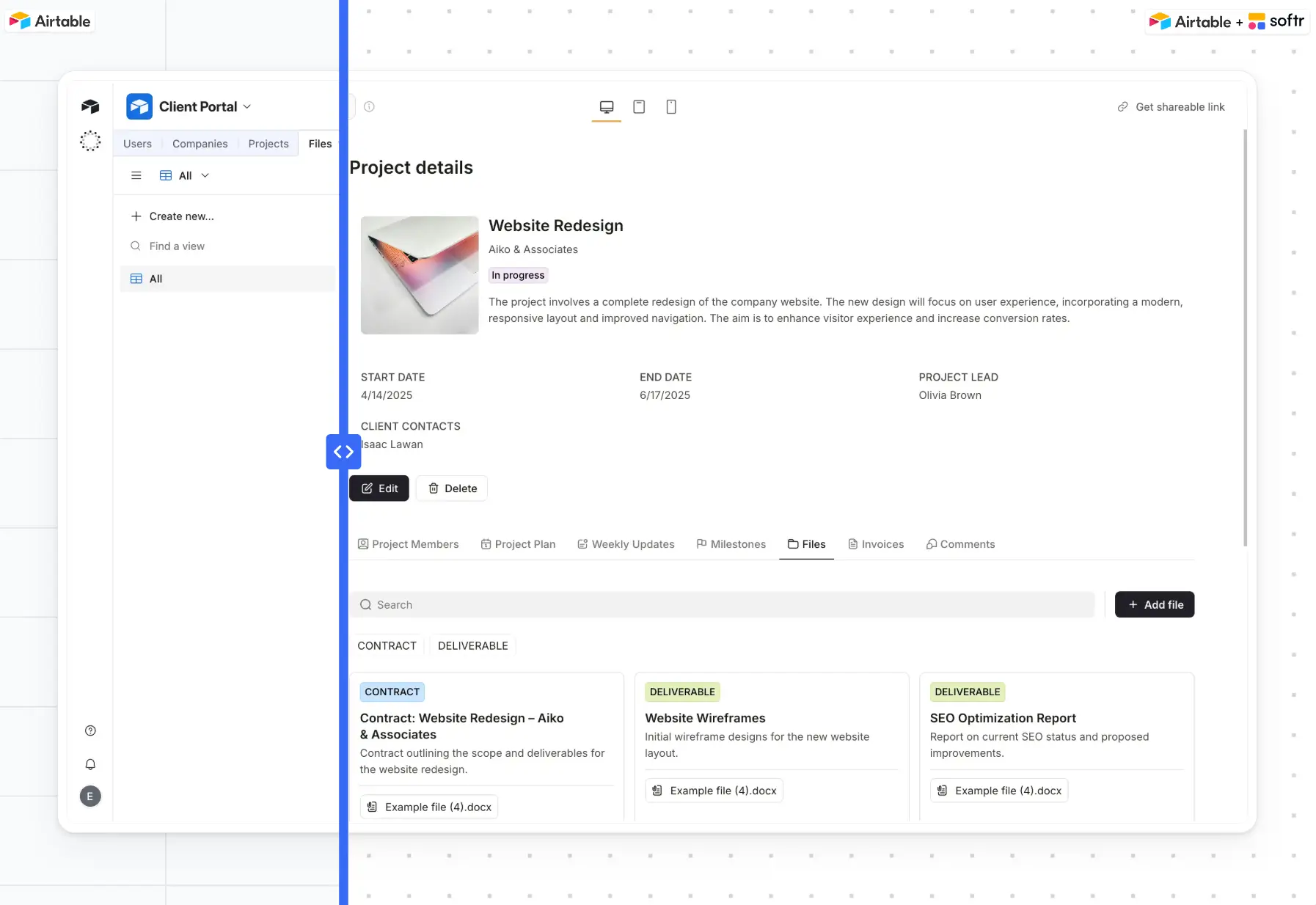
Softr makes that migration process as seamless as possible. It's the best platform for integrating directly with Airtable as a backend. So, if you're not ready to fully swap vendors, you can keep your bases where they are, and move the apps (portal, dashboard, CRM, etc.) your team and clients actually use to a Softr application builder you control.
This fixes a problem that existed before Bending Spoons even entered the equation. Airtable's interfaces aren't really built for advanced apps with authentication, roles, and granular permissions. If you have external-facing apps like client and partner portals, Softr lets you create branded, aesthetically pleasing interfaces and cut costs on client licenses.
Softr also lets you keep your options open, so you can take the "wait and see" approach while still preparing for a possible move. If pricing or limits change in a way you can't live with, simply swap the data layer without rebuilding the apps and worklows your team relies on.
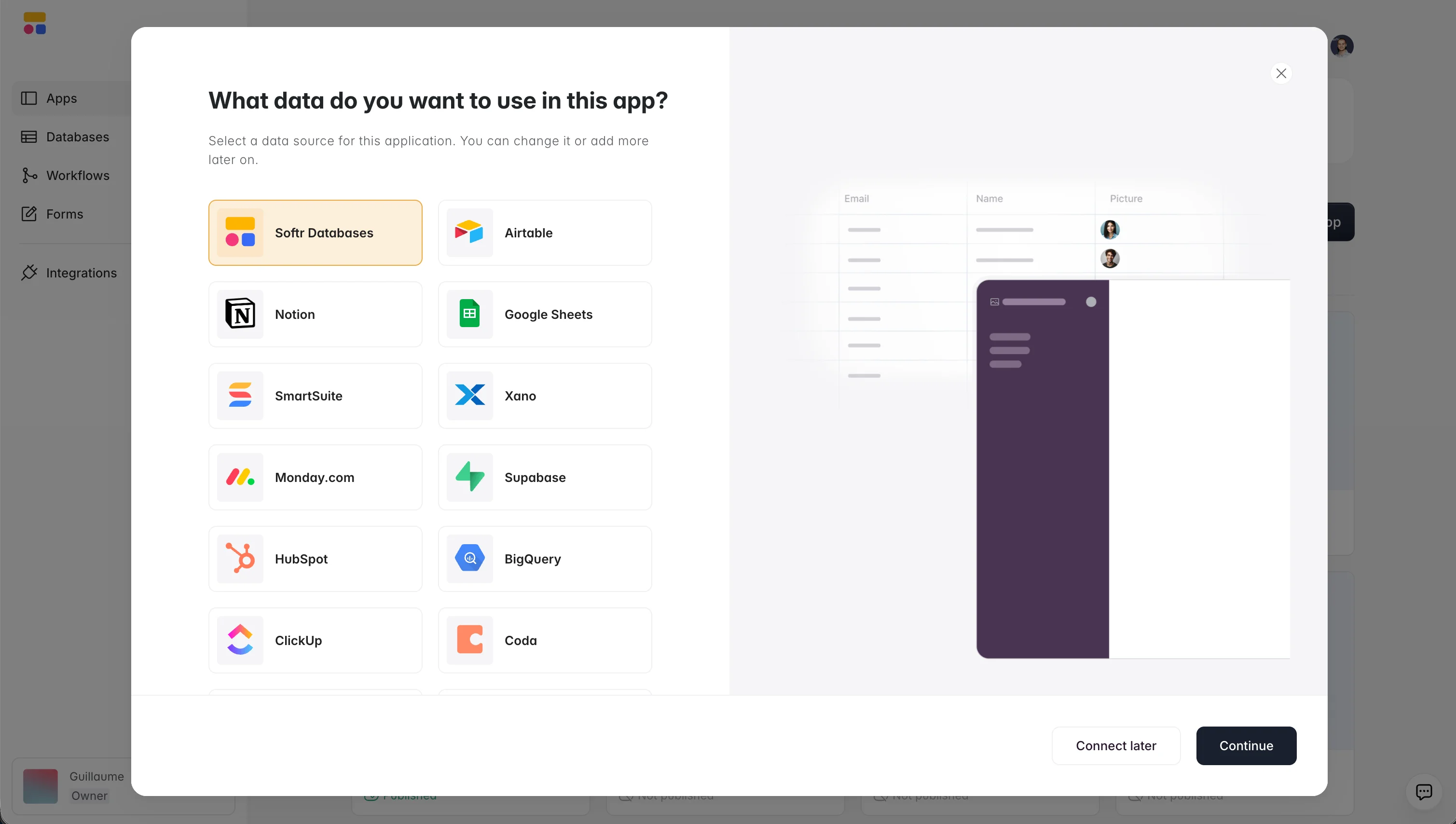
You can choose to instantly import your Airtable bases to Softr Databases—our native, fully-relational data management solution—or connect to 100+ other data sources. This means migrating doesn't require anything like a full rebuild.
Plus, even if Airtable's prices don't go up, Softr is generally a better value for businesses with lots of external users and internal collaborators. There's no separate portal add-on, and even the free plan lets you build unlimited apps on top of your data.
How to migrate from Airtable to Softr
Airtable isn't going anywhere, and any potential updates will only come after the deal goes through later this year. However, it's worth considering your other options in the event that you do need to leave the platform due to changes in pricing, feature offerings, or customer support quality.
Bending Spoons isn't a private equity firm, so its play here won't be to buy, strip down, and then sell the company for maximal profit. But because it has a clear track record with other acquired businesses, we can expect that some customers will probably be burned going forward. Whether you fall into that group or not, this news is a good opportunity to evaluate what leaving Airtable would actually cost (or save) you.
That's why we're offering Airtable users a free migration consultation. Our team will review your current setup, scope the work, and map out the smoothest path to Softr (whether you keep your bases in Airtable or move everything into Softr Databases).
{{cta-1}}
Prefer to get started on your own? You can connect an Airtable base to Softr and have a working interface in front of your team in less than an hour, or import everything to our database while maintaining your relational structure. And if you're still weighing the field, our roundup of Airtable alternatives covers the top tools businesses are comparing right now.
Frequently asked questions
Is Airtable shutting down?
Will Airtable get more expensive?
Should I migrate off Airtable right now?
What is Bending Spoons' track record with acquisitions?
Can I keep using Airtable as my database and just change the front end?