Build vs. buy: Your decision guide in the AI, DIY era


In June, I hosted a roundtable with CEOs, investors, and growth leaders on selling in the “Build vs. Buy” world. And while our discussion focused on how to lead conversations with DIY buyers and generate a competitive position, it opened my eyes to something broader.
Think about it, 20 years ago, if you wanted software or a website, you needed a coder. Fast forward to 10ish years ago, and drag-and-drop and site builders let folks create websites without touching a line of code. Then you started seeing low-code and no-code. You could connect apps and automate your business by dragging icons on a visual workflow with a few clicks.
Now? AI has let anyone replace experts and build entire systems from scratch. Folks are using ChatGPT for contract reviews and basic legal advice; something an attorney had to do just a few years ago. And building brand-new software that integrates with their tech stack from plain-English prompts.
So when should you build your own vs. buy from experts? Let's dive in:
The DIY green light: When it makes sense to “build”
Technologies like AI, no-code tools, and low-code platforms allow anyone to do and learn things without hiring an expert. A solopreneur can now build a full SaaS product, complete with user signups and payment processing, in a single weekend. Just as a small finance team can get basic corporate tax advice from AI without waiting weeks for an email response from its CPA.
There’s a lot of money saved in self-building and finding your own answers. And it's forced providers to find new ways to add value in ways these tools can’t replace.
But just because you can do it yourself, should you? If you have a problem in your business, and can answer “yes” to some of these questions, it might make sense to skip the developers and consultants and DIY:
- Are the stakes manageable? If something breaks, is the worst-case scenario a temporary inconvenience—or lost revenue, a compliance violation, or something more serious?
- Can your team own it? Who will maintain the application, troubleshoot problems, and make changes six months from now?
- Can you tolerate downtime? If the tool goes offline or an AI-generated change breaks something that previously worked, can the business absorb it?
- Is the data and access low risk? Vibe coding and AI app builders can produce working software incredibly quickly, but generated applications can introduce vulnerabilities, expose credentials, or implement authentication and permissions incorrectly. If you're connecting sensitive company data or systems, consider whether you're comfortable owning and validating what gets generated.
- Can you govern what gets built? As building becomes decentralized, someone still needs visibility into what applications exist, what data they access, who can use them, and who owns them over time.
The buyer approach: When the problem has already been solved
Sometimes you don't need to build anything.
If your problem is common enough, there's a good chance somebody has already spent years developing, securing, maintaining, and improving software designed specifically to solve it.
Need payroll software? Project management? Video conferencing? Expense management?
Buying an established product can give you a mature solution immediately, without taking responsibility for building and maintaining it yourself.
The trade-off is flexibility.
Off-the-shelf software is designed to solve a problem for many businesses, not specifically yours. That can mean adapting your workflows to the product, accepting features you don't need, or stitching multiple tools together when no single product quite fits.
Buying tends to make sense when:
- Your requirements are relatively standard.
- An existing product solves most of the problem well.
- Customization isn't strategically important.
- You'd rather pay a predictable subscription than own the build.
- The time and resources required to create something yourself outweigh the benefits of doing so.
If the software already exists and your business doesn't gain anything meaningful from reinventing it, buying is often the simplest answer.
Just “outsource”: When to pay for expertise and development entirely
Even with all the fancy tools at your disposal, sometimes the old-fashioned way works: Just hire an expert. Pay someone to:
- Give you strategic advice that shapes your entire business direction or legal standing.
- Build a high-end, custom website that serves as your primary revenue channel and brand anchor.
- Create an internal software tool that gives your team an edge in their day-to-day workflows.
- Develop a customer-facing portal that's market-ready, flawless, and secure at launch.
- Manage your payroll service instead of calculating and paying withholdings by hand (because one mistake with the IRS is more expensive than any subscription fee).
So when should you hire an expert? Consider this: If the consequences are high, you should probably buy. And we’re not just talking about potential risks of cybersecurity incidents, legal repercussions, or revenue downturns.
It may be a classic example of something not worth your (or the team’s) time. Sure, you can spend months learning advanced software development or mastering tax law. But there’s a cost to that.
After all, peace of mind and getting your time back are often worth the price tag.
The hybrid approach: Build some, outsource the rest
Often, the most pragmatic path is a hybrid. Maybe you can get an application “skeleton” from AI, providing an interface and basic business logic. Then, you can bring in an application security expert to audit for vulnerabilities and patch up issues, while a UX designer can ensure customers will find it intuitive.
Or you can use AI to help the marketing team ideate brand messaging, positioning, GTM, plans, and value props, then hire an agency to execute campaigns and assets.
No matter the need, hybrid makes sense when there are either highly specific knowledge gaps in the process or when the cost of getting it wrong outweighs the savings of DIY.
.webp)
How Softr fills all the gaps
Deciding to build something yourself doesn’t mean you need to build every part of it yourself.
That distinction matters more as AI app builders and vibe coding tools make it possible for anyone to generate working software. The interface and workflows might be easy to create. But business applications also need authentication, permissions, secure data access, infrastructure, backups, auditability, and a way for IT to govern what happens after they go live.
Those aren't necessarily things you want AI generating from scratch every time someone needs a new app.
This is exactly where a platform like Softr fills the security, AI, and vibe-coding gaps. Its AI Co-Builder generates complete, production-ready software from a prompt.
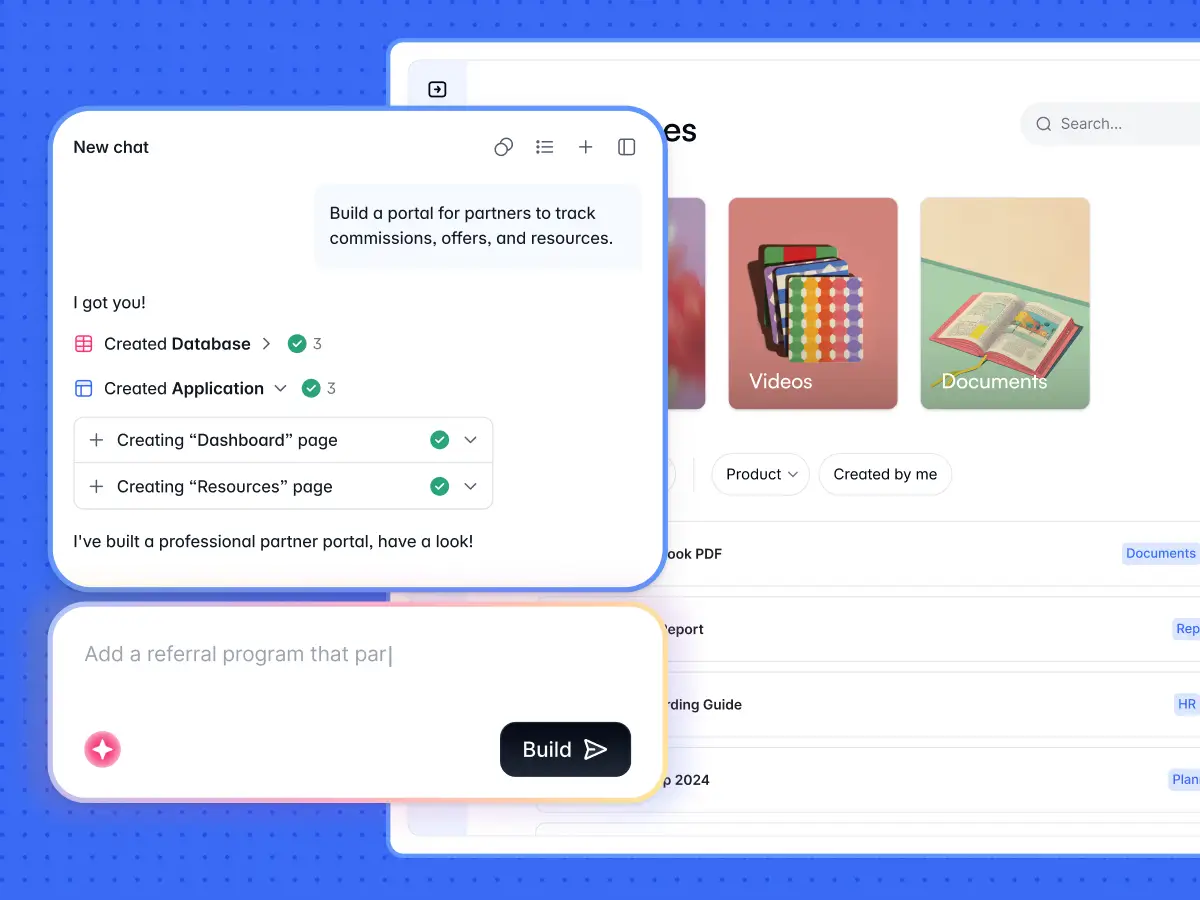
Tell it "build me a client portal where clients can see project status and approve deliverables" or "create an internal CRM for my sales team to track leads and deals," and you'll get the full foundation of a working app.
That includes a database, interface, authentication protocols, permissions, and workflows, all in minutes, but with all the IT protocols already in place:
- Identity and access: SSO, MFA, SCIM provisioning, user groups, and granular permissions.
- Data governance: Global Data Restrictions control what data different users can access, with encrypted credentials for connected data sources.
- Security: Encryption in transit and at rest, scoped API tokens and OAuth, IP blocking, and expiring file URLs.
- Visibility and control: Application and database audit logs give IT visibility into changes as applications evolve.
- Enterprise infrastructure: Managed AWS infrastructure, SOC 2 Type II controls, GDPR compliance, EU or US data residency, backups, and 99.9% uptime.
Softr’s Vibe Coding block gives you more control when you need to customize individual parts of an app. Describe the component you need and Softr generates it within your existing app—using its design system, connected data, and existing user permissions rather than treating it as a standalone piece of code.
So teams still get the biggest benefit of the AI/DIY era: they can solve their own problems without waiting for developers. But IT doesn't have to accept a growing collection of applications with unknown permissions, credentials, infrastructure, and owners.
Try Softr for free and start building your custom business software (with security handled for you) today.
Frequently asked questions
How has AI changed the build vs. buy decision?
What’s the difference between build, buy, hybrid, and outsource?
When should you build software instead of buying it?