Marketing teams: How to convince your manager about using no-code

[.blog-callout]
TL;DR
- Build your case around four pillars: efficiency, empowerment, cost savings, and innovation, and back each one with real numbers.
- The evidence is strong: teams using no-code report results like 58% lower operational costs, 100+ admin hours saved per month, and tens of thousands saved versus custom development.
- A live demo beats any slide deck. With Softr's AI Co-Builder, you can generate a working campaign tracker from a plain-language description and show it to your manager the same day.
- Prepare for the common objections (security, learning curve, vendor dependency) and answer them with specifics, not reassurance.
- After the yes, prove it: start with one contained project, measure time and cost savings, and use those results to expand. [.blog-callout]
In the fast-paced world of marketing, having the right tools makes a measurable difference. Time and efficiency are of the essence, and yet teams often find themselves caught up in manual tasks, battling uncooperative software, or waiting for IT's helping hand.
That's where no-code technology comes into play.
It's more than just a buzzword; it's a way to run real marketing operations, from campaign tracking and creative approvals to client-facing reporting portals. In this post, we'll arm you with the arguments you need to convince your team and your managers about the value of no-code. Because, let's face it, in today's marketing landscape, those who can leverage technology will lead the pack.
So, buckle up and get ready to make your case.
The four-pronged approach to convincing your marketing manager
So, you're sold on no-code. But how do you get your marketing manager to see the light? Don't worry, we've got you covered. Here's a four-pronged approach that will help you make a compelling case for your marketing team to adopt no-code.

Efficiency
This is your ace in the hole. Show your manager how no-code can speed up project timelines, eliminate bottlenecks, and let your team get more done in less time. Bring data, examples, and case studies if possible.
The numbers are easy to find. One marketing agency that moved its client reporting and creative approval workflows to Softr saved 8 to 10 hours per week on managing systems and generating reports, time it redirected to strategic work. Paint a picture of a marketing ops team that's agile, responsive, and measurably more efficient.
Empowerment
This is where you tug at the heartstrings. No-code isn't just a tool, it's a way to empower your team. It gives everyone the ability to contribute ideas and solutions, not just the tech-savvy ones. It fosters a culture of creativity and innovation, where everyone feels valued and engaged.
Cost savings
Here's where you speak the language of the C-suite. No-code can drastically reduce development costs and free up resources. Plus, the ability to quickly test and iterate means less risk and more return on investment.
Show your manager the numbers, because they don't lie. A recruitment company that built its three-sided portal on Softr avoided over €50,000 in custom development costs and now saves 100+ admin hours per month. MIT replaced a custom-coded portal that had cost over $100,000 to build and maintain with a Softr app built by a single person. And one agency cut its operational and software costs by 58% after consolidating its workflows into a single Softr portal.
"Softr allows me to deliver business apps in a few days where a custom stack would take weeks. The pricing remains clear, the ROI is obvious, and the client can manage their pages on their own." - Verified G2 review, Computer Software (Small-Business)
Innovation
Last but not least, make it about the future.
No-code is more than a trend; it's how a growing share of business software gets built. According to Vercel, 63% of people using AI-assisted building tools are non-developers, and Google reports that 88% of early AI agent adopters are already seeing positive ROI on at least one use case. Adopting no-code is about staying competitive in a rapidly changing digital landscape and fostering a culture of continuous improvement.
Remember, convincing your manager isn't just about making a logical case. It's also about sparking excitement and painting a vision of a brighter future. Show them not just why no-code is a smart choice, but also why it's an exciting one. If you need more ammunition, this roundup of no-code benefits from seven CEOs is a useful reference to share.
Demonstrating no-code in action
Let's bring all this no-code chatter to life, shall we?
It's one thing to talk about the value of no-code, but seeing is believing. We're going to show you just how easy it is to build a campaign tracker or a marketing portal with Softr. Unlike tools that only handle the frontend, Softr gives you the full stack: the interface, native Softr Databases, and Softr Workflows for automation, all in one place.
Generate it with AI (or start from a template)
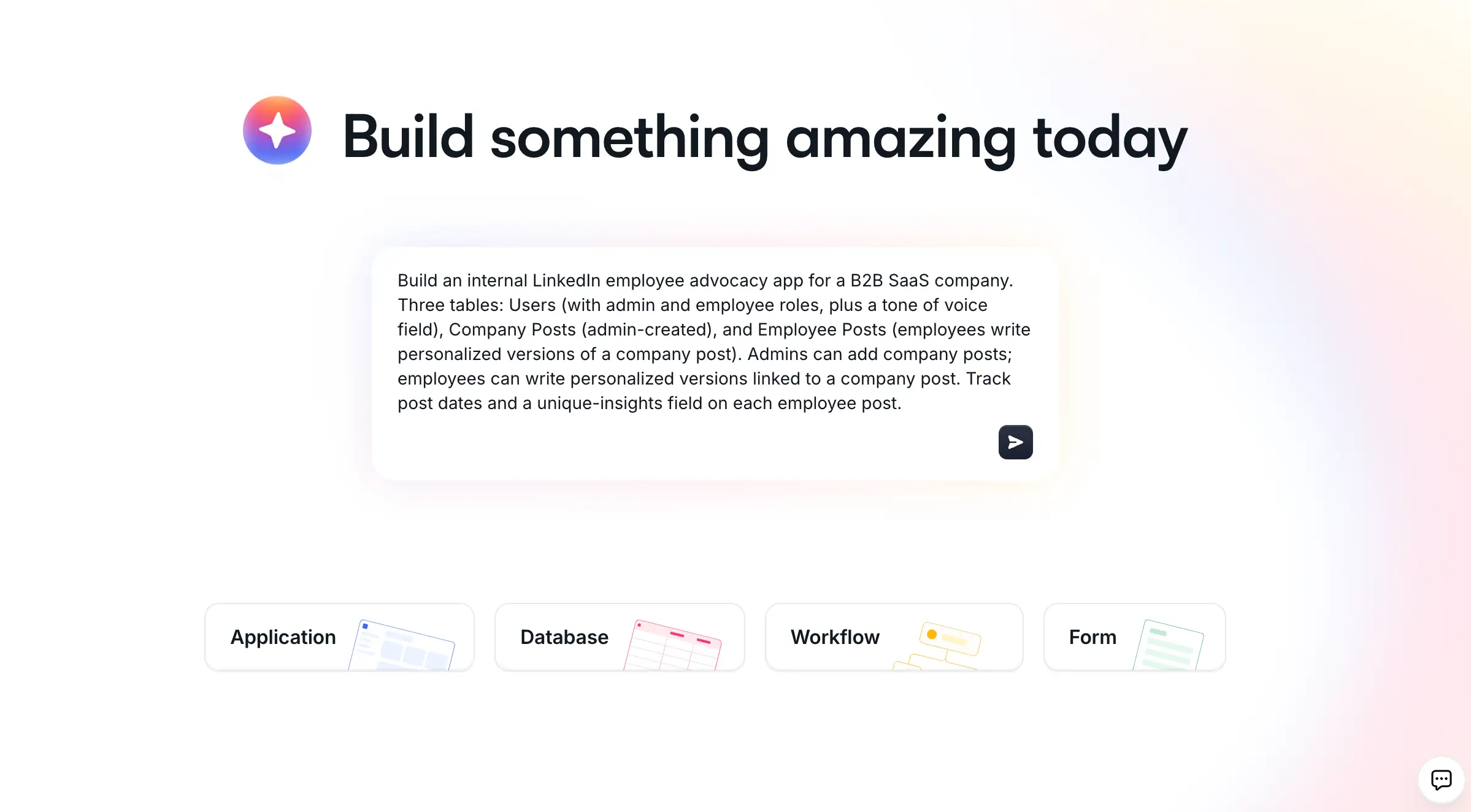
The fastest path is the AI Co-Builder: describe the app you need in plain language ("a campaign tracker with statuses, deadlines, and an approval flow for creative assets") and Softr generates a working version, complete with the database and pages, already connected. This is your strongest demo argument, because you can show your manager a functioning app the same day you pitch the idea.
Prefer a head start with a proven structure? Softr also offers a plethora of templates, whether you're building a campaign tracker, a content calendar, or a client reporting portal. And if you like full control, you can always build from a blank canvas.
Connect your data
Your app needs a home for its data. You can use Softr Databases, the native option that keeps everything in one place, or connect to the data sources your team already uses, like Airtable, Google Sheets, or HubSpot. Softr supports 17+ data sources, including a REST API connector. Either way, adding a new campaign is as simple as adding a record.
Drag and drop
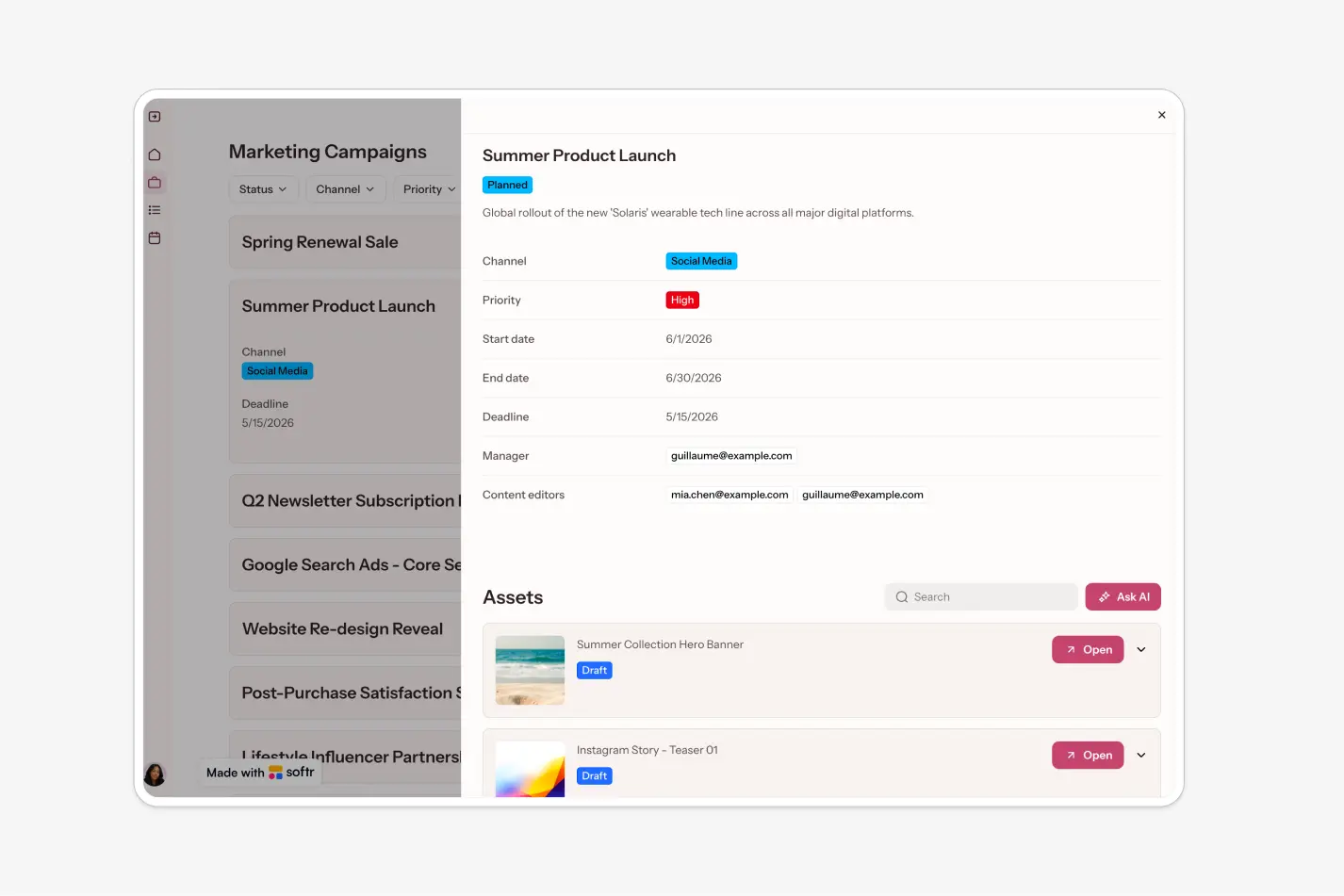
Next, it's time to refine your app. Softr's user-friendly interface lets you drag and drop blocks onto your canvas, or you can ask the AI Co-Builder to add and configure blocks for you by describing what you need. It's a bit like building with LEGO, but without the risk of stepping on a rogue piece.
Customize
Now for the fun part. You can not only add your brand colors, logo design, and content but also set logic for the content to be displayed. That means you can tailor what content gets shown based on certain criteria, like showing each campaign manager only their own campaigns. And if you ever hit the limits of pre-built blocks, the Vibe Coding block lets you generate fully custom components with AI.
Automate
This is where no-code earns its keep for marketing ops. With Softr Workflows, you can trigger automations directly from your app: a new campaign brief notifies the right channel, an approved asset updates its status automatically, a form submission creates a task. If you need external tools, Softr also has native integrations for platforms like Zapier and Make that work seamlessly with Softr Databases.
Publish
Here's where the magic happens. Hit publish, and voila! Your campaign tracker or marketing portal is live. And the cherry on top? Softr lets you add a custom domain, so your app doesn't just work like a dream, it looks the part too.
Iterate
The beauty of no-code lies in its flexibility. You can easily tweak and update your creations without having to navigate a maze of code. It's as easy as pie (and just as satisfying).
This is what no-code is all about: empowering you to take control, solve problems, and run real operations. And with a tangible example like this, your manager will be hard-pressed not to see the potential of no-code. After all, the proof is in the Softr-built pudding.
Handling objections: Common concerns about no-code
Now, we can't promise your manager will immediately start singing no-code's praises. Like any new concept, no-code might face some initial resistance, and for sure there are plenty of myths out there pushing in the wrong direction. But fear not, we've got you covered. Here's a handy guide to handling common objections:
Security concerns
This is a common one. After all, you're dealing with business-sensitive data. Reassure your manager that no-code platforms like Softr adhere to top-notch security standards. They encrypt data, run regular security audits, and use secure hosting environments. Softr also gives you granular users and permissions, so clients, executives, and team members each see only what they should. Plus, with no-code, there's less chance of human error leading to security vulnerabilities.
Learning curve
Your manager might worry about the time it takes to get up to speed with a new tool. The beauty of no-code platforms is their intuitiveness. They're designed to be user-friendly, and AI co-building shortens the curve even further, since you can describe what you need instead of figuring out every setting yourself. With plenty of tutorials and resources available, you'll become a no-code pro in no time.
Dependency
What if the no-code platform shuts down or changes its pricing? This is a valid concern. But remember, choosing a reputable platform like Softr or Bubble, which is backed by solid investors and has a large user base, can minimize this risk.
No-code limitations
Yes, no-code platforms might not offer the same flexibility as custom coding. But they're evolving rapidly. Today, teams run production apps on them: client portals, CRMs, and internal tools used daily by hundreds of people. For the vast majority of marketing needs, no-code platforms are more than sufficient, and AI-generated custom components cover most of what's left.
Integration with existing systems
This is a piece of cake for most no-code platforms. Softr, for instance, comes with its own native databases and connects to 17+ data sources, including Airtable, Google Sheets, HubSpot, and a REST API connector, so it fits into the stack your team already runs, including your marketing automation software.
Remember, your job isn't to convince your manager that no-code is perfect. Your job is to debunk those common no-code myths and show that no-code is a flexible, dependable way to run your marketing operations, with benefits that far outweigh any potential drawbacks.
From pitch to implementation: What happens next
High fives all around! You've won your manager over to the no-code side. But this isn't the end of your journey, it's just the beginning. Now, it's time to get your hands dirty and start implementing no-code in your marketing operations. Here's what the road ahead looks like:

Team training
With no-code, your team becomes the builders. You can even foster no-code skill development within your organization. Luckily, most no-code platforms, like Softr for instance, offer multiple seats, allowing various team members to explore and learn simultaneously. Start by organizing training sessions and sharing helpful resources. Encourage your team to dive in, explore, and get their hands on the tools. The best part? Many no-code tools, including Softr, offer live or recorded workshops to guide you through the process. Plus, with Softr's reputation for responsive customer support, help is always just a message away.
"The learning curve for Softr is approachable and not intimidating to users who have never coded." - MIT Project Manus team, on the makerspace portal now used by 2,800+ people
Gradual implementation
Think of your no-code adoption as a marathon, not a sprint. Begin with smaller projects, let your team get comfortable, and gradually take on bigger challenges. This phased approach will give your team the confidence to scale mountains and prove no-code's effectiveness.
Feedback and iteration
Rather than a set-it-and-forget-it deal, no-code adoption is a dynamic, evolving process. Encourage your team to share their experiences, both good and bad, and use this feedback to refine your approach. This iterative process will help you make the most of no-code.
Measure success
What's better than a happy manager? A manager who sees the value in your new approach. Show the impact of no-code through concrete data: time saved, increase in productivity, reduction in costs. Demonstrating these tangible benefits will ensure continued support for your no-code adventures.
Time to market
One of the biggest advantages of no-code tools is the speed at which you can build and implement solutions. Keep track of how long it takes to create a tool using no-code versus traditional development methods or customization of an off-the-shelf product. This will give you a clear picture of the time saved.
Cost savings
Building tools in-house or customizing existing ones can be quite expensive. With no-code, you can build tools at a fraction of the cost. Calculate the difference in cost between a no-code solution and the alternatives. Don't forget to factor in the cost of potential delays with traditional development methods.
Productivity
No-code tools can streamline many repetitive tasks, freeing up your team's time for more strategic work. Measure the time saved by automating tasks and processes. This could be in the form of hours saved per week or tasks completed faster.
User adoption
The success of a tool is largely dependent on how widely and readily it is adopted by the team. Keep a tab on the number of team members using the no-code tool versus an alternative. High adoption rates often indicate a tool that's user-friendly and effective. For reference, Arizona State University's Softr-built curriculum hub reached a 90% adoption rate among its core users in under a month.
Flexibility
No-code platforms provide a high degree of flexibility. You can easily adapt your tools to meet changing business needs without having to wait for long development cycles. While this is more qualitative, feedback from your team can help gauge this benefit.
Innovation
No-code empowers your team to experiment and innovate. Track the number of new ideas or projects that have been made possible because of no-code. This will help illustrate the value of no-code in fostering a culture of innovation.
Celebrate wins
And finally, don't forget to celebrate! Built a nifty tool that streamlined your workflow? Ran a campaign that smashed all records, thanks to no-code? Crack open that virtual champagne and make some noise. Recognizing these wins will keep your team motivated and excited about the potential of no-code.
With your manager on board and your team trained up, you're ready to start your no-code journey.
Conclusion: The future is no-code
Well, folks, there you have it. We've navigated the twists and turns of the no-code journey together, from understanding its value to convincing your manager, and finally, to the all-important task of measuring its impact.
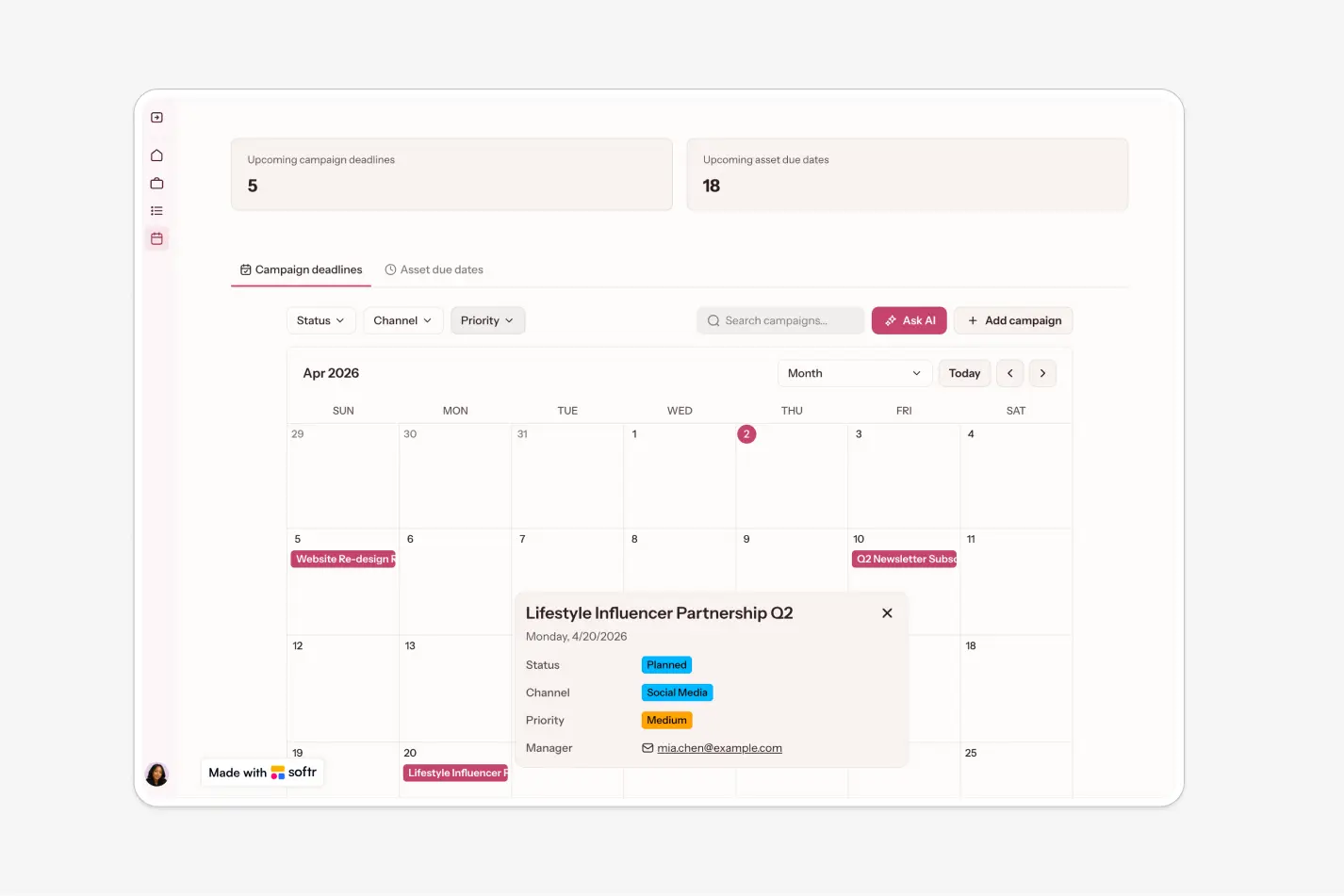
Embracing no-code means marketing ops is no longer just about managing campaigns, but also about building and iterating tools that truly cater to your team's unique needs. With a full-stack platform like Softr (interface, native databases, workflows, and an AI Co-Builder to generate all three), you're not just saving time and money, you're empowering your team to run its own operations.
The best next step? Pick one workflow that frustrates your team today, describe it to the AI Co-Builder, and bring the working app to your next team meeting. That demo will make your case better than any slide ever could.
Frequently asked questions
- What's the strongest argument for no-code in a marketing team?
- How much can a marketing team actually save with no-code?
- Is no-code secure enough for marketing and customer data?
- What should a marketing team build first with no-code?
- Do marketers need technical skills to build apps with no-code?