38 technical terms vibe coding makes you learn (and Softr doesn't)



[.blog-callout]
✨TL;DR:
- AI can write an app's code in seconds, but the moment a real user logs in, you inherit dozens of technical terms to learn, configure, and debug.
- This guide explains 38 common terms in plain language, from edge functions and row-level security to CORS and JWTs.
- You never deal with any of them on Softr. The platform handles the full technical stack: frameworks, servers, deployment, data security, and authentication.
[.blog-callout]
Building software used to mean hiring developers. Now you can describe an app to an AI and watch it generate code in seconds.
But when real users try to log in, the demo turns into software. As soon as you need accounts, permissions, live data, and hosting, you inherit a complex technical vocabulary you suddenly have to learn.
This guide walks through the technical terms you may encounter when building an app the hard way. We explain what each term means and why you never have to deal with them on Softr. We handle the plumbing so you can focus on the parts of the app only you can decide.
Frameworks, tooling, and the build itself
This is the machinery that turns code into a running website. In a coded project you choose it, install it, and keep it current. In Softr, there's nothing to pick, since all the infrastructure is managed by default.
React
A JavaScript library for building user interfaces out of reusable components.
In Softr: Your interface is made of native, responsive blocks (tables, forms, kanbans, calendars), so you assemble pages instead of writing components. When you need something custom, the Vibe Coding block generates the React for you and surfaces the parts worth editing as visual settings.
Responsive breakpoints
The screen-width thresholds where a layout has to rearrange itself so it still works on phones, tablets, and desktops.
In Softr: Every native block is responsive out of the box, so you never define breakpoints or re-prompt an AI to stop a layout from breaking on mobile. You can fine-tune the look per device, but the defaults already hold up.
Next.js
A popular React framework that bundles routing, rendering, and server logic into one project.
In Softr: There is no framework to set up or keep updated. Routing between pages, rendering, and server logic are all handled by the interface builder. You add a page, you don't scaffold a route.
Node.js
A runtime that lets JavaScript run on a server instead of only in the browser, and the foundation most modern web backends are built on.
In Softr: There is no runtime to install, version, or keep patched. The environment your app runs on is fully managed, so you never match a Node version to a hosting provider's requirements.
TypeScript
A typed version of JavaScript that catches certain errors before code runs, in exchange for extra setup and a compile step.
In Softr: There is no language to learn, configure, or compile. The Vibe Coding block handles any generated code for you, so type errors and build configs never reach your desk.
Vite
A build tool and local development server that bundles your code while you work.
In Softr: There is no dev server to run and no bundler to configure. You edit in the studio and preview your live app in one click, including impersonating any user group to see exactly what they will see.
npm, npx, and pnpm
Package managers that install and run the third-party libraries your app depends on.
In Softr: There is no dependency tree to install and no lockfile to babysit. We maintain every underlying package and keep them secure, updated, and compatible for you.
Wrangler
Cloudflare's command-line tool for configuring and deploying code to their infrastructure.
In Softr: You never open a terminal. There is no CLI to learn, no config file to edit, and no cloud account to wire up. You hit publish.
Build and deployment
Compiling your source code into something a server can run, then pushing that result live.
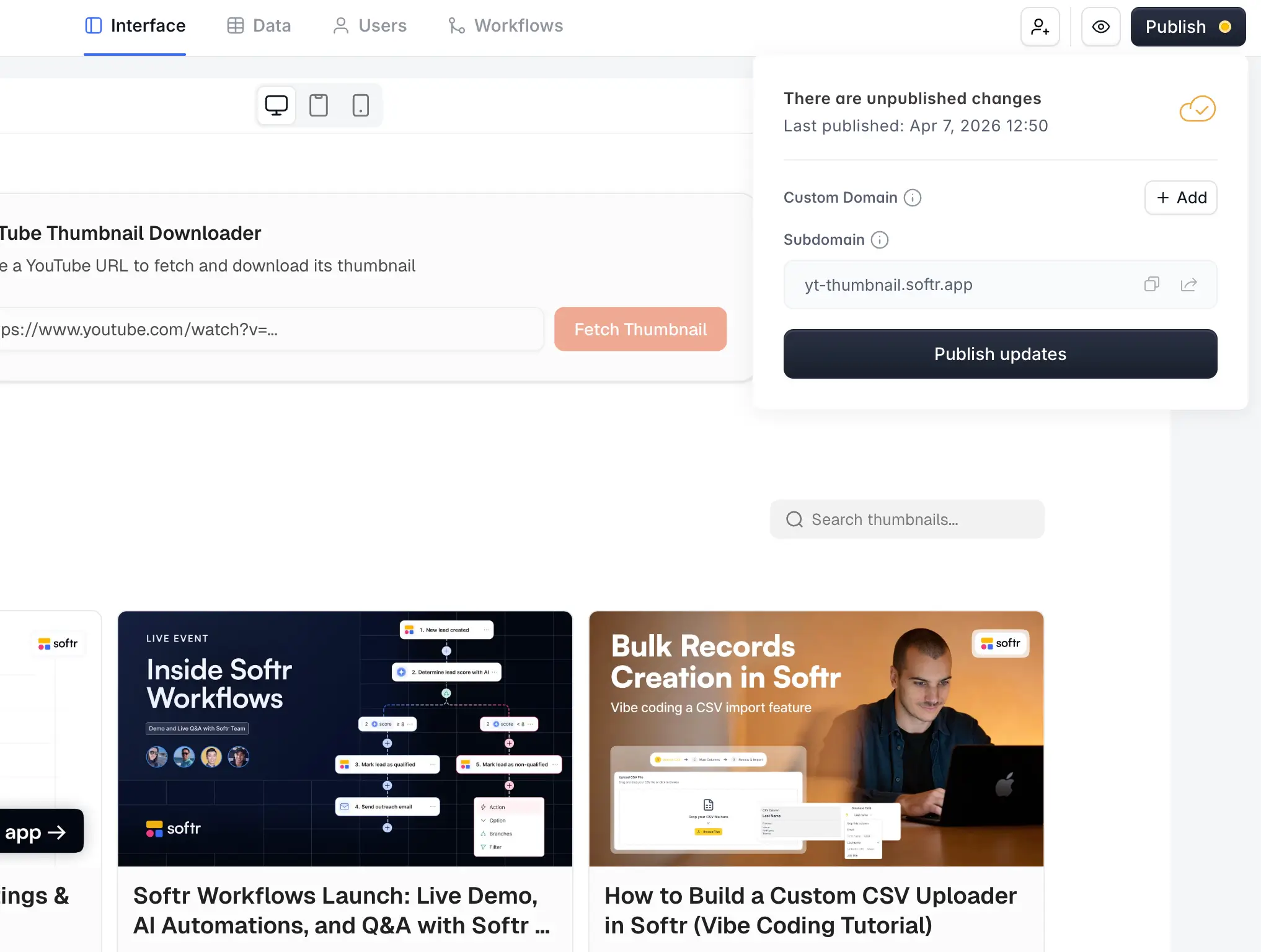
In Softr: There is no build step to wait on and no deploy to configure. That also removes a classic vibe-coding trap, where a deploy quietly fails, you keep looking at a cached version, and you re-prompt the AI to fix code that was never broken. You publish, and it is live.
CI/CD
Continuous integration and continuous deployment: the automated pipelines that test and ship code on every change.
In Softr: There is no pipeline to build or own. Changes preview instantly and go live when you choose, with none of the test-and-ship machinery to maintain.
Servers, hosting, and infrastructure
These are the terms for where your app actually runs and how it scales. They are usually the steepest part of the learning curve, and the part where surprise bills appear.

Server-side
Code that runs on a server rather than in the user's browser, which is where anything sensitive belongs.
In Softr: The choice is made for you. Database connections and data operations always run server-side, hidden from the browser, so a user can never intercept a request to grab your keys or bypass your rules.
vCPU
A virtual CPU, the unit of compute you rent and pay for on a cloud host.
In Softr: You never size a machine or reason about cores, RAM, or performance tiers. Apps scale automatically, so there is nothing to provision and nothing to outgrow.
Workers and edge functions
Small server-side functions that run on demand, often distributed close to users around the world.
In Softr: Any backend logic you need lives in Softr Workflows, built visually or by the Workflow AI Co-Builder. You write logic as steps, not as functions you deploy onto infrastructure.
Durable Objects
A Cloudflare primitive for keeping consistent state, like a live session or counter, at the edge.
In Softr: State and sessions live in Softr Databases and the platform's built-in session handling. There is no low-level state primitive for you to coordinate.
Docker and containers
A way to package an app with everything it needs to run, so it behaves the same on any machine it's deployed to.
In Softr: There is nothing to containerize. Your app runs on managed infrastructure the moment you publish, with no image to build, no registry to push to, and no container to keep alive.
Reverse proxy
A server that sits in front of your app to route incoming traffic, handle HTTPS, and shield what's behind it.
In Softr: That routing and protection is part of the hosted platform. There is no proxy to stand up and no Nginx config to debug.
S3 and R2
Cloud object storage services from Amazon and Cloudflare, where apps keep files, images, and uploads.
In Softr: File and image storage is built in. Uploads from forms and records are stored and served for you, with no bucket to create, no access policy to write, and no separate storage bill.
CDN
A content delivery network: a global set of servers that cache and serve your app's assets quickly worldwide.
In Softr: Your app is served fast globally by default, with no CDN to set up or configure.
Caching and cache invalidation
Storing a copy of data or pages so they load faster, plus the famously tricky job of knowing when that copy is stale and has to be refreshed.
In Softr: Caching is handled for you. Your app stays fast without you writing cache rules, and you avoid the classic bug where users keep seeing out-of-date data after something changed.
Redis
An in-memory data store often run alongside an app for caching, sessions, and queues. It's fast, but it's one more service to host and maintain.
In Softr: The jobs you'd reach for Redis to do (fast reads, session handling, background queues) are covered natively, so there is no extra service to run.
SSL/TLS certificates (HTTPS)
The certificates that encrypt traffic between a browser and your app, and the reason a site shows a padlock instead of a "Not secure" warning. They have to be issued and renewed.
In Softr: Every app, whether on a Softr subdomain or your own custom domain, is served over HTTPS automatically. There is no certificate to buy, install, or remember to renew.
Environment variables
Configuration values and secrets (API keys, database URLs) kept outside your code and set per environment.
In Softr: There are no env files to manage, and no risk of leaking a key by pushing it to a public repository, which is a genuinely common accident. Credentials for integrations are stored securely on our servers and are never exposed to your users.
Bindings
Declared connections that let code reach a resource, such as a database or a storage bucket, at runtime.
In Softr: Those connections already exist. You point a block at a data source from a dropdown; there is no resource to bind in a config file.
APIs and the wiring between systems
This group covers how different pieces of software talk to each other. It's where a lot of "it worked yesterday" bugs come from.
API routes
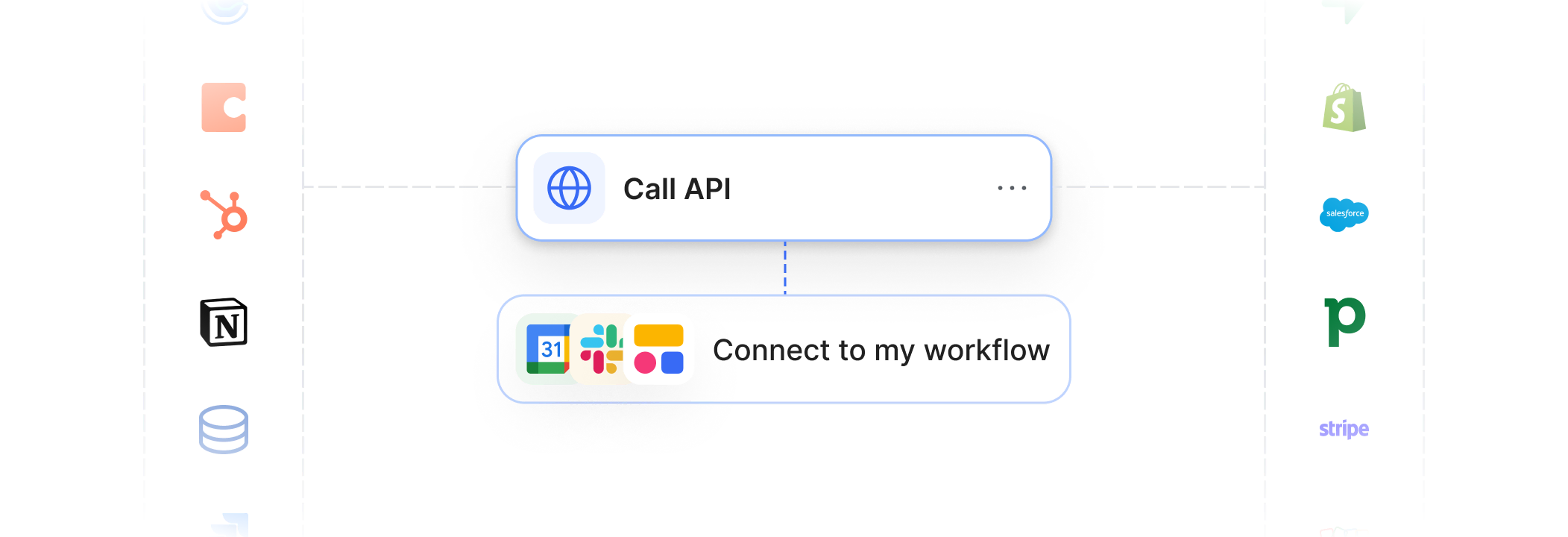
The specific URLs your own backend exposes so the frontend, or other systems, can read and write data.
In Softr: You don't design, build, or secure endpoints. Blocks read and write through a secured layer automatically, with permissions enforced server-side.
Middleware
Code that sits between an incoming request and your app logic to handle things like authentication checks, logging, or redirects.
In Softr: Those jobs are handled by visual user groups, page rules, and data restrictions. You configure who sees and does what in settings, not in an interceptor function.
CORS
Cross-origin resource sharing: the browser rules that decide which sites are allowed to call your API, and a notorious source of "works locally, breaks in production" bugs.
In Softr: Because the data layer and the app are one hosted system, there are no cross-origin headers for you to configure or get wrong.
Callback
Broadly, a function that runs once something else finishes. In app-building it most often shows up as the callback URL step when setting up an integration.
In Softr: Native connectors are pre-approved by the platforms they link to, so you connect an account in seconds with no developer app to register and no callback URL to configure correctly.
SDK
A software development kit: a vendor's official code library for talking to their service, such as Stripe or AWS.
In Softr: Integrations are native or set up as workflow steps. You don't install a vendor SDK, read its docs, or keep its version in sync with their API.
The data layer
Your data is the one part of this list you absolutely have to care about. The good news is you get to care about its shape and meaning, not its plumbing.
SQL
Structured query language: the language used to read and write data in relational databases.
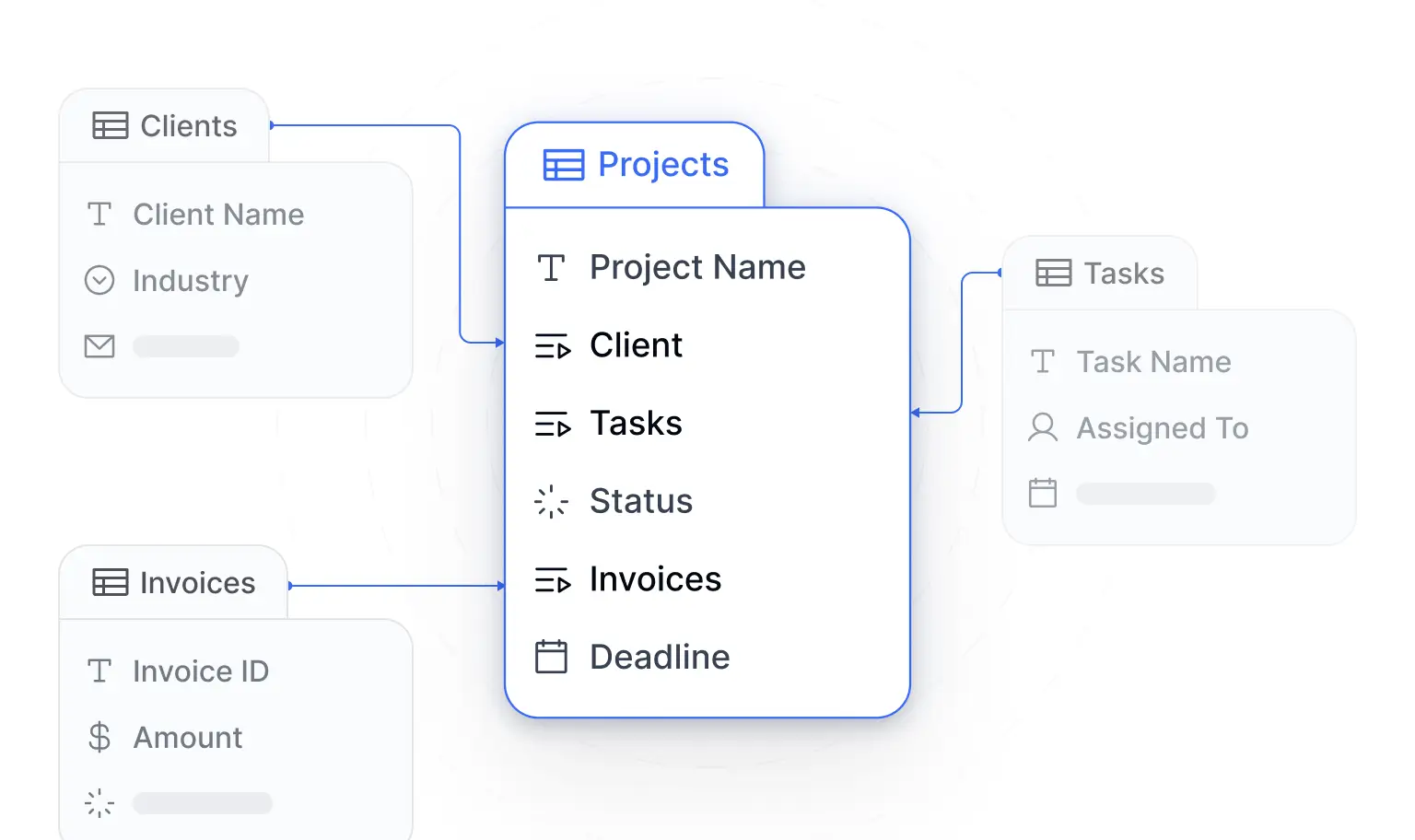
In Softr: You work with your data visually, and Ask AI lets your users ask questions of a dataset in plain language. Even complex filters and formulas are written for you by local AI helpers from a natural-language description.
DDL
Data definition language: the part of SQL that creates and changes database structure, like tables, columns, and types.
In Softr: You create and change tables, fields, and relationships in the visual editor, or by asking the Database AI Co-Builder. There is no schema script to write.
RLS (row-level security)
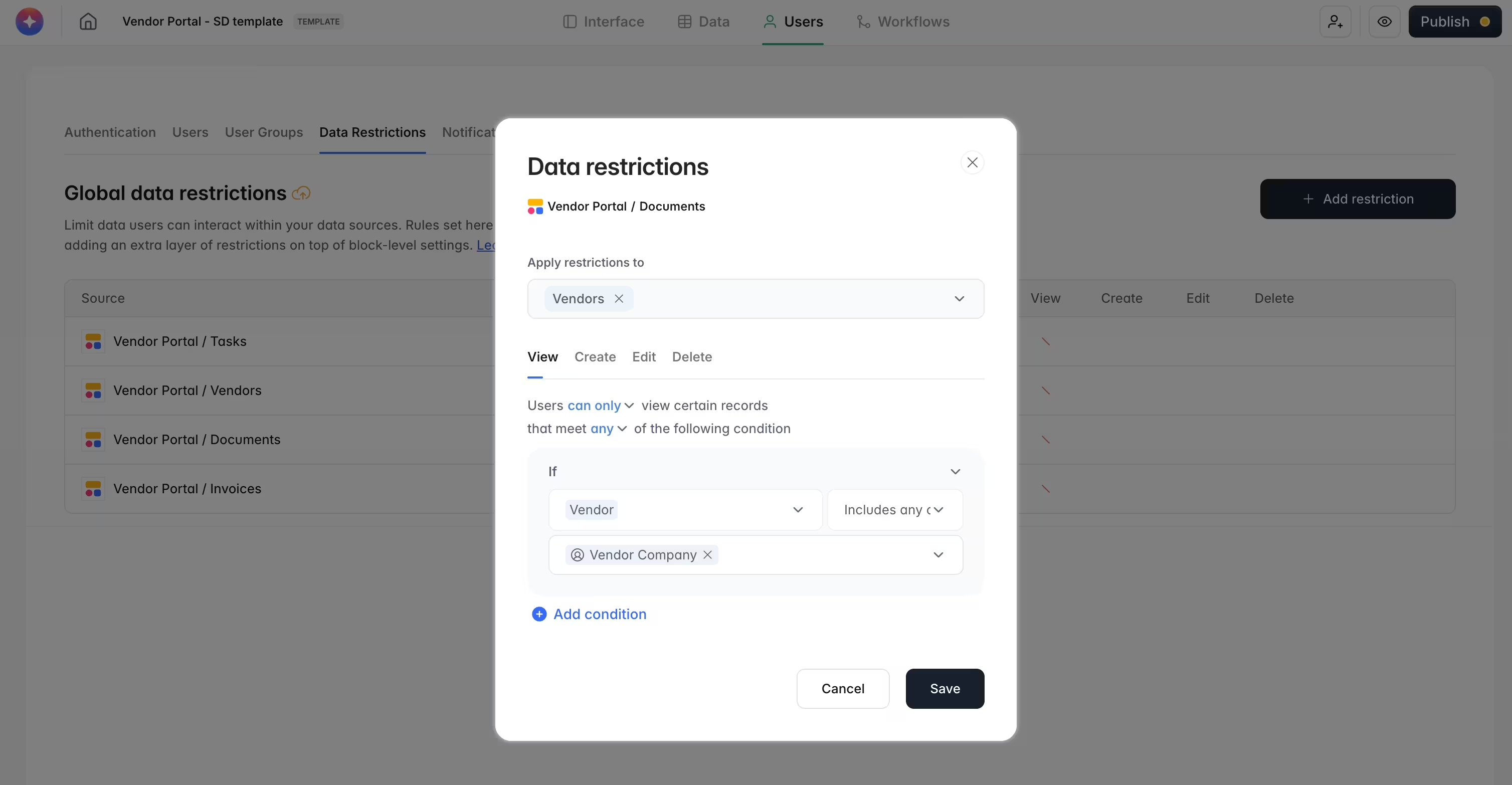
Database rules that restrict which records each user can see or change. This is one of the biggest wins here, because RLS policies are highly technical and easy to misconfigure into a silent data leak.
In Softr: We replace them with visual data restrictions and record-level permissions you can verify instantly by previewing the app as any user group.
ORM
An object-relational mapper: a layer of code that translates between your programming language and the database so developers don't write raw SQL by hand.
In Softr: There is no translation layer to set up or reason about, because the visual database and your interface are part of the same native system.
Connection pooling
Managing a limited number of simultaneous database connections so a coded app doesn't fall over under load.
In Softr: This is handled natively. Your app stays fast as usage grows, and you never tune a pool size.
Authentication and security
Getting these wrong is how data leaks. In a coded app, each is your responsibility to implement correctly. In Softr they're built into the foundation.
JWT (JSON web token)
A signed token a server hands a user after login to prove who they are on later requests.
In Softr: Authentication, sessions, and tokens are handled natively. You toggle login methods (password, one-time code, two-factor, Google, magic link, or SSO) in a settings panel, and never issue, sign, store, or expire a token yourself.
Password hashing and salting
The techniques for storing passwords safely, so that even if data is exposed the actual passwords are not.
In Softr: This is never something you build, because users and permissions and login are handled natively. User credentials are not something you store or protect by hand.
XSS, CSRF, and SQL injection
The classic web attacks a custom app has to actively defend against: injecting malicious scripts, forging requests from a logged-in user, and slipping commands into a database query.
In Softr: This whole class of risk is reduced by default. Data operations run server-side and hidden from the browser, inputs are handled by the platform, and you are not hand-writing the queries or pages where these holes usually open up.
Version control and developer workflow
This is how teams manage changes to code without overwriting each other. It is essential when you have a codebase, and pure overhead when you don't.
PR / MR (pull request / merge request)
The formal "please review and merge my changes" step before code goes live.
In Softr: There is no repository, no branches, and no merge ritual. You edit, preview, and publish, and changes can be staged and reviewed visually rather than through a code diff.
Git merge conflicts
What happens when two people change the same lines of code and the system can't decide which to keep.
In Softr: There is nothing to merge. Built-in version history, including a saved version for every prompt or edit in the Vibe Coding block, lets you roll back cleanly without ever untangling a conflict.
Why these terms matter in the AI era
The industry has swung from "everyone should code" to "AI will code for you." Both ask the same thing of you in the end. Even when an AI types the syntax, you still have to think like a developer: debugging logic, managing state, wiring up infrastructure, and securing data. Vibe coding didn't remove the complexity of software; it handed it to everyone.
Softr takes a different path. Instead of generating an entire codebase you then have to host and maintain, our AI Co-Builder assembles battle-tested, pre-built components: a real database, page routing, authentication, native blocks, and permissions. You can also build visually from a template or from scratch, and switch between building modes whenever you like. The result is that the terms above stay where they belong, inside the platform, and out of your day.
What you control in Softr, and why that's the point
Everything above is what Softr takes off your plate. The flip side is what we deliberately hand to you, because these are the decisions that make the app yours and deserve your attention:
- Your database. A native, relational database you edit visually, structured around your business objects instead of scattered across spreadsheets.
- Your users and their permissions. Visual user groups and data restrictions, so an admin and a client see entirely different apps from the same build, verified instantly by previewing as any user.
- Your workflows. Automations and AI steps you set up as logic, triggered by what users do, with no servers or pipelines to stand up.
- AI features for your users. Ask AI on any dataset, database AI agents that enrich records automatically, and human-in-the-loop AI flows, all configured visually and bound by your permissions.
- Your integrations. Native, pre-approved connectors to the tools you already use, plus 17+ data sources, linked in seconds.
- Your look and feel. A global theme (colors, fonts, sizing, logo, and custom domain) that every block, including custom ones, inherits automatically.
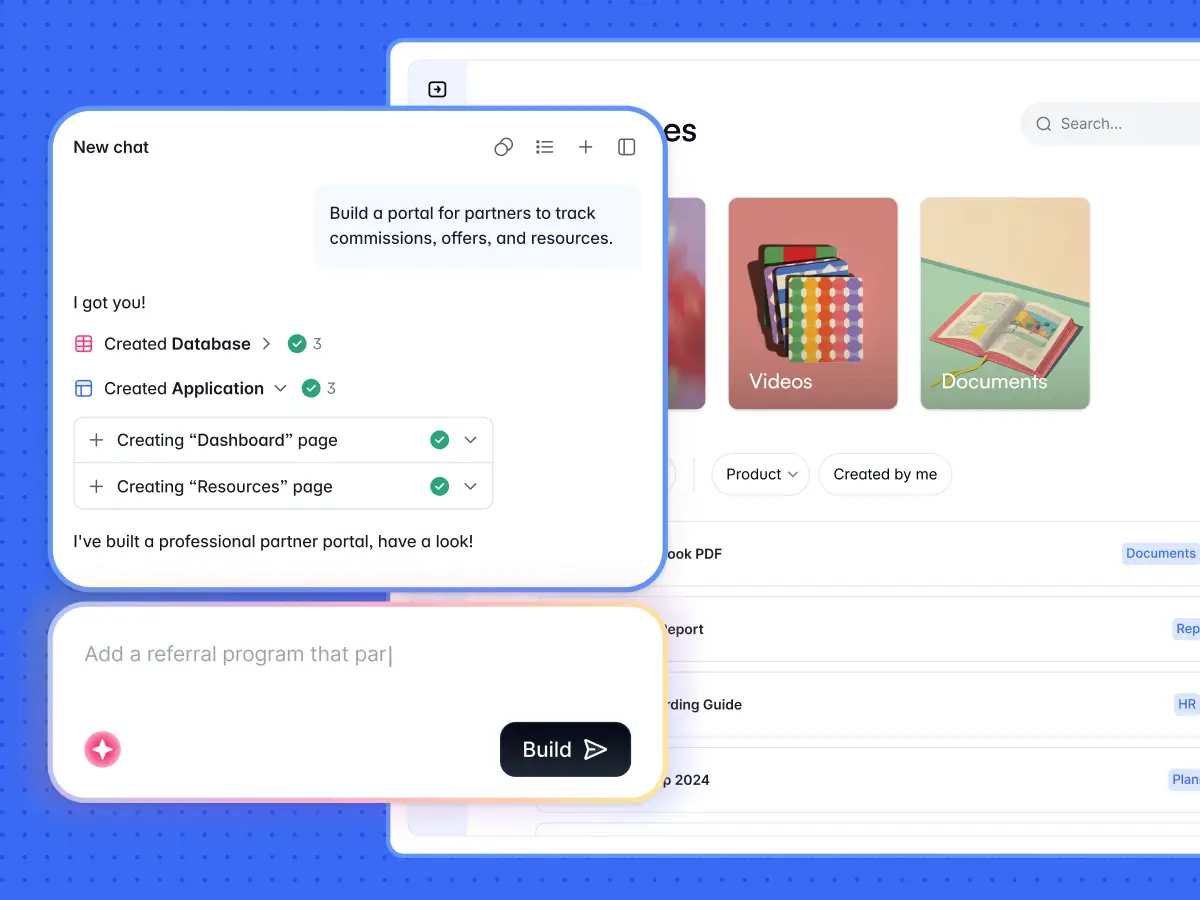
That trade is the whole idea. Vibe coding handed software's complexity to everyone who never asked for it. Softr keeps that complexity inside the platform and gives you back only the choices that are genuinely yours, so you can describe what you need, ship it the same day, and spend zero minutes thinking about edge functions. If you've been hesitating because "building an app" sounded like learning a second job, this is your sign to start with the part that matters: your data.
Try Softr free and start building your first business app today.
Frequently asked questions
Do I need to know how to code to build an app on Softr?
What happens when I need something custom that native blocks don't cover?
Is a Softr app secure if I never configure things like row-level security or tokens myself?
Can I connect my own tools and data without dealing with APIs and SDKs?
Do I have to manage servers, hosting, or scaling?