Lovable vs Replit vs Softr: Which AI app builder should you choose?


Sign up for any AI app builder, describe the app you want, and a few minutes later, you have a working first version. But you still have to customize the app, fix any bugs, control who can see what, and make sure it works well before putting it in front of real users.
Lovable, Replit, and Softr all build apps from a prompt, but they handle what comes next very differently. In this guide, I compare all three tools based on ease of use, flexibility, permissions, workflows, AI features, pricing, and real user reviews.
Lovable vs Replit vs Softr at a glance
| Lovable | Replit | Softr | |
|---|---|---|---|
| Best for | Prototypes, websites, and custom customer-facing apps | Complex custom products and web plus mobile apps | Client portals, internal tools, CRMs, and dashboards |
| Technical skills needed | Beginner-friendly, but complex changes can get technical | Easy to start, more technical as your app grows | Beginner-friendly, no code needed |
| AI app generation | ✓ | ✓ | ✓ |
| Visual editing | Visual edits for text, colors, spacing, and layout | Visual editor for UI tweaks | ✓ Full visual editor |
| Code access | ✓ Code editing on paid plans | ✓ Full codebase | Not required. Custom code and Vibe Coding blocks available |
| Built-in database | ✓ Lovable Cloud | ✓ Built-in database | ✓ Softr Databases |
| External data sources | Connectors and APIs | Integration library and APIs | 21+ external data sources and APIs |
| User authentication | ✓ | ✓ | ✓ |
| Granular permissions | Built through prompts and database rules | Built in code | ✓ Built-in user groups and granular permissions |
| Workflows | Written into code, outside tools for scheduling | Written into code, built-in scheduling | ✓ Visual and AI workflow builder |
| GitHub sync | ✓ | ✓ | — |
| Code export | ✓ | ✓ | — |
| Customization approach | Prompt-first with visual edits and MCP | AI-first development environment with full code access | AI app building and visual editing; MCP and Vibe Coding for custom builds |
| Pricing model | Credits, from $21/mo | Credits plus pay-as-you-go, from $18/mo | Plan limits, from $19/mo |
| Main trade-off | Credit usage, and changes can affect other parts of the app | Usage-based costs and technical complexity | No code export |
What is Lovable?
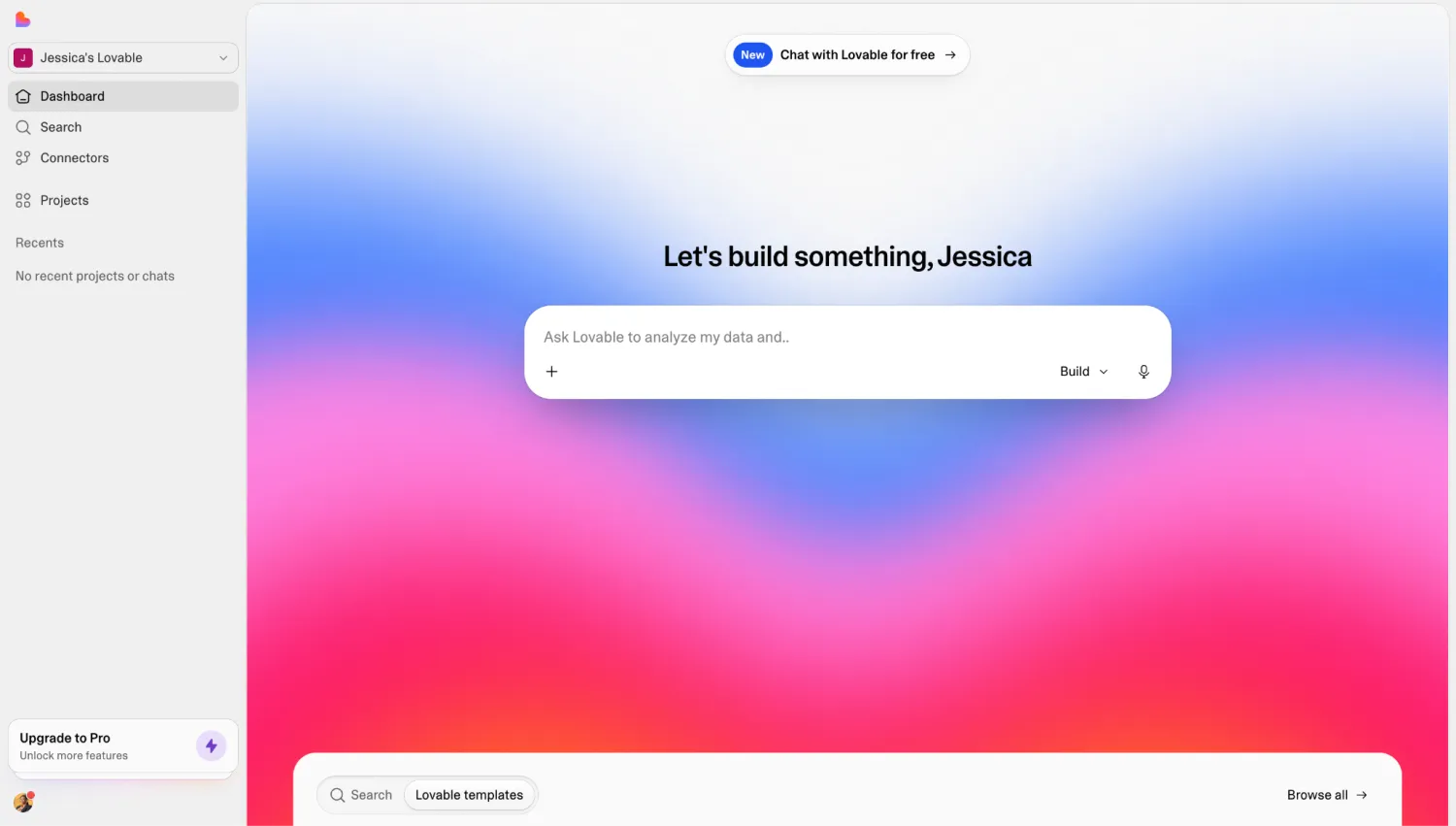
Lovable is an AI app and website builder that lets you turn your ideas into websites, prototypes, or custom internal tools. Give it a prompt, along with relevant context such as a screenshot, Figma file, Notion doc, or other source material, and Lovable creates the first version for you.
From there, tweak your app until it looks and works the way you want.
Who is Lovable best for?
Lovable is built for product managers, designers, and founders who want to test ideas quickly without waiting on engineering. Marketing teams also use it to build landing pages. HR, sales, and ops teams use Lovable to build tools like ROI calculators, dashboards, and onboarding portals.
How does Lovable work?
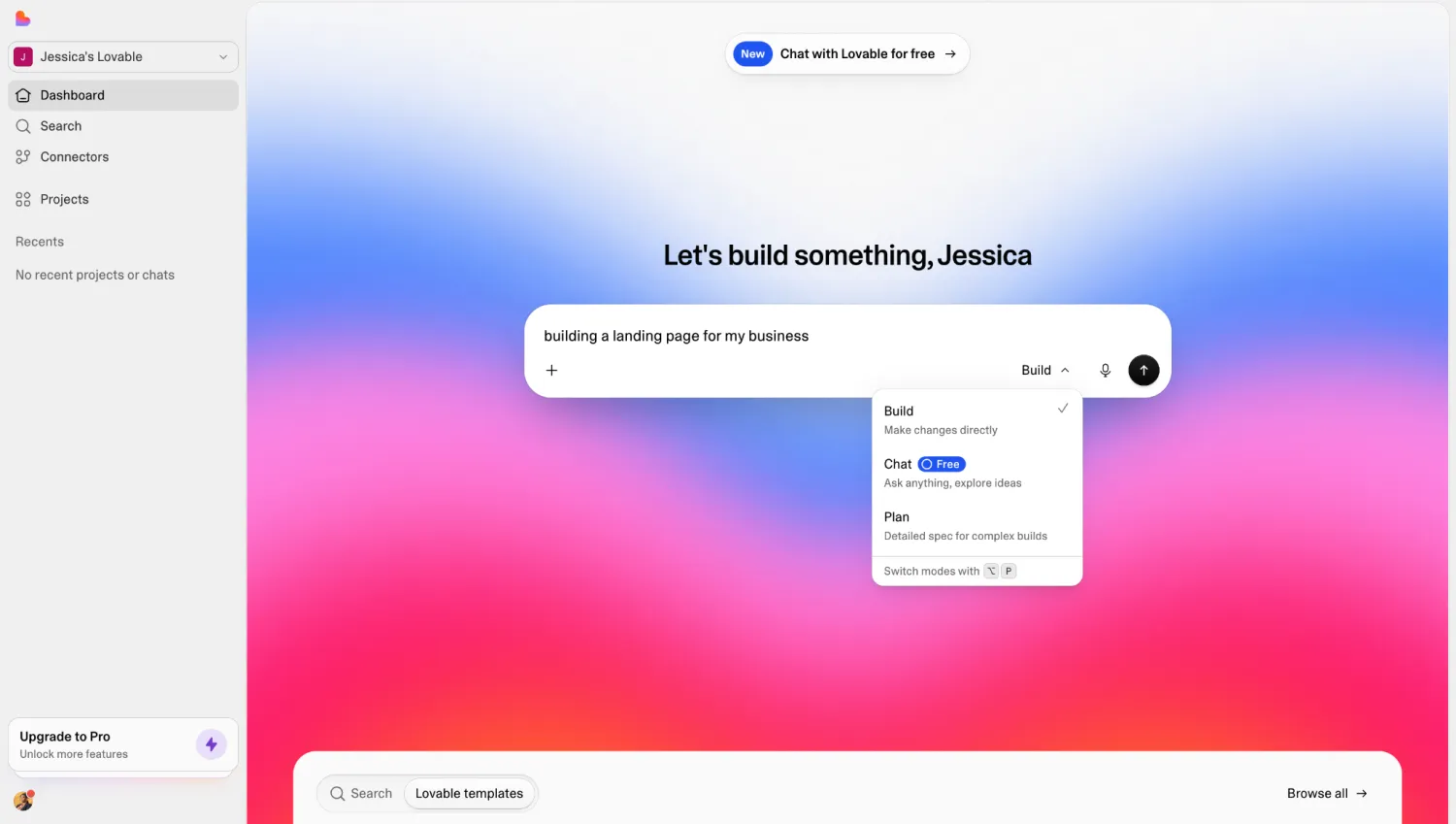
Lovable gives you three ways to work with its AI.
- Chat: Ask questions and explore ideas without changing your app. Chat is free, so it doesn't use your credits.
- Plan: Lovable maps out a detailed plan for bigger builds. You can review the steps and adjust them before it makes any changes.
- Build: Lovable starts building your app or making the changes you asked for right away.
Once your app is built, you can make changes through chat or directly in the visual editor, like adjusting layouts, colors, spacing, or copy.
For apps that need a backend, Lovable Cloud handles the database, user authentication, file storage, and real-time features without you having to set them up separately. It runs on Supabase, which uses a PostgreSQL database, and you can connect your own Supabase project instead if you'd rather manage the backend yourself.
You can also connect external services, such as Stripe for payments, and link other tools through APIs and webhooks.
If you already work in tools like Claude, Cursor, or VS Code, Lovable's MCP server lets you create, edit, and publish Lovable apps from there.
When your app is ready, you can publish it through Lovable or connect your own domain. And if you have developers on hand, they can step in when needed. Lovable projects sync to GitHub, so your technical team can access the code and keep building your app outside Lovable.
What is Replit?
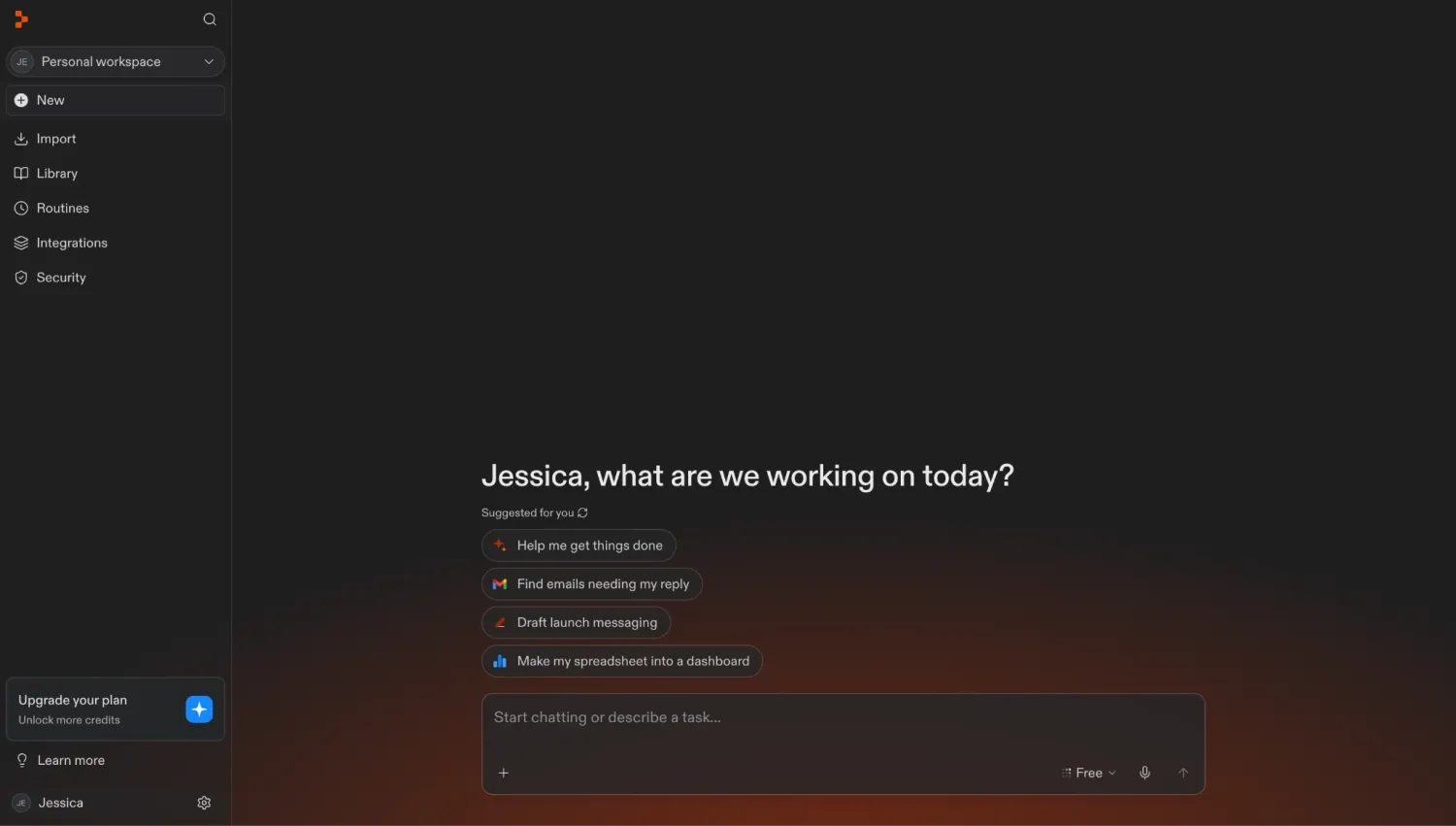
Replit is an AI app builder that lets you turn a natural-language prompt into a working website, mobile app, internal tool, prototype, or other software. You can also create slides and designs in the same workspace.
The AI can handle the coding for you, and you can open the full codebase and make changes yourself whenever you want.
Who is Replit best for?
Replit works well for collaborative teams with mixed technical skills. For example, a product manager can import a Figma design, ask Replit Agent to add the backend, and share a working version with the team. Developers can then step in to build more advanced features directly in the code.
Individual builders like founders and designers also use Replit to turn ideas into working prototypes, landing pages, and internal tools.
How does Replit work?
You start by describing what you want to Replit Agent. Then, the Agent plans the work, builds the app, and tests it in a browser as it goes. If it finds problems, it tries to fix them before showing you the result.
For more complex requests, turn on Extended Thinking to give the Agent more time to work through the task.
Once the first version is ready, make changes through chat or use the visual editor for smaller tweaks, like changing text or images. Teammates can collaborate at the same time and see each other's changes as they happen.
Replit also takes care of the technical setup behind your app. It comes with a built-in database, user authentication, file storage, hosting, and monitoring. Your development and production databases stay separate, so you can test changes before pushing them live. You can also connect outside services like Stripe, OpenAI, and other tools through integrations.
When you're ready to launch, you can publish directly from Replit, using a Replit subdomain or connecting your own domain.
What is Softr?
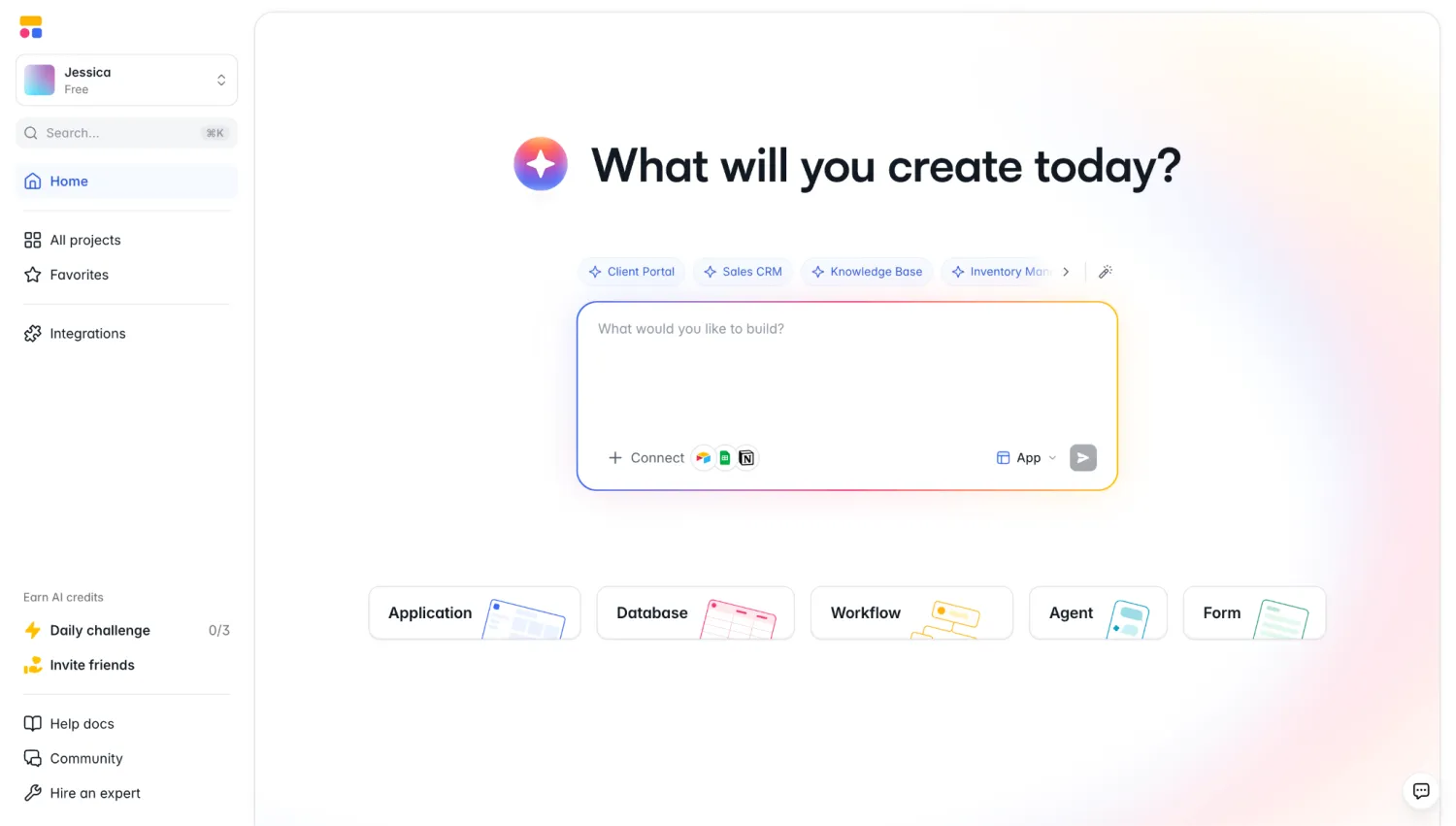
Softr is an AI-native app builder for creating and launching secure business apps. Use it for internal tools like CRMs, dashboards, and intranets, as well as external apps like client portals.
You can build your app on top of your data stored in Softr's native database. Or connect data you already use in tools like Airtable, Google Sheets, Notion, HubSpot, Supabase, and SQL databases.
Who is Softr best for?
Softr is built for business teams that need custom software but don't want to rely on developers to build and maintain it.
Ops, finance, HR, sales, and marketing teams, as well as agencies, use it to build client portals, CRMs, and internal tools that replace spreadsheets, email chains, and off-the-shelf software that doesn't match how they work. Your team can keep managing the app after launch, without needing a developer.
How does Softr work?
Start by describing the app you want, and Softr's AI Co-Builder creates the pages, database, user groups, permissions, and workflows for you.
Login, hosting, user management, and security are already built in, so you don't have to set them up separately.
After Softr generates your app, you can make changes in one of three ways:
- Ask AI to update it: Tell Softr what you want to change, such as adding a page, changing a layout, or updating who can see certain content.
- Use the visual editor: Make changes yourself by clicking into pages and blocks. You can adjust layouts, content, permissions, and other settings without using AI credits.
- Use the Vibe Coding block: For more custom features, describe what you need and let Softr generate a component like a calculator, dashboard, form, or custom widget.
If you already work in Claude, Codex, or Cursor, Softr MCP lets you build in Softr without leaving those tools. Ask them to create databases, add pages, set up user groups, build workflows, or generate custom UI.
You can also automate repeatable tasks with Softr Workflows. For example, send a notification when someone submits a form, update a record after an approval, or run a task on a schedule.
Preview the app to see if it works as intended, then publish it to a Softr URL or connect your own domain and invite users. Once your app is live, you can also add AI features like Ask AI and Softr Agents to help users get work done.
Lovable vs Replit vs Softr: Features compared
Here's how Lovable, Replit, and Softr compare across the features that matter most once your app is in daily use.
Which is easiest to use and set up?
Softr is the easiest overall for non-technical teams. You can start with AI, choose a template, or build in the visual editor.
Core features like login, user groups, permissions, and hosting are already included, so you don't have to set them up from scratch. And when you need to tweak the app, you can do most of the work through the visual editor or with AI instead of touching code.
Lovable is also easy to start with. But as your app grows, even small changes can take several prompts to get right. And a fix in one part of the app can sometimes break another feature that was already working.
Replit Agent handles a lot of the coding for you. But you're still working in a full development environment, so if you're not comfortable with code, you'll likely need someone technical to step in.
Verdict: Softr is the easiest choice if non-technical users will build and update the app themselves. Lovable is also quick to get started, while Replit works best when someone on your team is comfortable with code.
Which offers the most features and flexibility?
Replit gives technical teams the most flexibility of the three. You can access the full codebase, add custom logic, and change almost any part of the app. It also supports web and native mobile apps, so teams can build and deploy different versions of a product from the same environment.
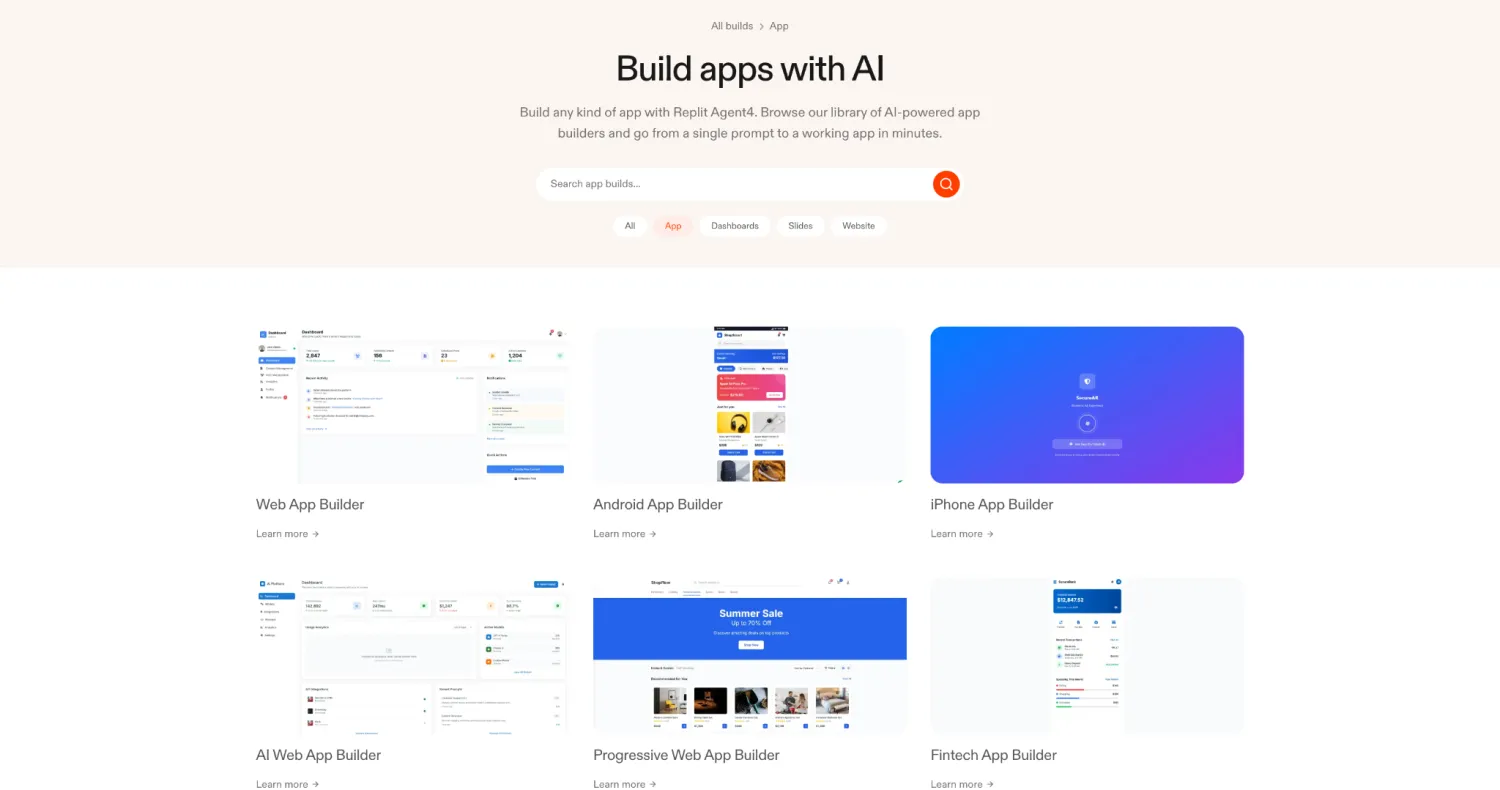
Lovable also gives you code-level freedom. Because it generates a full codebase, you can customize user flows, backend logic, and other app behavior. It has built-in payments through Stripe or Paddle, can add AI features like chatbots or AI search to your app, and builds pages that search engines can easily read, which helps for public websites.
Softr comes with more business app features built in. It gives you flexibility in four main areas.
- Where your data lives: Keep it in Softr Databases, connect Airtable or any of 21+ external data sources, or use both in the same app. With Softr Databases, Database AI Agents can also clean, enrich, and update records automatically as they're added.
- Which tools you connect: Native integrations connect your app to tools like Slack, Gmail, Stripe, and DocuSign. You can also use APIs when there's no native integration.
- How you build: Use AI, the visual editor, or Claude, Codex, or Cursor through Softr MCP. For custom features, use the Vibe Coding block or add your own HTML, CSS, and JavaScript.
- How work gets automated: Workflows and AI run on the same platform as your app, so automations use your app's data and permissions without a separate tool.
But you can't export your Softr app as code to another platform.
Verdict: Replit is the best choice when you need full control over every part of your app. Lovable offers similar code-level freedom in a more beginner-friendly builder, while Softr gives non-technical teams the most ready-to-use business features, with no code to manage.
Which handles users and permissions best?
Softr handles users and permissions best for business apps. Authentication is built in, and custom user groups and granular access controls are available on paid plans. You decide who can access the app, which pages or blocks they can see, which records they can view, and what actions they can take.
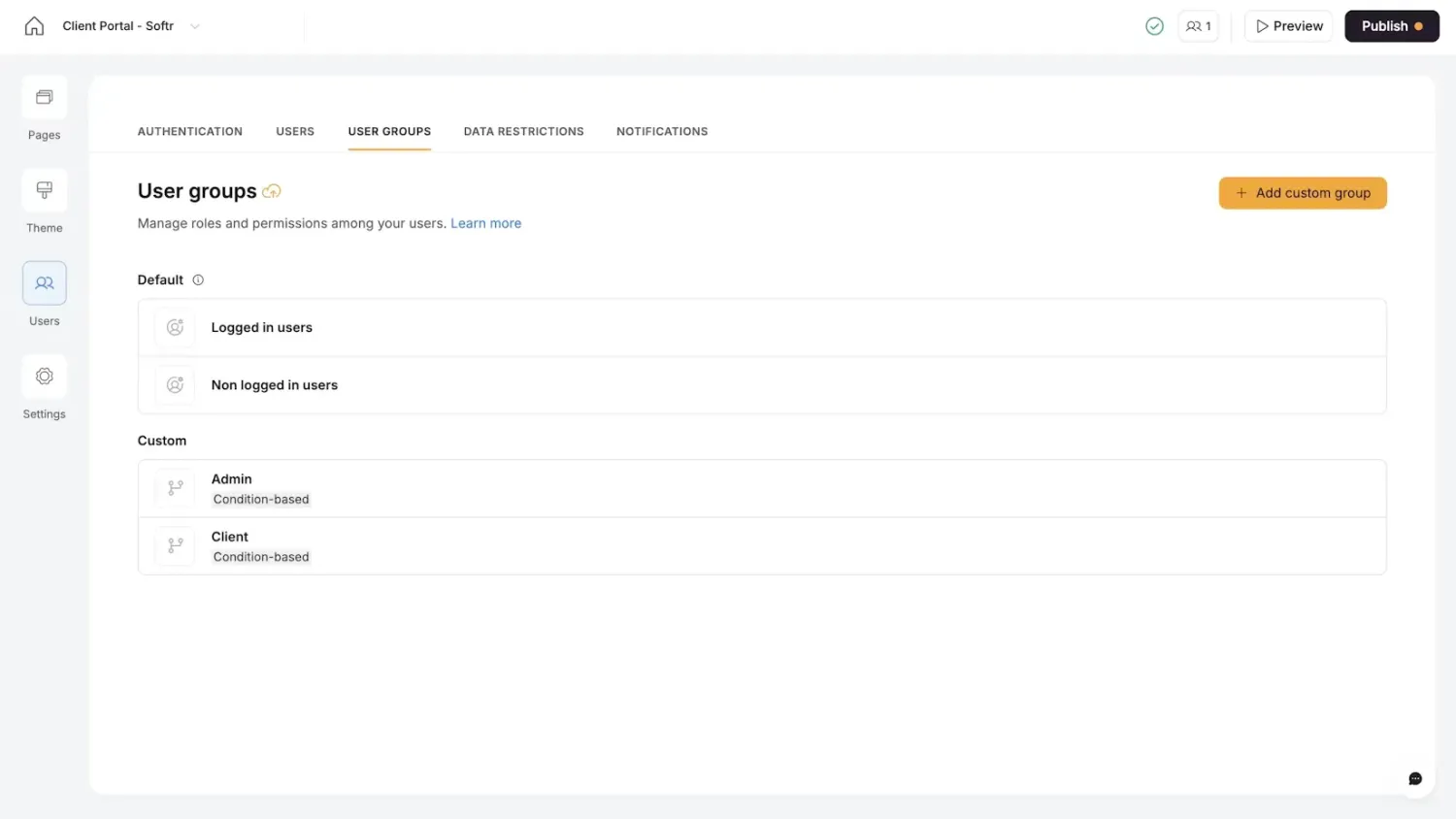
Lovable takes care of logins and user roles, but security happens at the database level. Want admins to see everything while clients only see their own data? Lovable can write those rules for you. Just be sure to test and review them before going live, especially if your app has multiple user roles.
Replit has built-in authentication, and you can write custom permission rules directly in the app's code. That gives developers on your team full control. But setting up detailed access for different users takes technical knowledge.
Verdict: Softr is the strongest option for configuring permissions without building the system yourself. Lovable and Replit also offer the freedom to create custom access rules, but that freedom depends on prompts and code.
Which has the best workflows and automation?
Softr has the strongest built-in workflow features for business apps. Softr Workflows works like Zapier or Make, but it runs inside the same platform as your app and data, so you don't need a separate automation tool.
You can describe what you want and let AI build the workflow, start from a template, or create it yourself in the visual builder.
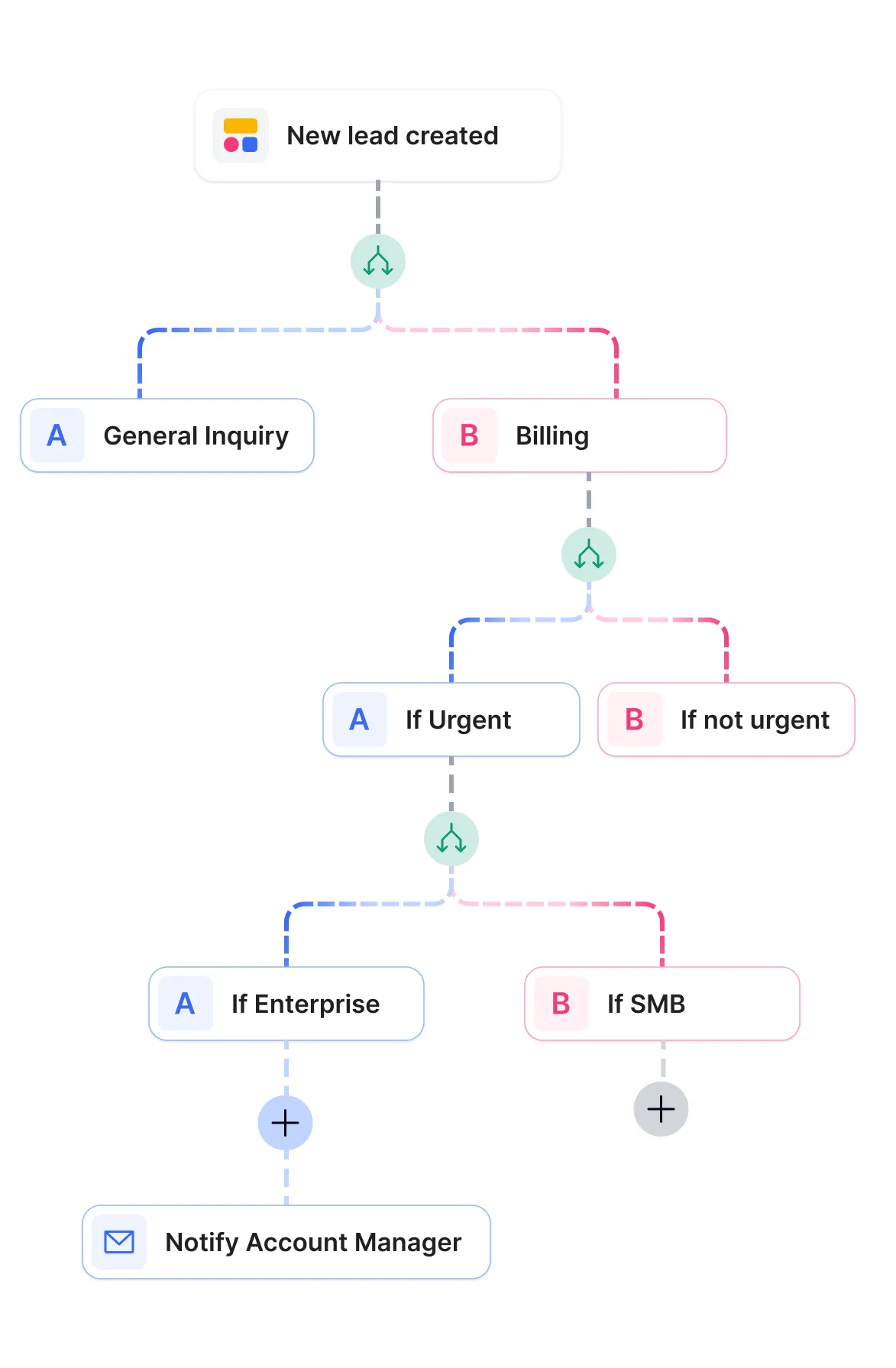
Workflows can handle more complex processes too. You can add branches, loops, filters, and wait steps, or use AI to summarize, categorize, or extract data from PDFs and webpages during the workflow.
For more advanced logic, you can add custom JavaScript or Python, or use webhooks to trigger workflows from outside tools. Each workflow also has a Runs view where you can test it and check the logs if something goes wrong.
Lovable and Replit don't have a built-in workflow builder like Softr Workflows. Instead, they write automations into your app's code. For example, you can ask either tool to send a Slack message when a new order comes in.
But Replit can run tasks on a schedule, like a weekly email, without an outside tool, while Lovable usually needs one. In both cases, the logic lives in code, so developers have full control. But non-technical users on your team may find automations harder to follow or change.
Verdict: Softr is the best option when non-technical teams need to build and manage automations themselves. Lovable and Replit can automate some tasks, but every change goes through the AI or a developer.
Which has the best AI capabilities?
Softr uses AI across more parts of the business app. Its AI Co-Builder helps with the build itself, setting up pages, databases, permissions, and workflows that you can still see and change in the visual editor.
AI also works inside your data. Database AI Agents can automatically summarize, categorize, clean, or enrich records as your data changes.
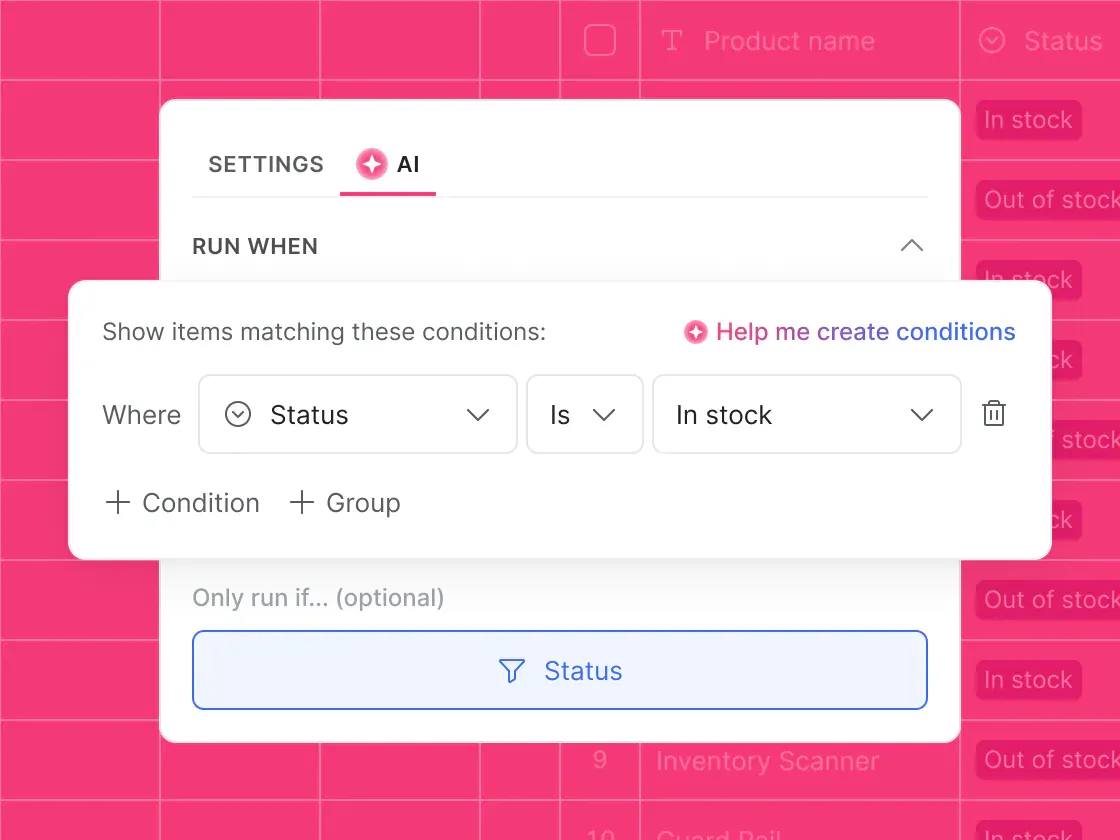
Inside the live app, Ask AI lets users ask questions about the data they're allowed to see. Softr Agents act on a user's request—like sending messages or running scheduled tasks—using the same permissions set up in the app.
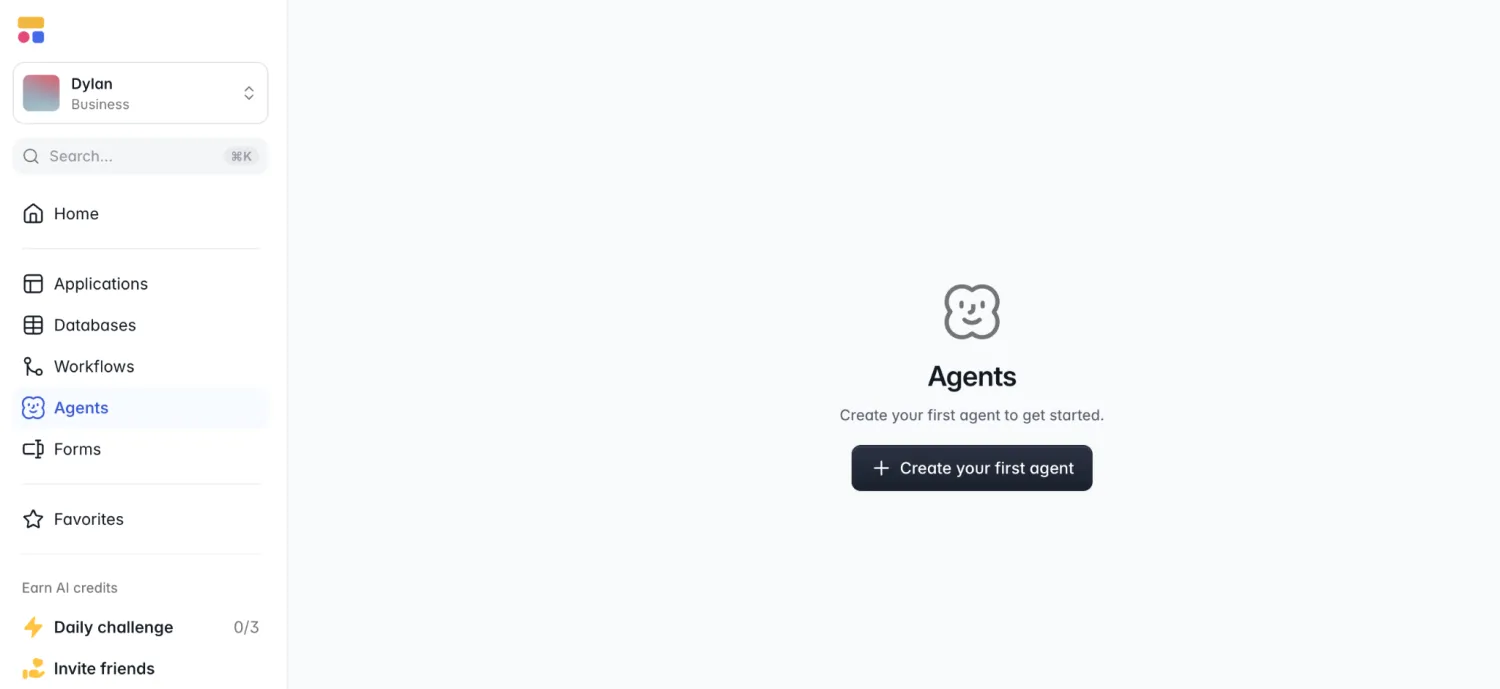
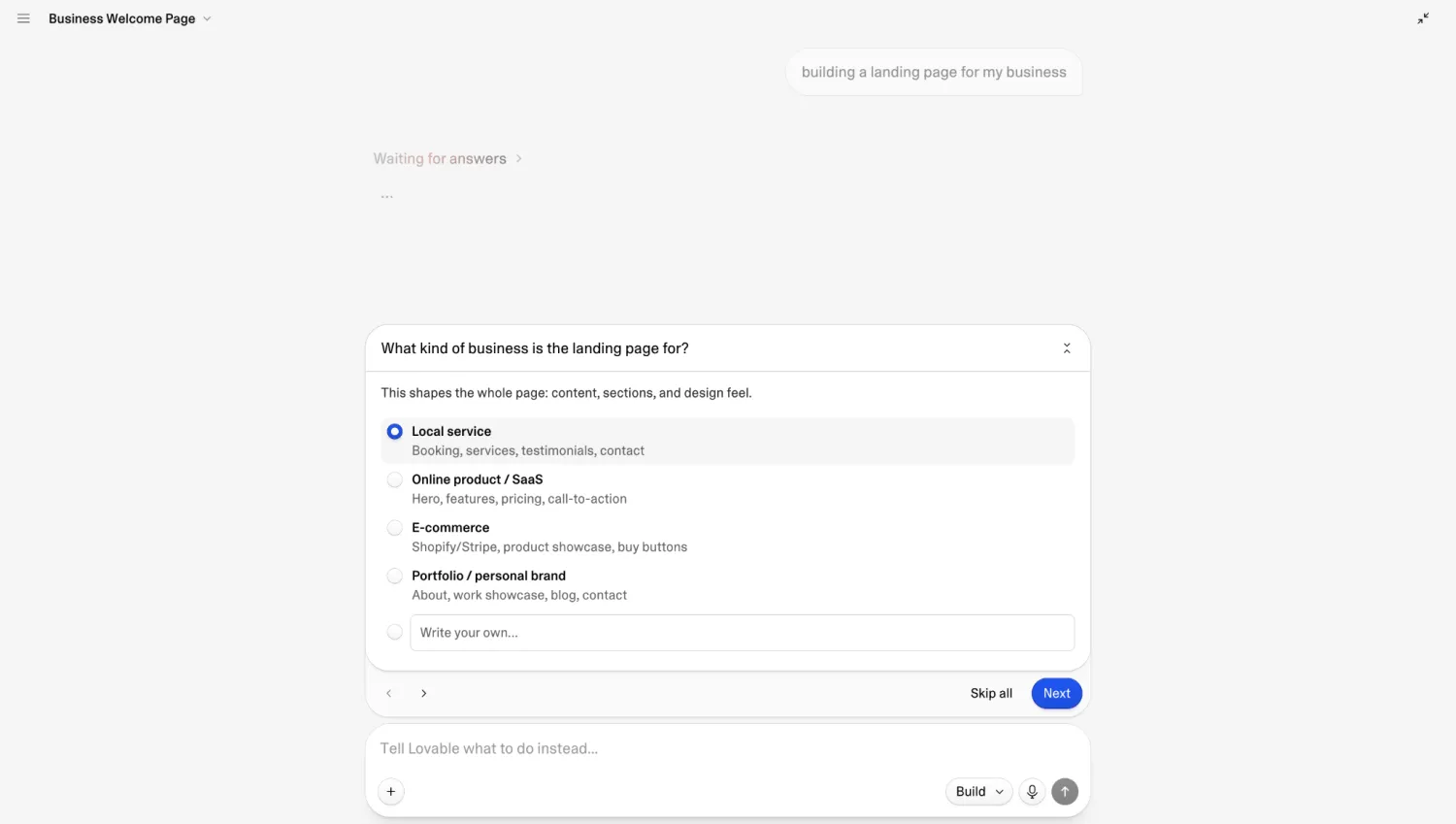
Before it starts building, Lovable's AI can ask you a few clarifying questions, like what kind of business your landing page is for, with multiple-choice answers you can pick from or skip. You can also queue several requests and let Lovable work through them in the background. Plus, it tests the app for you by clicking through it like a real user and fixes issues it finds.
Replit Agent can break a large request into smaller tasks, run several at once, and bring the results back together. Team members can also submit different tasks to the same project at the same time and review the changes before they're merged. Replit also chooses the AI model that best fits each task, and like Lovable, it tests the app in a browser, finds issues, and fixes them.
Verdict: Softr is best if you want AI working across your data, workflows, and users after launch. Lovable and Replit focus their AI on building and fixing the app, with Replit better suited to larger, more complex builds.
Lovable vs Replit vs Softr on Reddit, G2, and other reviews
Lovable holds a 4.6/5 rating on G2 and 4.2/5 on Trustpilot. Across both review sites and Reddit, users praise how quickly they can launch an app.
One Trustpilot reviewer with no coding experience said they built the basic version of their app in a single afternoon.
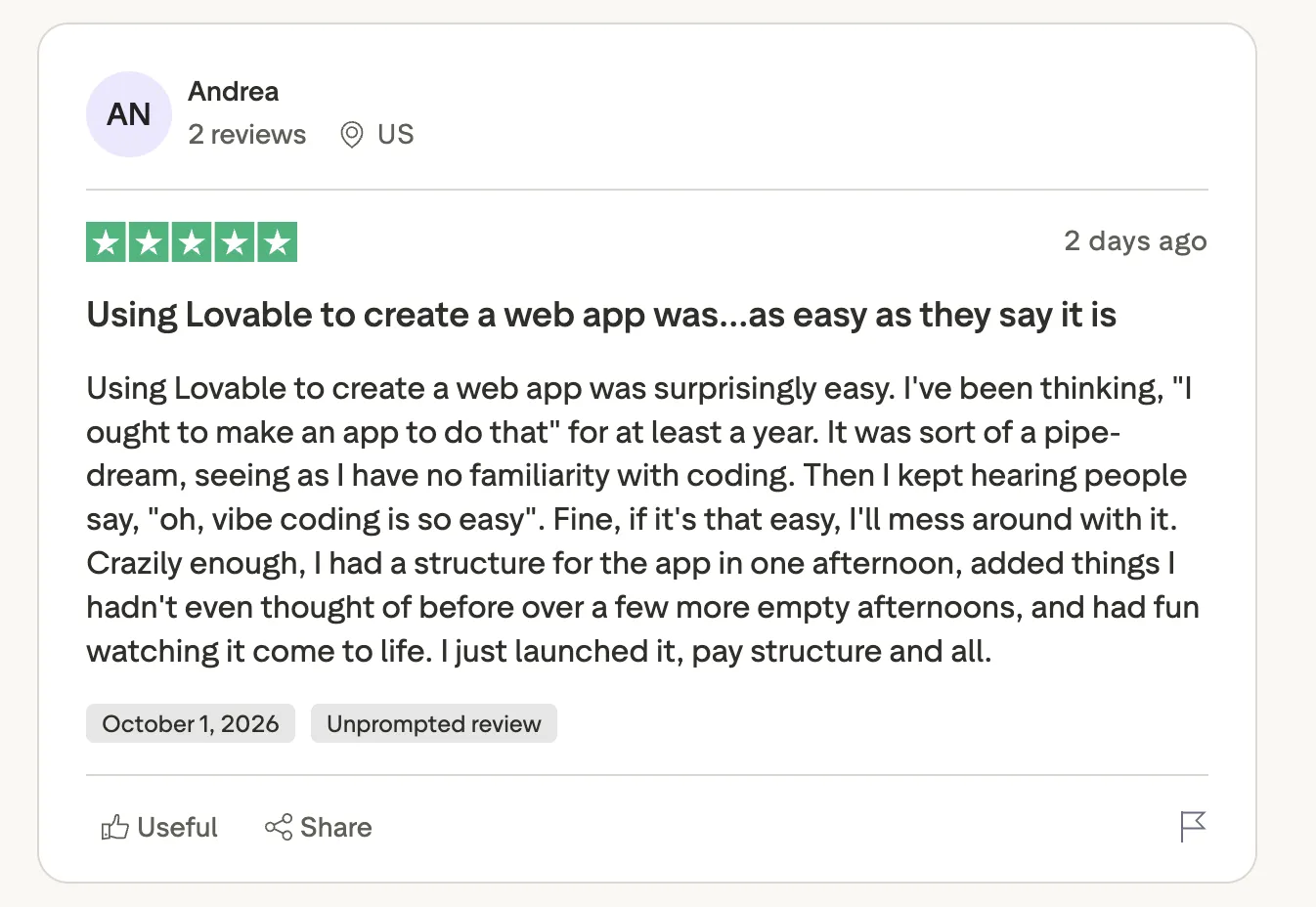
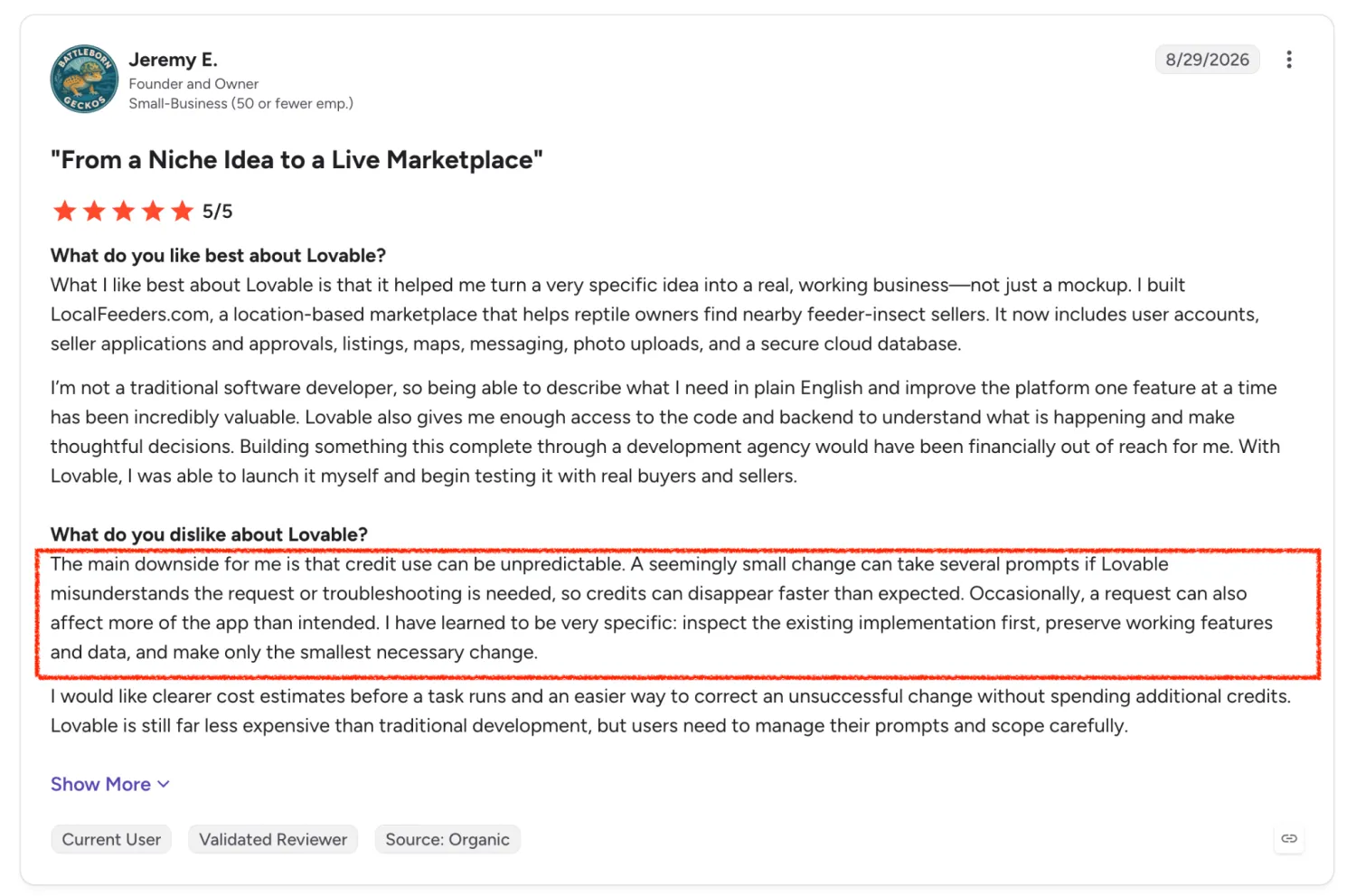
There are plenty of positive reviews like this, but complaints come up too, especially around credit consumption.
One G2 reviewer who built a local marketplace said usage felt unpredictable. When Lovable misunderstood a small change, fixing it took several more prompts, which meant credits ran out faster than expected.
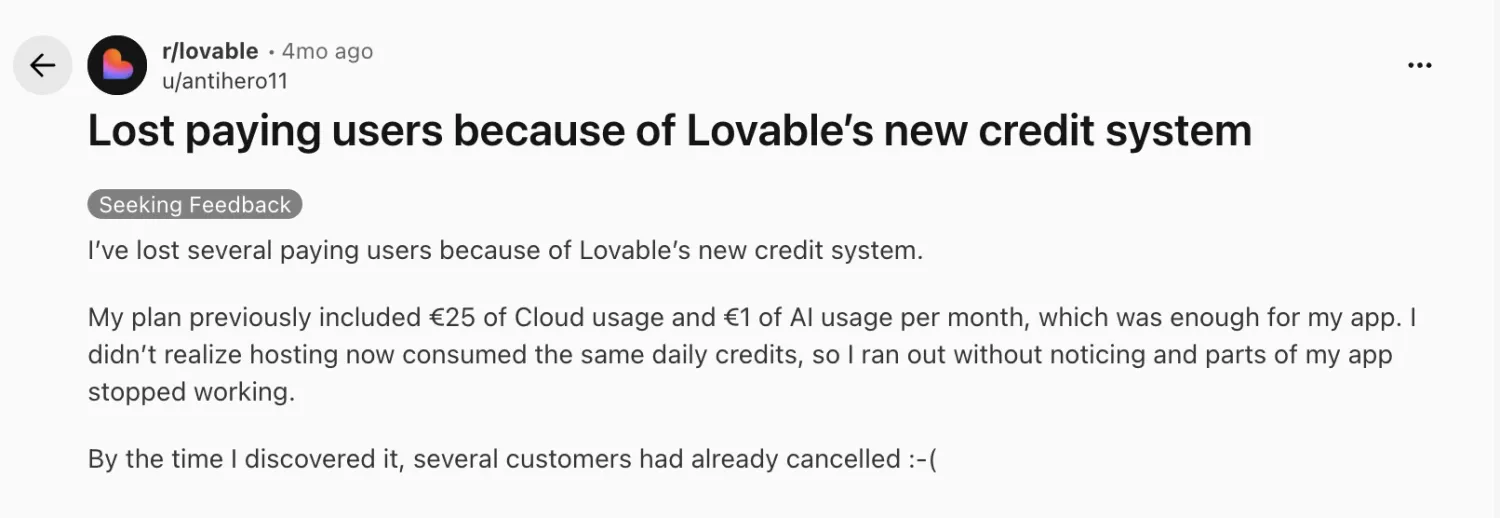
Lovable's single credit balance also caught some users off guard. A Redditor ran out of credits without realizing it. Parts of their live app stopped working, and by the time they noticed, several paying customers had cancelled.
Replit holds a 4.4/5 rating on both G2 and Capterra. Users like having coding, hosting, and deployment in one place. One Capterra reviewer said this makes it easy to share an app with others for testing, since Replit handles the setup.
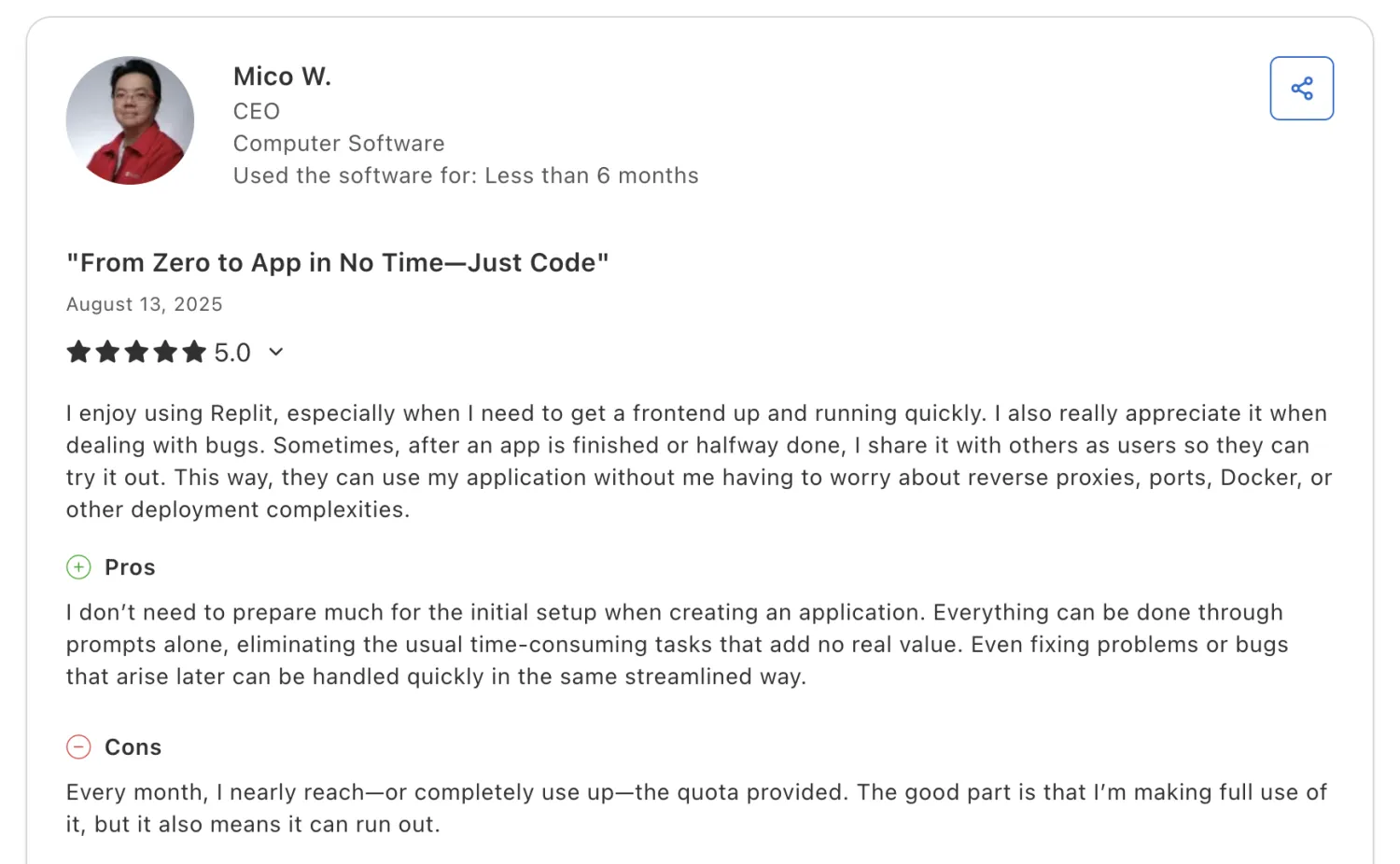
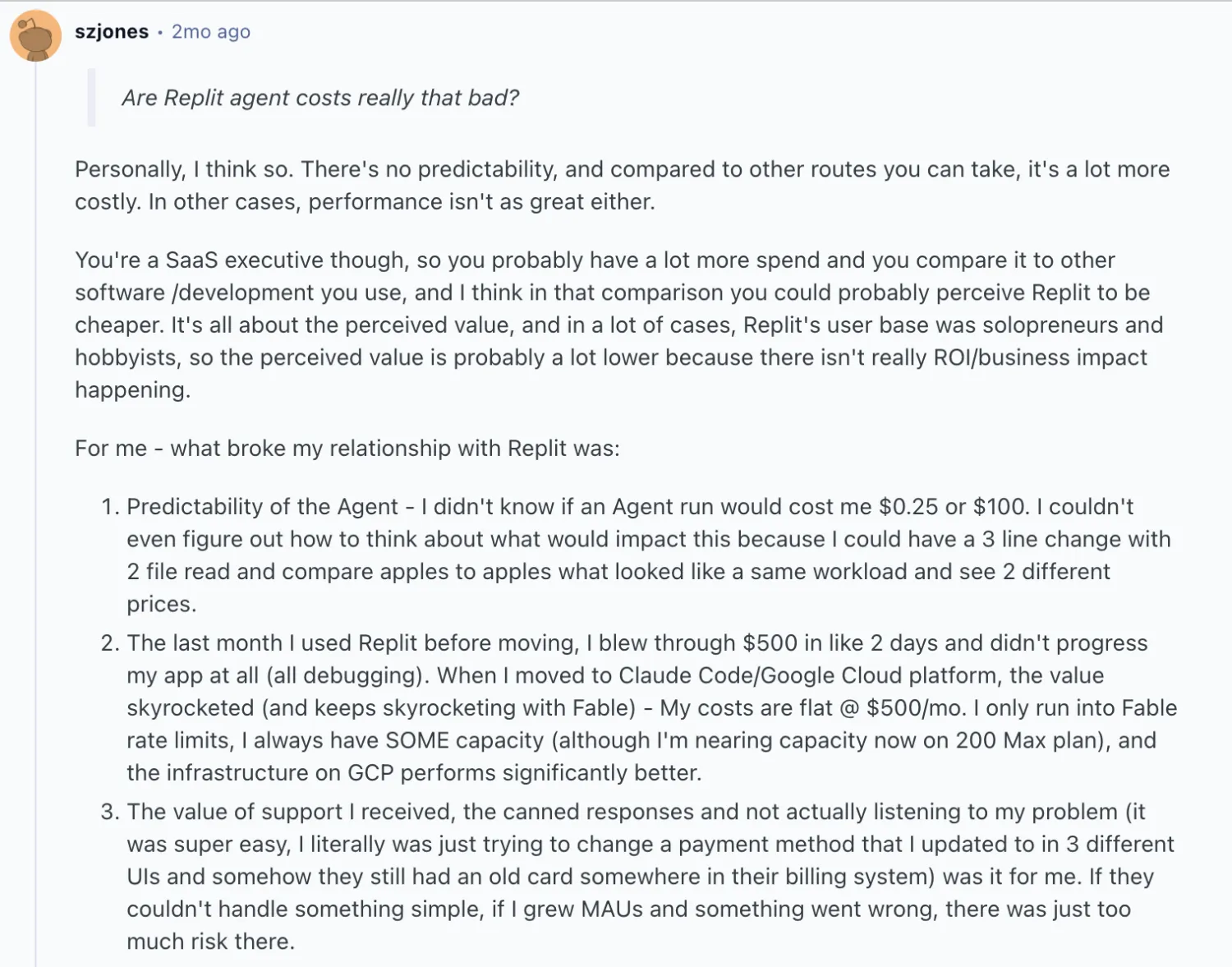
That convenience does come with some complaints, particularly around usage costs. On Reddit, one user said it was hard to predict what an Agent run would cost. In their final month using Replit, they spent about $500 in two days trying to debug their app, without making meaningful progress.
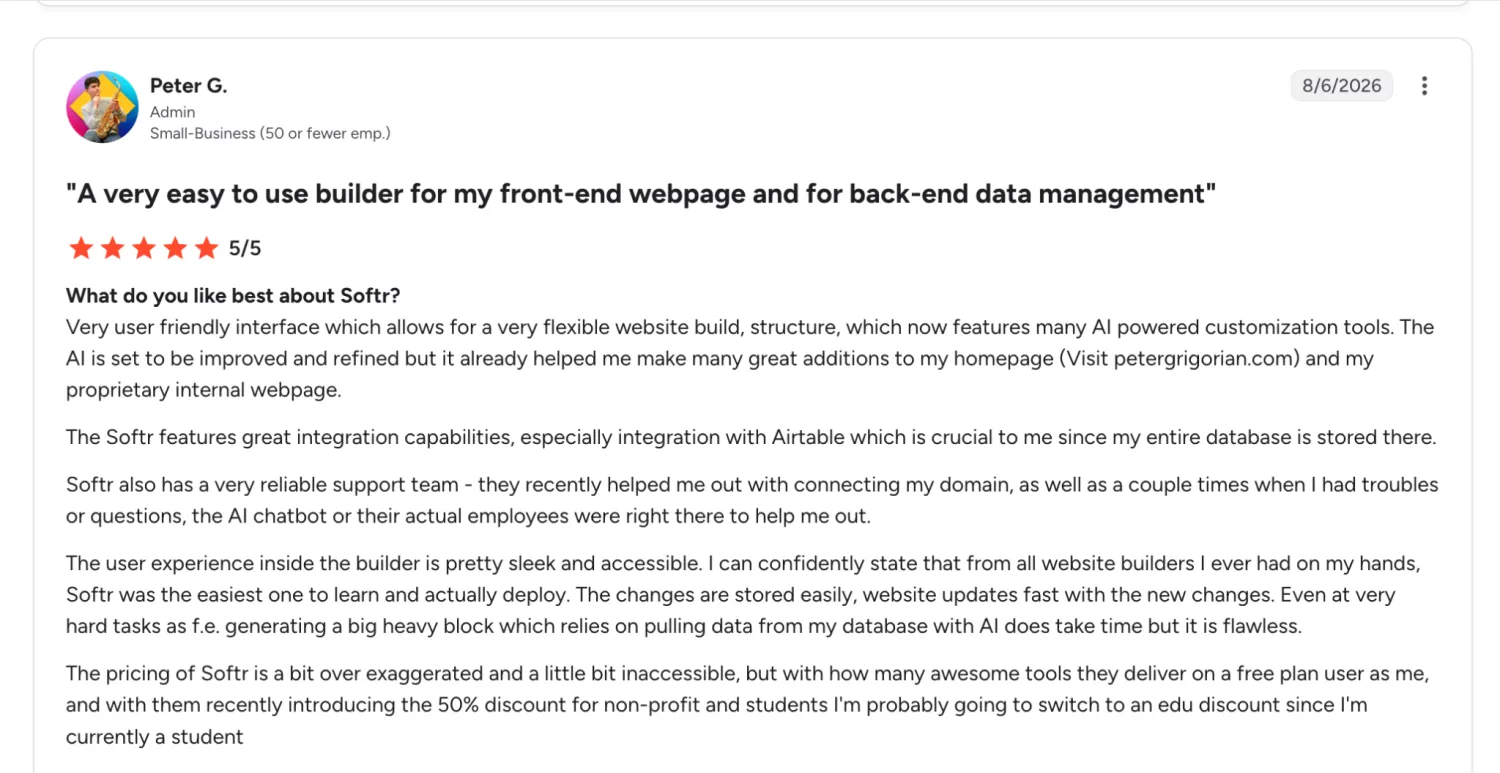
Softr has a 4.7/5 rating on G2 and Capterra. People love it because of how easy it is to use and set up. One G2 reviewer said Softr was the easiest builder they had ever learned and deployed.
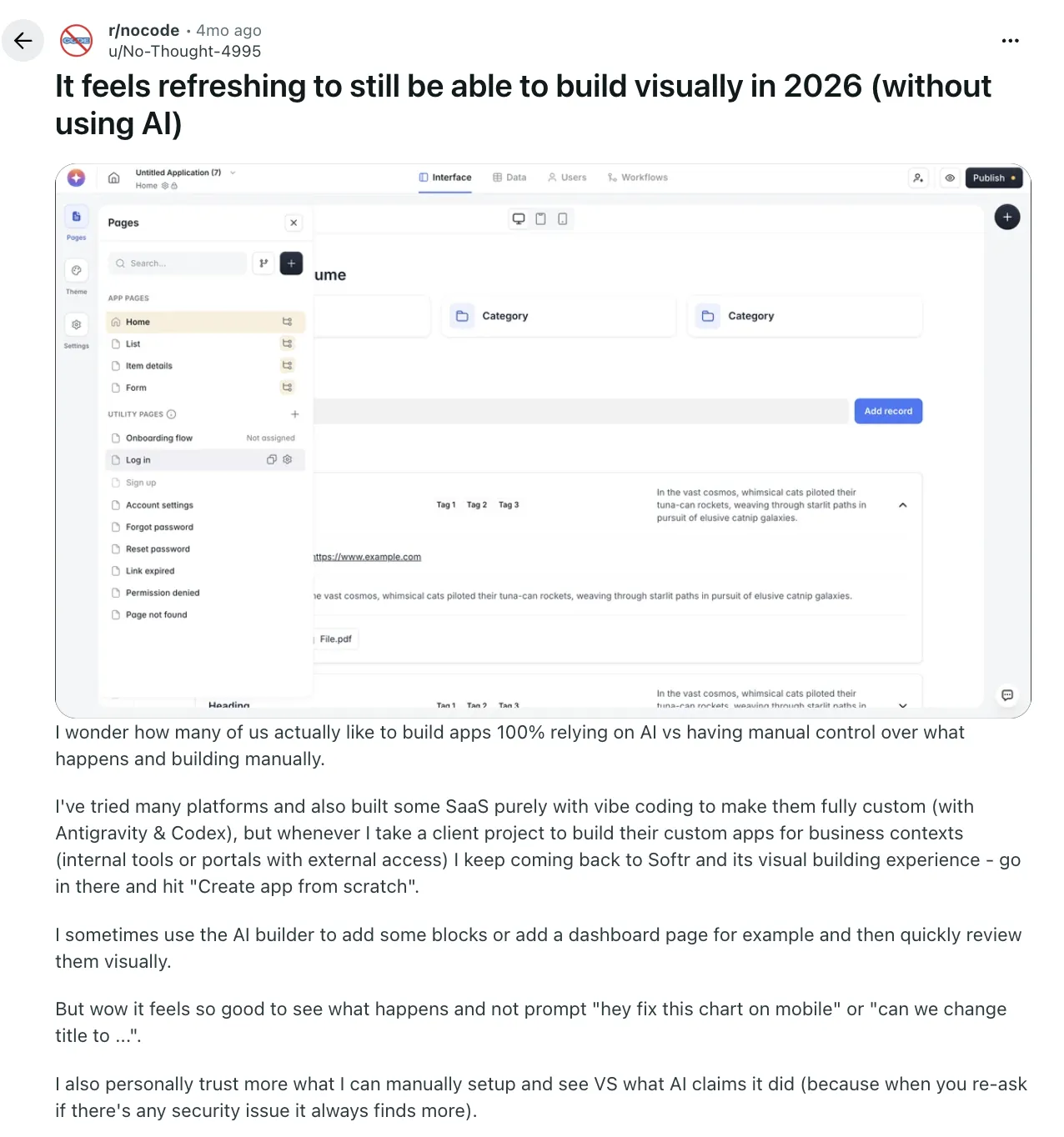
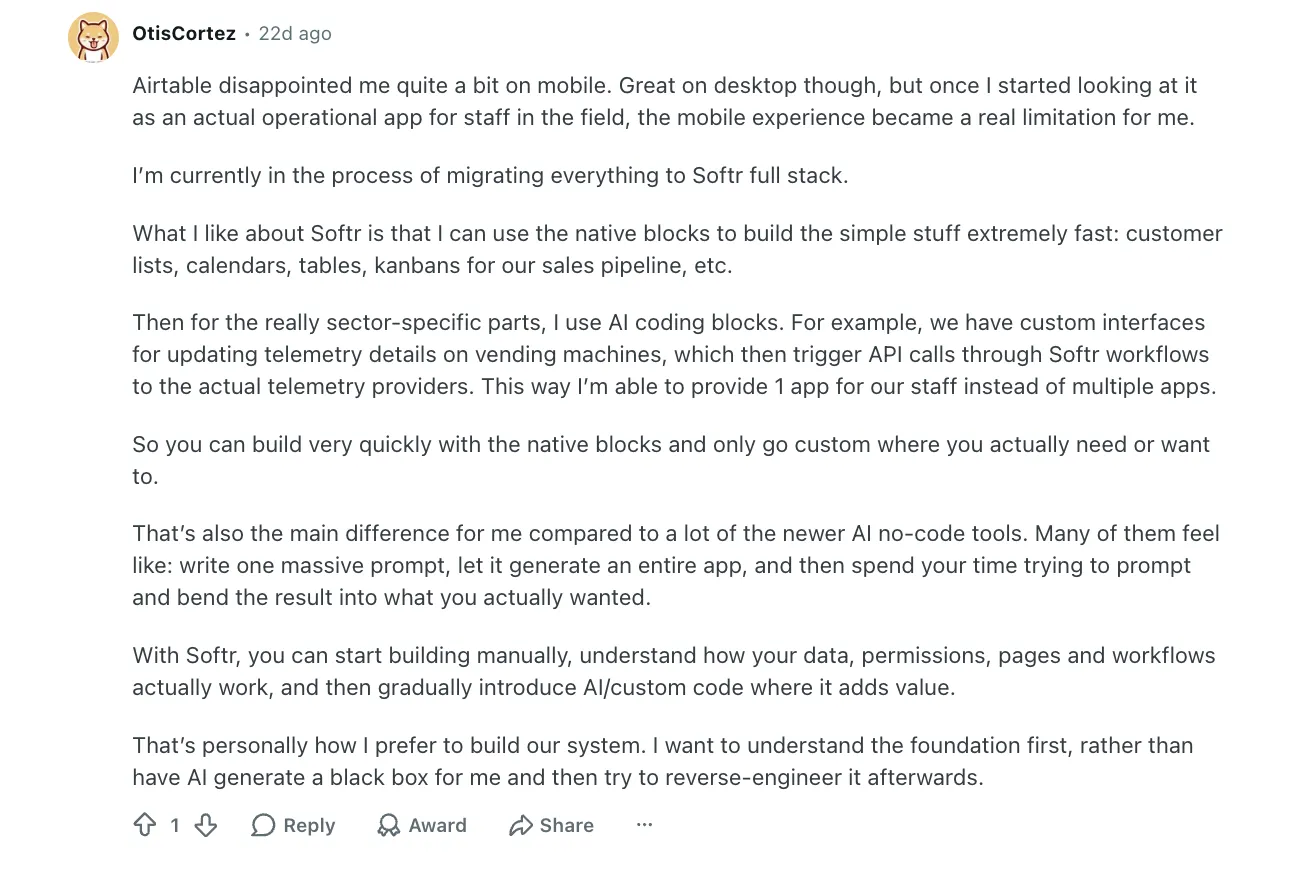
On Reddit, one user who builds internal tools and client portals said they keep coming back to Softr, even after building other apps with AI tools. They like being able to see and control changes in the visual editor, instead of asking AI to fix small things.
Another user said they're moving their company's operations to Softr from Airtable. They use Softr's built-in blocks for everyday tools, then add AI-generated custom blocks for specialist needs, like updating vending machine data. As a result, their staff use one app instead of several.
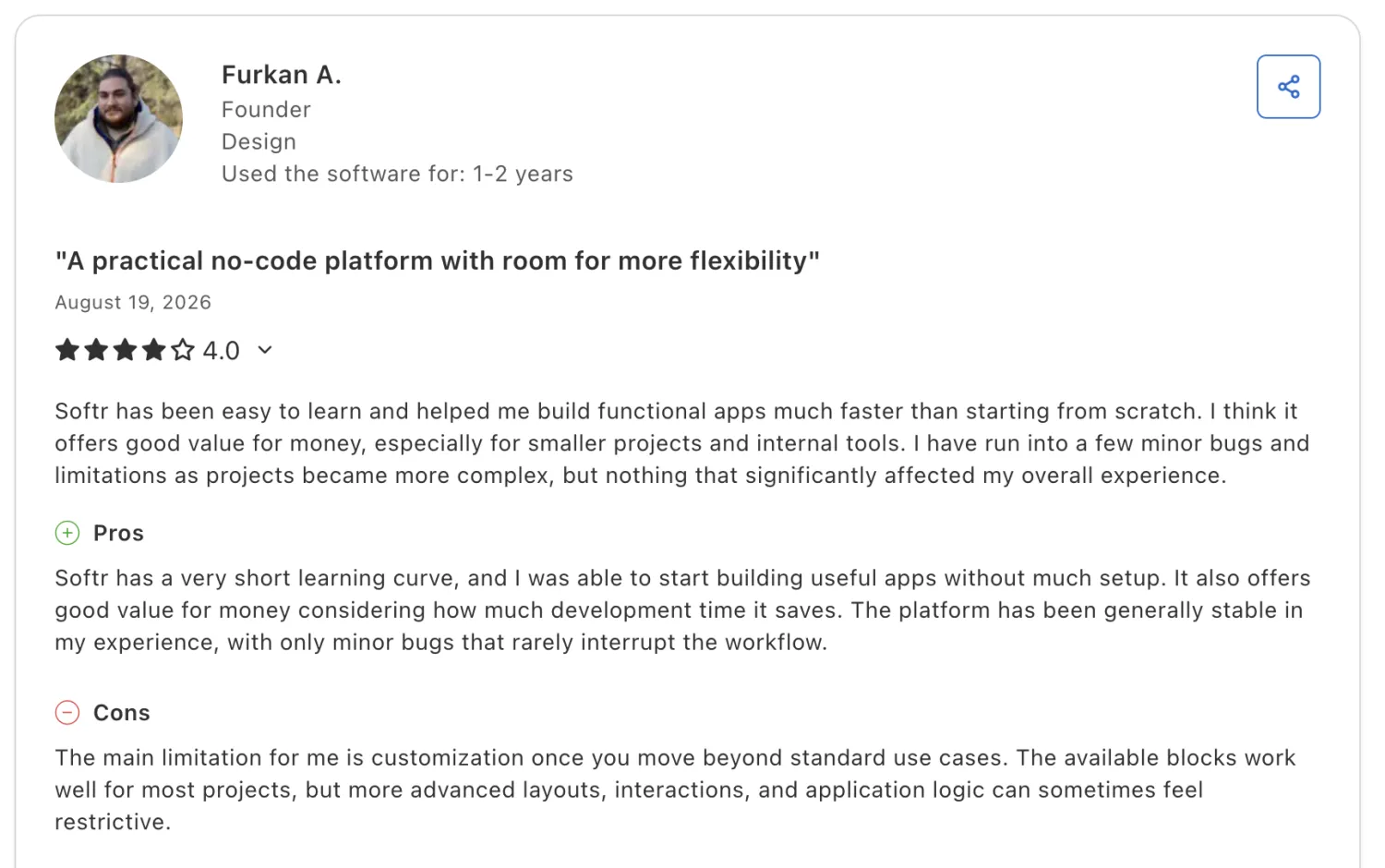
One Capterra reviewer said Softr works well for most projects, but advanced layouts and custom logic can feel restrictive.
Lovable vs Replit vs Softr: Pricing compared
All three tools let you start for free, but they charge for growth in very different ways. The prices below are monthly equivalents when billed annually.
| Lovable | Replit | Softr | |
|---|---|---|---|
| Free plan | $0. 5 build credits per day (up to 30 per month), plus small monthly Cloud and AI grants | $0 (Starter). Daily Agent credits and 1 published app | $0. Up to 3 builders, 5 app users, 5 AI credits, 5,000 records, 500 workflow actions |
| First paid plan | Pro, $21/mo. 100 monthly credits, custom domains, credit rollover | Core, $18/mo. $20 in monthly credits, Plan mode, up to 5 collaborators | Basic, $19/mo. 1 builder, 10 app users, 10 AI credits, 50K records, 2,500 workflow actions, custom domain |
| Next tier | Business, $42/mo. 100 monthly credits, team workspace, role-based access, SSO | Pro, $90/mo. $100+ in monthly credits, 10 parallel agents, up to 15 collaborators | Pro, $99/mo. 2 builders, 60 app users, 50 AI credits, 500K records, 10K workflow actions, granular permissions, custom code |
| Higher tiers | Enterprise, custom (platform fee plus usage) | Enterprise, custom | Business, $329/mo (130 app users, 100 AI credits, 1M records, 2FA). Enterprise, custom |
| What drives your bill | Credits for building, hosting, and in-app AI, all from one balance | Agent effort, plus hosting, database, and other usage | Plan limits on users, records, workflow actions, and AI credits |
| Extra usage | Credit top-ups on paid plans | Credit packs or pay-as-you-go | Extra users, builders, or AI credit add-ons without changing plans |
| If you run out | Building stops, and backend features like database, authentication, storage, and AI can stop working until you have credits again. | Apps stay live, but usage continues on pay-as-you-go unless you set a budget | AI features pause until credits reset. The rest of your app keeps running |
Lovable uses one credit balance for building your app, running its backend, and powering AI features inside it.
That means the same pool of credits pays for development and live app usage. If you spend a lot of time fixing bugs or your app gets busy after launch, those credits disappear faster.
Replit uses effort-based pricing. The more work Replit Agent has to do, the more credits a request costs.
Hosting, database activity, and other services also count toward usage. Once your credits run out, Replit keeps running on pay-as-you-go rates. You have to set a spending limit to avoid surprise bills.
With Softr, your monthly price is set by your plan. Each plan includes a fixed number of builders, app users, records, and workflow actions, so you can see when you're getting close to needing more.
Each plan also includes a monthly allowance of AI credits. These are used by Softr's AI features, like the AI Co-Builder, Ask AI, Softr Agents, and AI steps in workflows. Editing in the visual builder and running your live app don't use AI credits. If you run out, those AI features pause until next month or until you buy more, but your app, data, and non-AI workflows keep working.
You can also build through Softr MCP from tools like Claude without using Softr AI credits, unlike Lovable's MCP that draws from your credit balance.
Which works out cheaper? Softr, for most business apps. All three have free plans, and paid plans start at $18 a month for Replit, $19 for Softr, and $21 for Lovable, billed annually. Lovable and Replit charge credits for building, hosting, and in-app AI, so every fix and all app traffic add to the bill. Softr's price is fixed by your plan, and editing in the visual builder, building through MCP, or running the live app doesn't use AI credits.
Lovable vs Replit vs Softr: Which should you choose?
Each tool is built for a different kind of project and team, so the right choice depends on what you're building and who will maintain it.
Choose Lovable if...
- You want to turn an idea into a working prototype or MVP quickly.
- A custom design matters for your first version.
- You plan to hand the code to developers later.
- You're comfortable keeping an eye on credit usage as your app grows.
Choose Replit if...
- Someone on your team is comfortable working with code.
- You're building a complex product, like a SaaS tool or marketplace.
- You need web and mobile versions of the same app.
- You want several people or AI agents working on the same project at once.
Choose Softr if...
- You're building a business app like a client portal, CRM, or internal tool.
- Non-technical team members will build and maintain it.
- Different users need to see different data.
- Your IT team needs a secure, governed place to deploy the apps employees build with AI.
- You want your data, workflows, and app in one place, including data you already store in other tools.
- You want costs you can plan for as more people use the app.
Still not sure? All three have free plans, so the best way to decide is to try building the same small project in each one.
Try Softr for free and turn your workflow into a working business app.
Frequently asked questions
Is Lovable better than Replit?
Is Softr better than Lovable or Replit for business apps?
Which is easiest to use among Lovable, Replit, or Softr?
Can I export my app's code from Lovable, Replit, or Softr?
Can I build with Lovable, Replit, or Softr from Claude?