Sales teams: How to convince your manager about using no-code


[.blog-callout]
TL;DR
- Pitch no-code to your manager the way you'd pitch a deal: understand their priorities, quantify the value, and handle objections before they come up.
- The strongest argument is the math: automating small inefficiencies (data entry, reporting, follow-ups) adds up to tens of thousands of dollars a year, and real customers report savings like $6,000/month and 58% cost reductions.
- Build a small working demo before the meeting. Platforms like Softr let you generate a working CRM or lead tracker in hours with the AI Co-Builder, then refine it visually.
- After approval, lock in momentum with quick-win projects, team training, and a longer-term roadmap. [.blog-callout]
Hey Sales Ops, let's cut to the chase. We've got a big task ahead: convincing the higher-ups to adopt no-code. "No-code, really?" you might ask. Yep, that's right! While it's often framed as something for the IT crowd, it's just as transformative for sales teams.
No-code is like having a blank canvas and a box full of colors, but without the need to be Picasso to create a masterpiece. It's about building business apps and internal tools without writing a single line of code. And the best part? You're in the driver's seat.
But the road to getting the green light for no-code isn't always smooth. It's a bit like selling a product: your manager's the customer, and you've got to close the deal. Your pitch needs to be bang on. Don't fret, though, we're here to help you plan it all out.
This post is your roadmap. We'll delve into understanding your manager's mindset, framing the no-code value proposition with real numbers, leveraging customer success stories, and tailoring the pitch to address specific sales pain points. And if you want something concrete to show before the meeting, grab our free sales CRM template as a starting point.
How to make the case for no-code with your sales manager
Understand your audience
Got a manager who's all about the bottom line? Or one who's more focused on innovation and efficiency? Understanding your manager's mindset is step one to a winning no-code pitch.
First, let's dig into their priorities. Are they always hunting for cost-saving measures? Do they constantly seek out tools that improve team productivity? Or perhaps, they are passionate about customer experience? Their priorities will be your guiding stars in shaping your no-code pitch.
Next, consider their pain points. What challenges keep them up at night? Is it a struggle to get tools customized for your team's needs? Or maybe it's the long wait times for IT to create or modify tools? Identifying these problems will make your no-code pitch more relatable and potent.
Last but not least, anticipate their objections. Do they fret about data security? Are they skeptical about whether no-code tools can run real, day-to-day operations? Knowing their likely pushbacks upfront allows you to prepare convincing counterarguments.
All in all, to make a compelling case, you need to step into your manager's shoes. See the world from their perspective. Once you've got that, you're well on your way to a compelling no-code pitch.
Frame the no-code value proposition
When it comes to making a big splash with no-code, think small... in a big way. What does that mean? Well, we all know how budget talks usually go. If an IT solution doesn't promise sky-high returns (say, upwards of $100k), it's often brushed aside. But what if you could rack up those big numbers by addressing the myriad of smaller, yet cumulatively significant inefficiencies? Enter the world of no-code.
See, traditional IT overhauls demand heavy cash injections. And often, the reward doesn't justify the risk for those smaller-scale issues. But no-code flips the script. It thrives in finding and fixing those "insignificant" gaps that could save you $20k here or $30k there. Small potatoes individually, maybe, but they add up pretty quickly.
Take this example: a sales team of 10 spends about 5 hours a week each on manual data entry, a task a well-designed no-code tool could automate. Even assuming a modest hourly cost of $25 per employee, that's $1,250 a week. Multiply that by 52 weeks, and you've saved over $60k in a year on this task alone. Now think about all the other efficiencies you could gain across the sales process. Suddenly, those "small" savings don't seem so small, do they?
These aren't hypothetical numbers, either. Legal tech company EvenUp replaced per-seat tracking software with a Softr internal tool used by 340+ employees and contractors, saving roughly $6,000 per month, and built the first version in about 24 hours. Marketing agency Strupek cut operational and software costs by 58% and recovered 8 to 10 hours per week previously spent on manual reporting.
But the no-code value proposition isn't just about cost savings. It's also about speed and flexibility. Traditional IT projects can drag on for months if not years. With a platform like Softr, you can describe what you need and the AI Co-Builder generates a working app (database, interface, and logic included) that you refine and put into production within days. You're saving not just money, but also time, a precious commodity in the fast-paced world of sales.
In essence, the key to selling no-code is to show how it thrives where traditional IT approaches falter. It's about making the case for a multitude of "small" wins that together pack a significant punch.
Leverage success stories
Who doesn't love a good success story? They're inspiring, convincing, and real. No-code has plenty of these, and they're a powerful tool in your persuasion kit.
Consider Elite Retirement Alliance, which builds white-label sales CRMs for financial services clients. Using Softr, they launched custom portals in hours instead of weeks, supported 140+ users across active projects, and doubled CRM adoption with branded tools tailored to each client. Or take this G2 reviewer from the construction industry, who replaced an overpriced industry CRM entirely:
"In roofing, there were not many good CRM options, except for one that cost thousands of dollars a month. Instead, I used Softr to build our own CRM that rivals the expensive ones. I do not pay for features I will not use, and simply build the ones I want, exactly how I want them." - Verified G2 reviewer, Construction (Small-Business)
You can find a wealth of similar stories across industries, each highlighting a unique aspect of no-code's potential. So, dig in. Find examples that mirror the challenges in your organization, and the stumbling blocks that slow down your sales team. Seeing real-world applications and their results can bring your pitch to life.
Just remember, while sharing these success stories, tailor them to your team's context. Sure, a multinational saving a million dollars sounds impressive, but how does that relate to your operations? Instead, focus on the outcomes: the time saved, the processes streamlined, the flexibility gained.
Connect to sales-specific needs
Here's where you make it personal. Every sales team has its share of headaches. Late-night data entries? Unorganized customer databases? Slogging through spreadsheets to generate reports? Yep, we've all been there.
No-code has a solution for each of these and more. The magic lies in highlighting these fixes, making your sales team see how no-code can ease their specific pain points.
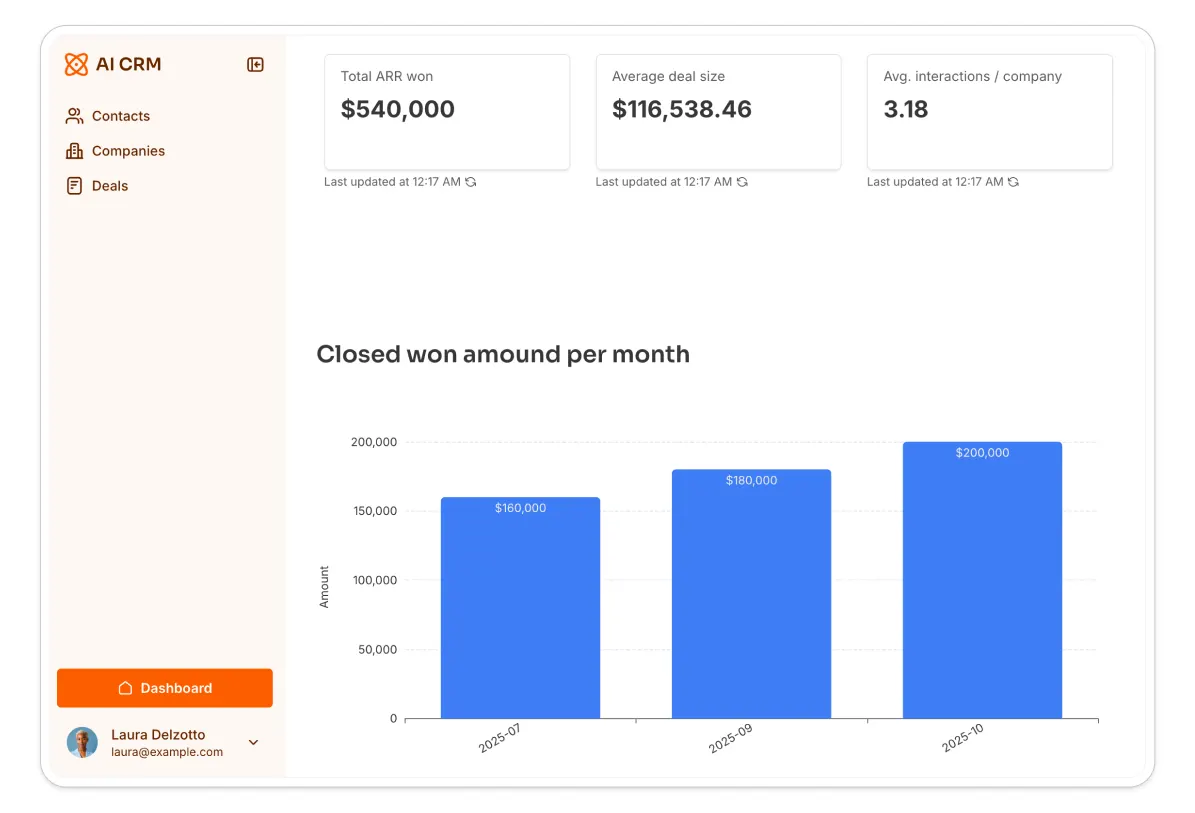
Say your team struggles with tracking leads across platforms. Show them how a custom no-code CRM can consolidate all lead information in one place, ensuring no lead falls through the cracks. In Softr, your data lives in Softr Databases, or connects to the tools you already use: HubSpot, Airtable, Google Sheets, and 17+ other data sources, including a REST API connector.
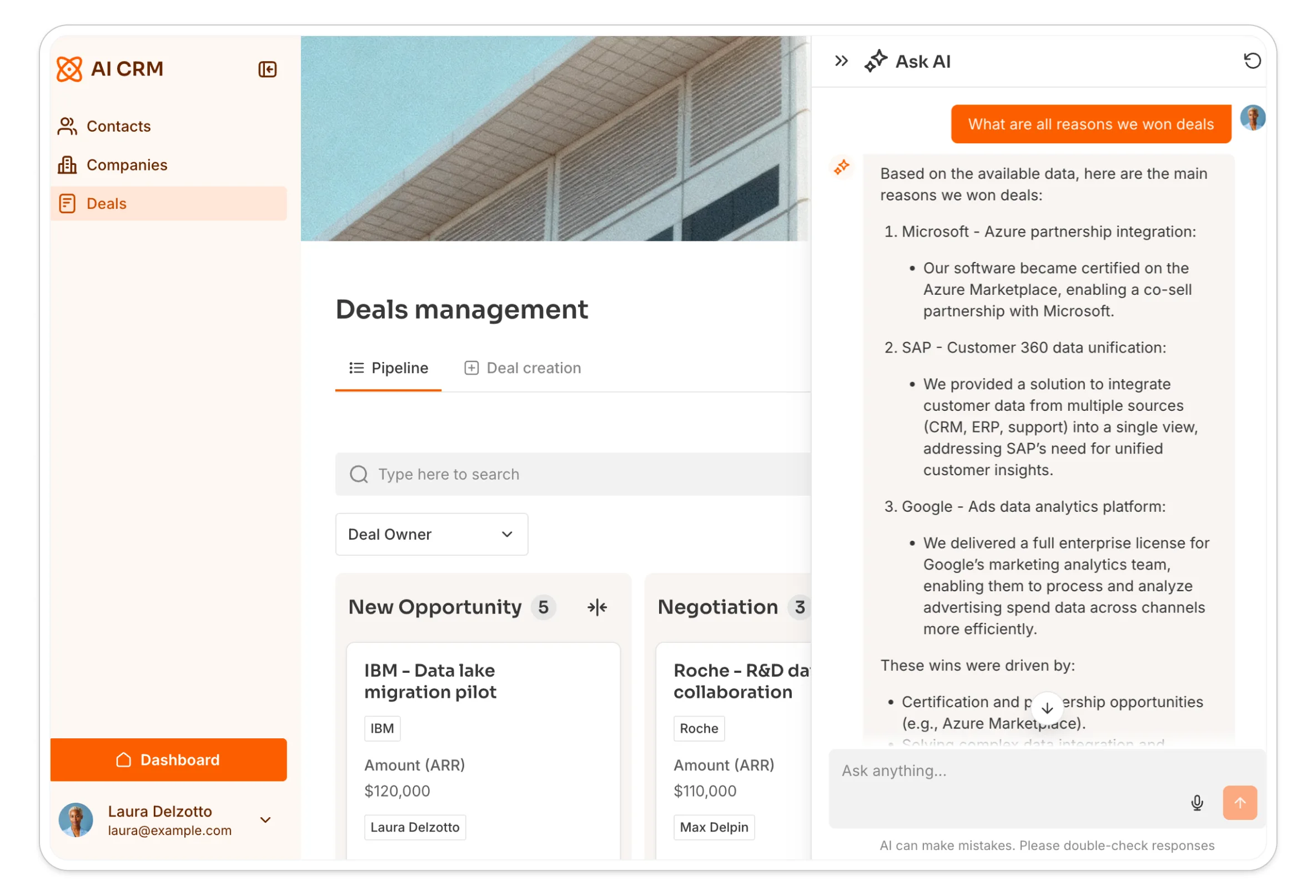
The AI layer is where the pitch gets really compelling for a sales audience. Database AI agents can automatically enrich new leads with firmographic data (industry, company size, description) the moment a record is created, so reps stop researching and start selling. And with Ask AI, anyone on the team can query the pipeline in plain language ("which deals over $10k haven't been touched in two weeks?") instead of building reports.
Or maybe the team spends too much time generating sales reports and follow-ups. Demonstrate how Softr Workflows can automate this directly inside the app, triggered by the buttons and forms your team already clicks (a new lead lands, a Slack notification fires, a follow-up task gets created). The numbers back this up at the industry level too: 88% of early AI agent adopters report positive ROI on at least one generative AI use case, according to Google.
In essence, tie the capabilities of no-code directly to the needs of your team. Make it about them. After all, who wouldn't want a solution custom-made to make their life easier?
Demonstrate its potential
Now, you've laid out the theory, but seeing is believing, right? One of the most powerful ways to sell no-code is to put it into action. A live demonstration can showcase its simplicity, power, and potential impact on sales operations.
Start small. Choose a simple process that your team deals with regularly, maybe it's updating customer information, tracking leads, or scheduling follow-ups. Then build a solution that simplifies this process. The fastest path: describe what you need to Softr's AI Co-Builder and it generates a complete app for you, or start from our sales CRM template and customize it to your process. Once your masterpiece is ready, walk your team (and the manager) through it. Let them see the before-and-after, experience the ease and efficiency first-hand.

The goal here is not to build the ultimate tool (not yet, anyway), but to demonstrate what's possible with no-code. It's about planting a seed and letting your team imagine how no-code could change the way they work. And these demos have a habit of growing into real systems:
"It started off as a simple CRM database, but then it grew into an influencer management system with a portal, and now tracking and dashboarding. It is just now an end-to-end system... and we can do the entire thing within Softr." - Shiran Brodie, Head of Marketing at Softr
Overcome objections: anticipating and addressing pushbacks
Even with a well-reasoned pitch and strong evidence of no-code's potential, you may face some resistance. Sales managers, like many professionals, often have reservations about adopting new technologies, particularly if they believe it may disrupt established workflows or require significant training. Here are some common objections you might encounter and strategies to address them.
"No-code is too simplistic."
Many might argue that no-code platforms lack the depth and versatility of traditional programming. While it's true that no-code cannot entirely replace coding in all contexts, for most sales operations it doesn't need to. Modern platforms are full-stack: Softr gives you the interface, a native database, and workflow automation in one place, with user permissions and role-based access built in. Sales teams aren't usually developing complex software; they're running operations, and that's exactly what these platforms are built to handle in production, day after day.
"Our team doesn't have time to learn a new system."
Learning new technologies can be daunting, but remind your manager that the learning curve for no-code is far lower than traditional coding, and AI assistance lowers it further (you can describe changes in plain language and let the AI Co-Builder make them). Besides, the time investment upfront will likely pay off in hours saved down the line. You might suggest setting up training sessions or offering resources to help your team get up to speed.
"If it's that good, why isn't everyone using it?"
The relative newness of no-code can make it seem less credible. While many companies are already leveraging its benefits, others might still be unaware or skeptical of its capabilities. Counter this argument with the success stories you've collected and reinforce that adopting no-code can provide a competitive advantage. This is also where third-party evidence helps:
"Softr allows me to deliver business apps in a few days where a custom stack would take weeks. The pricing remains clear, the ROI is obvious, and the client can manage their pages on their own." - Verified G2 reviewer, Computer Software (Small-Business)
"It might become another unused tool."
With any new tool, there's always a risk of it falling by the wayside. However, remember that the adoption of any tool depends on the team's willingness to use it and the problems it can solve for them. Tie the use of no-code back to your team's specific needs, and show how it can address their day-to-day challenges. Custom tools have a built-in advantage here: because they're shaped around your exact process (your pipeline stages, your fields, your reports), there's no awkward adaptation period that kills adoption.
Throughout these conversations, maintain a positive, solution-oriented tone. Your aim is to allay fears, counter objections, and highlight no-code's potential benefits. Remember that the goal is not to win an argument but to initiate a dialogue and collaborate to improve your sales operations. By demonstrating empathy and providing informed responses, you can effectively address concerns and build confidence in the potential of no-code.
Gain momentum post-approval
Alright, the hard part is over. You've sold your team on the concept of no-code and have the green light to charge ahead. But as you know, getting the go-ahead is just the starting line. Your task now is to keep the no-code ball rolling and make sure it gathers speed, not dust.
Kick things off with a couple of quick-win projects. These are low-hanging fruits that can be swiftly transformed by no-code tools, offering instant gratification. Whether it's an automated lead scoring system or a simplified quote generator, these tangible improvements will instill confidence in the team and underline the benefits of no-code.
Alongside these quick wins, keep an eye on the horizon with some long-term projects. The beauty of no-code is that it can compound: a lead tracker becomes a full CRM, the CRM gains automated follow-ups, and AI agents start enriching and summarizing deals. While these bigger transformations take time to implement, they underscore the long-term value of no-code.
But here's the kicker: all your no-code wins, whether quick or long-term, won't sustain unless your team is comfortable using them. Enter team training. It's crucial to ensure your team is well-versed with the new no-code tools. Organize hands-on training sessions, create easy-to-follow guides, and promote a culture of learning and curiosity. Encourage everyone to explore, experiment, and make the most of these tools.
Remember, no-code is a vast, evolving landscape. New tools, features, and possibilities keep popping up. Keep an open mind, stay updated, and continue to fine-tune your sales operations with the power of no-code.
Make your pitch, then build the proof
And there you have it: your blueprint to champion no-code in your sales operations. Your mission goes beyond convincing your manager or team of no-code's value; it's about busting myths and cultivating a new mindset, one that embraces agility, innovation, and efficiency.
The challenges you face in sales ops aren't unique. They're shared by countless teams globally. The solution, however, can be. With no-code, you're empowered to craft solutions tailored to your team's specific needs, without relying on generic tools or extensive coding knowledge.
The fastest way to start? Skip the slide deck and bring a working app to the meeting. Start from our free sales CRM template, or describe your process to the AI Co-Builder and let it build the first version for you. Good luck, and here's to a more efficient, adaptable sales operation!
Frequently asked questions
- What is no-code, and is it reliable enough for sales operations?
- How much money can a sales team realistically save with no-code tools?
- Can a no-code CRM replace tools like Salesforce or HubSpot?
- How long does it take to build a sales tool with no-code?
- How do I handle security concerns when pitching no-code to my manager?