Base44 vs Lovable: Full 2026 comparison guide


[.blog-callout]
✨ TL;DR:
- Base44 and Lovable are AI-first platforms that make it fast to generate and iterate on applications.
- As applications move into production, enterprise requirements such as granular permissions, governance, security, structured data, workflows, and long-term maintainability become increasingly important.
- Softr is built for this next stage. It combines databases, granular access controls, workflows, user management, integrations, and enterprise security in one platform, making it a stronger fit for organizations building secure, scalable business applications.
[.blog-callout]
AI app builders like Base44 and Lovable promise to turn ideas into working apps in minutes, but how far can they really take you once you move past the prototype stage?
Both platforms let you describe what you want in plain English and get an instant interface. Base44 focuses on speed and simplicity for non-technical users who want a hosted MVP fast. Lovable offers more creative control, giving teams editable React/TypeScript code and a polished front end they can refine or hand off to developers.
In this guide, we compare Base44 vs Lovable feature by feature: from usability and pricing to real-world scalability. We also show when it makes sense to start with either, and when to switch to a robust no-code platform like Softr, built for long-term, production-ready apps.
Base44 vs Lovable at a glance
| Category | Base44 | Lovable |
|---|---|---|
| Build approach | AI builds full-stack apps from prompts, including UI, database, authentication, and hosting | AI builds web apps from prompts with editable React/TypeScript code and backend capabilities |
| Code ownership | Full source-code export and two-way GitHub sync on supported paid plans | Editable code with GitHub integration for continued development |
| Database & back-end | Built-in managed database and back-end, with developer access through APIs, SDK, and CLI | Backend and database functionality through Lovable Cloud and integrations such as Supabase |
| Editing model | Conversational building, visual editing, and in-app code editing on paid plans | AI prompting, visual editing, and editable code for further development |
| Hosting & deploy | Managed hosting by default, with custom domains on paid plans and GitHub-based development options | Publish through Lovable Cloud or connect to GitHub for continued development and deployment |
| Authentication | Built-in authentication and user management, with support for custom authentication | Authentication and user management available through backend capabilities and integrations |
| Collaboration | Team collaboration with GitHub integration available on supported plans | Workspace collaboration plus GitHub-based development workflows |
| Pricing model | Credits for AI messages and integrations, with additional credits available | Credit-based usage across building, Cloud hosting, and AI functionality |
| Mobile responsiveness | Responsive web app support; complex layouts may require additional refinement | Responsive web app generation; complex interfaces may require additional refinement |
| Typical use cases | AI-generated full-stack apps, MVPs, internal tools, and prototypes | AI-assisted web apps, prototypes, and developer-led application development |
What is Base44?
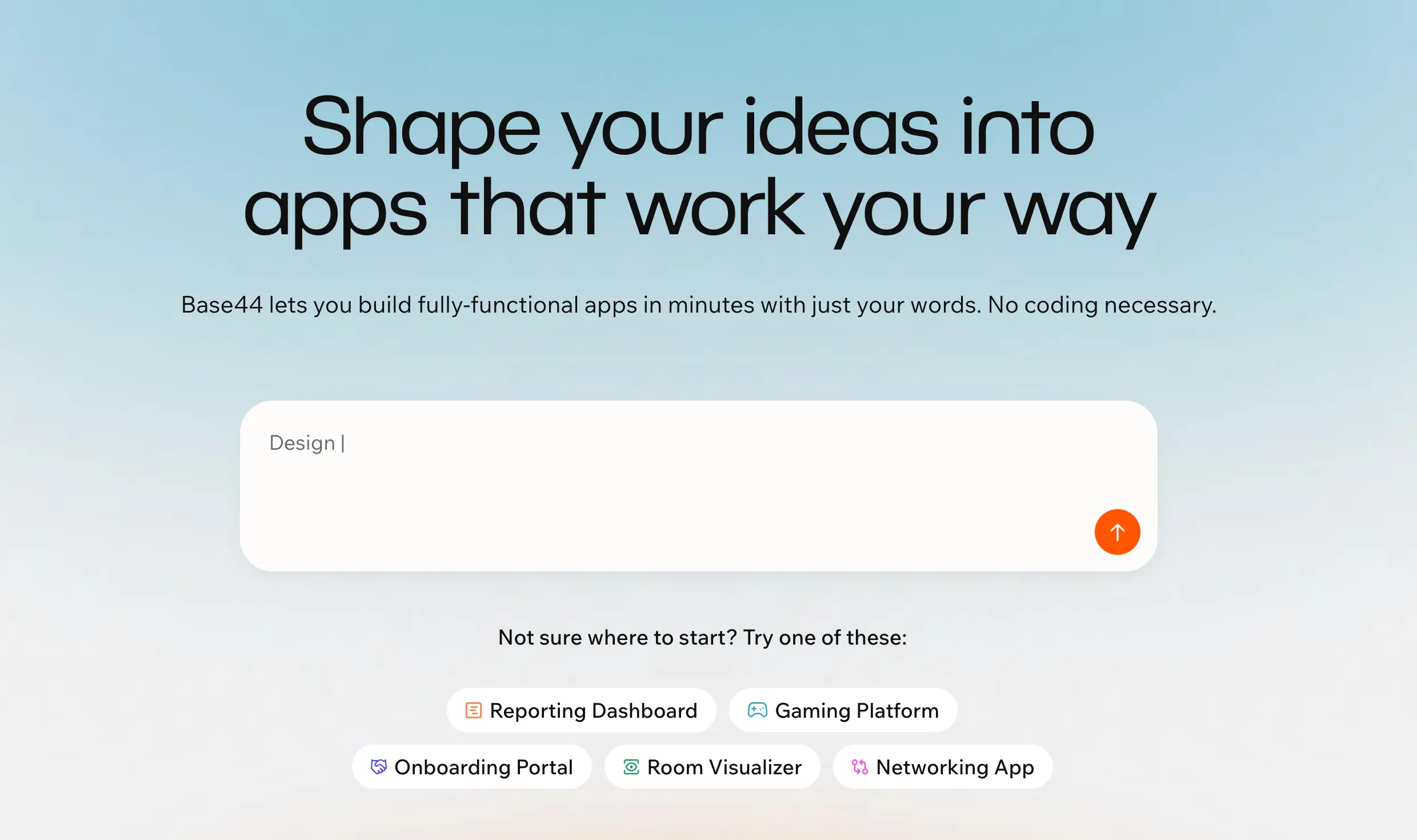
Base44 is an AI-powered all-in-one builder that turns plain-language prompts into lightweight apps. You describe what your product should do platform generates the UI, database, authentication, and hosting setup.
Unlike Lovable, which generates editable production-grade code, Base44 focuses on speed and simplicity for non-technical users. You can modify your app through its Builder Chat, adjusting page layouts, field names, and logic without writing code.
Paid tiers add features such as in-app code editing, custom domains, and higher credit limits, while higher tiers also support GitHub integration. This gives developers more control over the underlying application, although teams still need to consider how an AI-generated app will be maintained, governed, and managed as requirements become more complex.
Base44 stand-out features
1. AI-driven full-stack app generation
Base44 builds entire apps from text prompts. It helps you quickly put together pages, database tables, and user authentication. Describe what you want (“an internal CRM for a real-estate team”), and it assembles things automatically. It’s optimized for speed rather than deep customization, making it ideal for quick prototypes or internal tools.
2. Instant hosting and live preview
Instead of navigating complex editors, you use the Builder Chat to modify layouts, rename fields, or add logic. It’s responsive enough for quick changes, though more advanced edits can still feel limited compared to Lovable’s visual editor or code export.
3. Conversational Builder Chat
Instead of navigating complex editors, you use the Builder Chat to modify layouts, rename fields, or add logic. It’s responsive enough for quick changes, though more advanced edits can still feel limited compared to Lovable’s visual editor or code export.
4. Code export and GitHub integration
On the Builder plan and above, Base44 lets you export your app’s code to GitHub. The Builder plan starts at $50/month ($40/month billed annually):
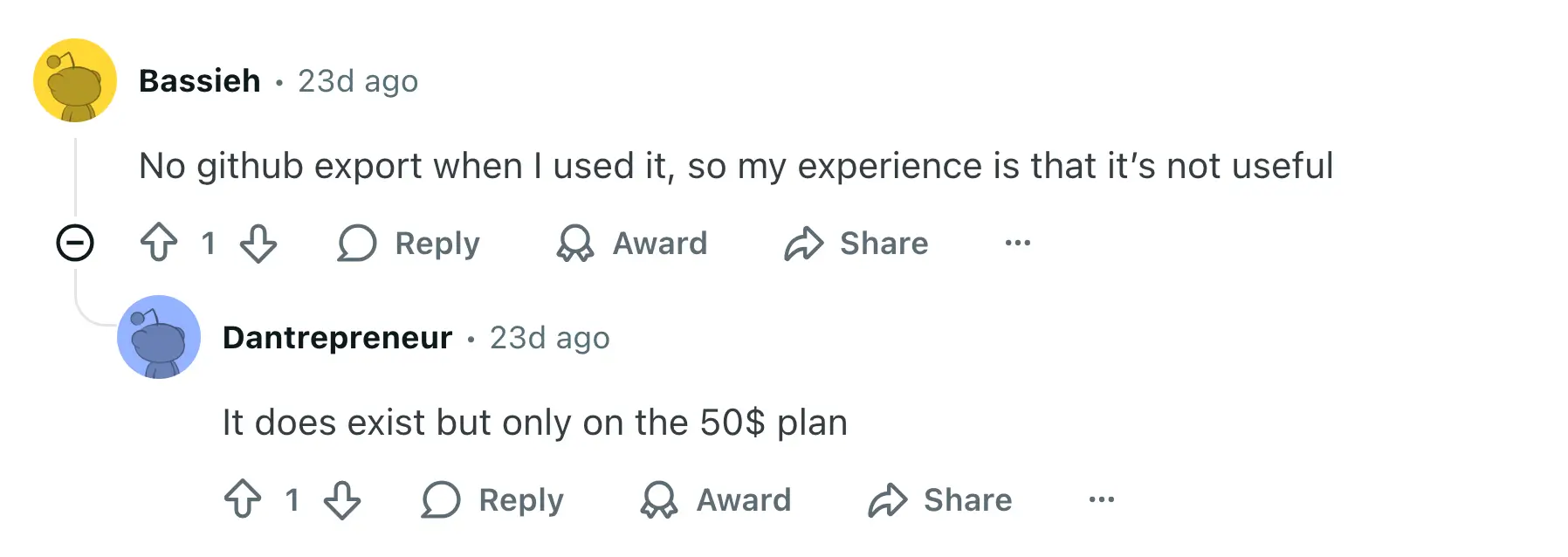
This allows developers to refine designs or add integrations outside the platform. The back-end logic remains hosted within Base44, which keeps things simple but limits full ownership of the codebase.
What Base44 is best for
Base44 is built for teams that want to move from concept to working MVP fast. It’s ideal for non-technical users who want to validate an idea fast, create live demos, or launch simple internal tools without hiring developers or managing infrastructure.
You can use Base44 to:
- Validate ideas quickly by generating a functional prototype that you can test or share with stakeholders before investing in full development.
- Build lightweight tools such as quick MVPs, startup pitch demos, or live demos of proof-of-concepts for clients or investors using the built-in hosting and instant redeployment features: all hosted automatically, with no setup required.
- Iterate on MVPs through Builder Chat, refining logic, layouts, or workflows conversationally as you validate use cases.
- Hand off designs to developers once ready for scaling, using the front-end code export to GitHub available on paid tiers.
In short, Base44 is best when your goal is to get a working app online fast, with minimal setup and enough flexibility to test real workflows.
Base44 limitations
While Base44 removes much of the setup friction common to app builders, its simplicity also brings limits that can slow teams’ scaling beyond basic use cases.
Key limitations:
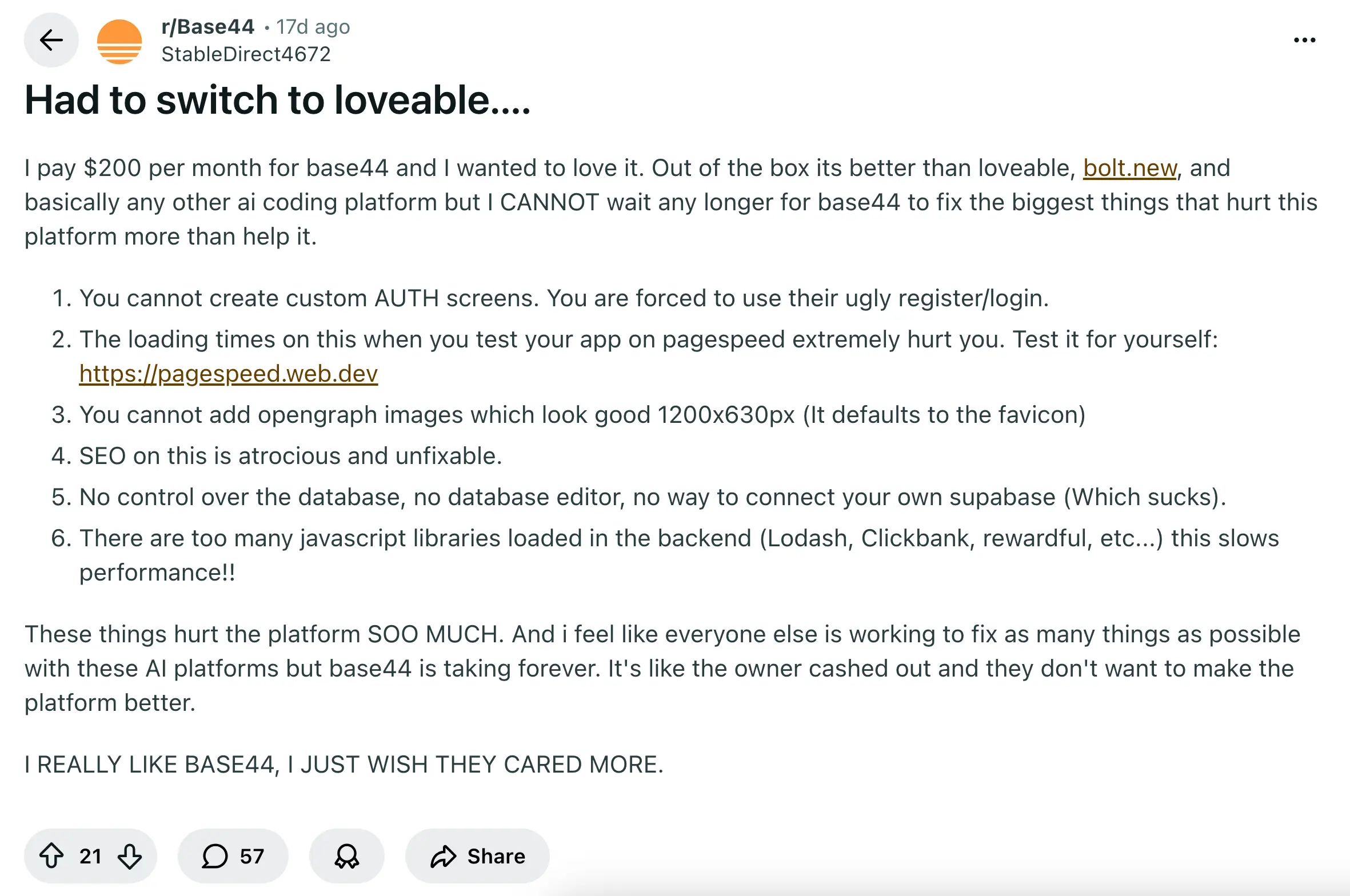
- No custom authentication screens: Users must use the default login and register pages, which can feel rigid for branded apps.
- Credit-based usage adds unpredictability: Each prompt, integration, or deployment consumes message credits, which don’t roll over. Heavy iteration can drain monthly limits fast.
- Performance constraints on complex apps: Loading times and responsiveness can lag once you add multiple workflows, scripts, or large datasets.
- Limited visual customization: Templates are basic, and designs may feel generic without custom styling or external code.
- Slow platform fixes and feature rollout: Users report that support and feature updates lag behind other AI builders.
Base44 pricing
Base 44 offers five pricing tiers, from a free starter plan to enterprise-level packages for large teams. Each plan includes monthly message credits (used for AI prompts) and integration credits (for actions like sending emails, API calls, or Slack notifications).
- Free: $0/month, 25 message credits and 100 integration credits per month; includes authentication, database, and analytics basics.
- Starter: $20/month ($16 billed annually), 100 message credits and 2,000 integration credits; unlimited apps with in-app code edits.
- Builder: $50/month ($40 billed annually), 250 message credits and 10,000 integration credits; adds domain connection and GitHub integration.
- Pro: $100/month ($80 billed annually), 500 message credits, and 20,000 integration credits; includes backend functions, early beta access, and priority support.
- Elite: $200/month ($160 billed annually), 1,200 message credits and 50,000 integration credits; includes premium support and expanded limits for teams.
Enterprise plans are available on request, with tailored support, higher limits, and compliance options.
How much does Base44 actually cost?
Base44’s pricing looks simple at first glance, but real costs depend on how often your team uses AI prompts and integrations. Each action, from generating new app components to sending automated emails, consumes message or integration credits, which reset monthly and don’t roll over.
Here’s what that means in practice:
- Credits can run out fast: Even the Starter plan’s 100 message credits and 2,000 integrations can disappear after a few days of iteration. Frequent AI prompts, redeployments, or API calls quickly use up the allowance.
- Hosting costs scale with usage: Higher-tier plans include more credits, but live apps that process form submissions or notifications regularly may need upgrades to Pro or Elite.
- Design and customization often require paid tiers: The free plan is useful for testing ideas, but meaningful customization, like domains, branding, and GitHub exports, starts at $40/month (Builder plan).
In short, Base44 stays affordable for quick MVPs, but costs can rise fast for active or long-term projects that need frequent edits, higher credit limits, or more control over deployment.
What is Lovable?
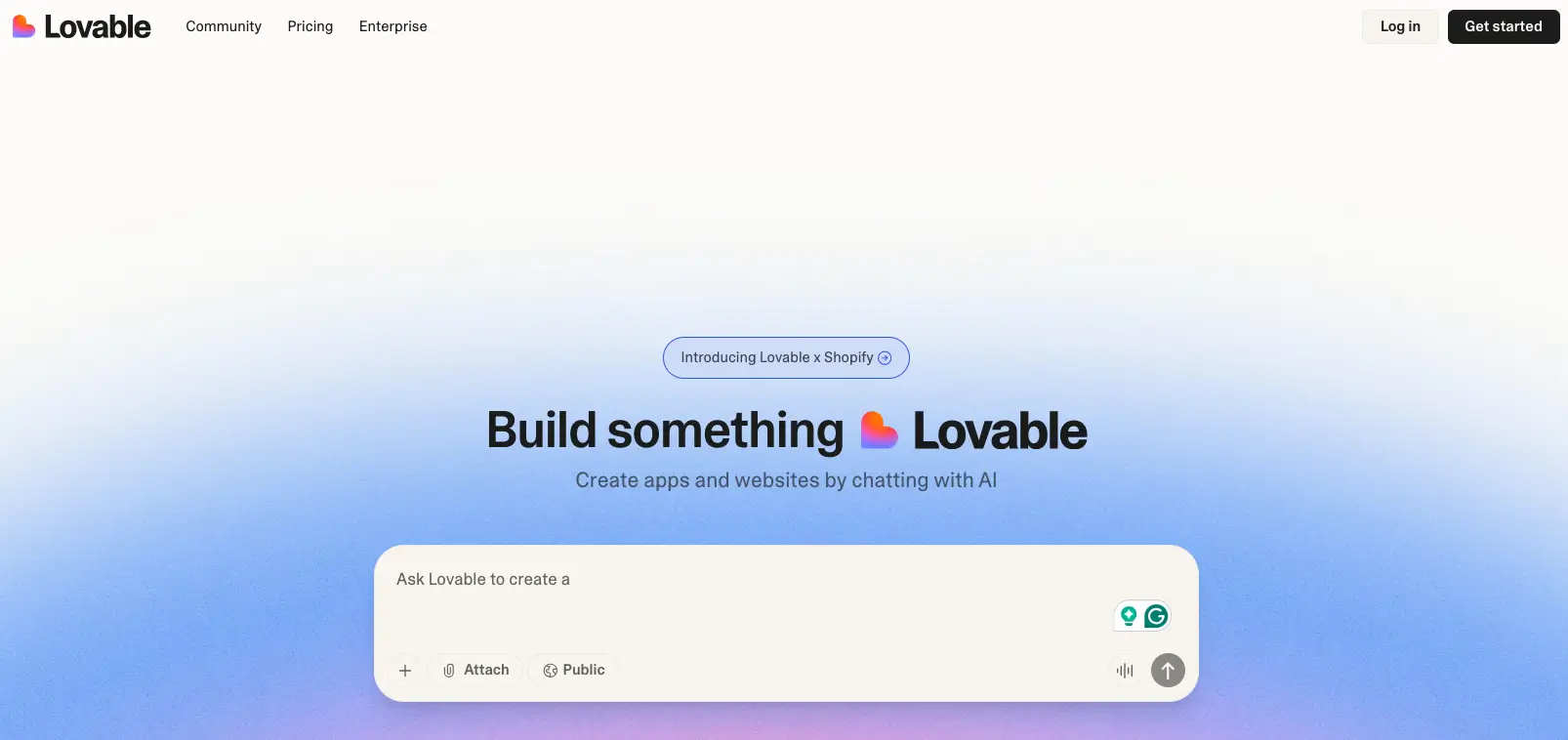
Lovable is an AI-powered app builder that helps small teams turn plain-language prompts into working prototypes. You describe what you want, for example, “a booking system for clients”, and Lovable instantly generates the app’s structure, layout, and logic.
Unlike Base44, which focuses on guided, hosted MVPs, Lovable gives you more control over what’s built. Every app it creates can be exported as React and TypeScript code, making it easy for developers to extend, debug, or deploy the project later.
The platform also includes real-time collaboration, AI-assisted design polish, and live previews, so non-developers can adjust layouts or copy while engineers handle the technical side. This makes Lovable a bridge between early validation tools and developer workflows.
Lovable’s credit-based model gives flexibility for small teams testing ideas, though frequent edits or complex AI generations can consume credits quickly.
Lovable stand-out features
1. Build from natural-language prompts
Lovable turns plain English descriptions into editable apps. The AI generates pages, navigation, and basic data flows. It’s ideal for teams that want a working version fast without coding setup.
2. Editable React and TypeScript code
Each project is fully exportable as React/TypeScript code, so developers can refine, extend, or deploy it elsewhere. This gives teams long-term flexibility and makes it easier for developers to continue working on the application outside Lovable.
3. AI-assisted interface design
Lovable’s built-in AI polishes layouts, colors, and spacing to make your app look clean and professional, though if you skip design guidelines, it tends to default to a familiar “Lovable look.” You can still customize by uploading assets or screenshots of your designs to help the AI match your brand.
4. Simple deployment and sharing with Lovable Cloud
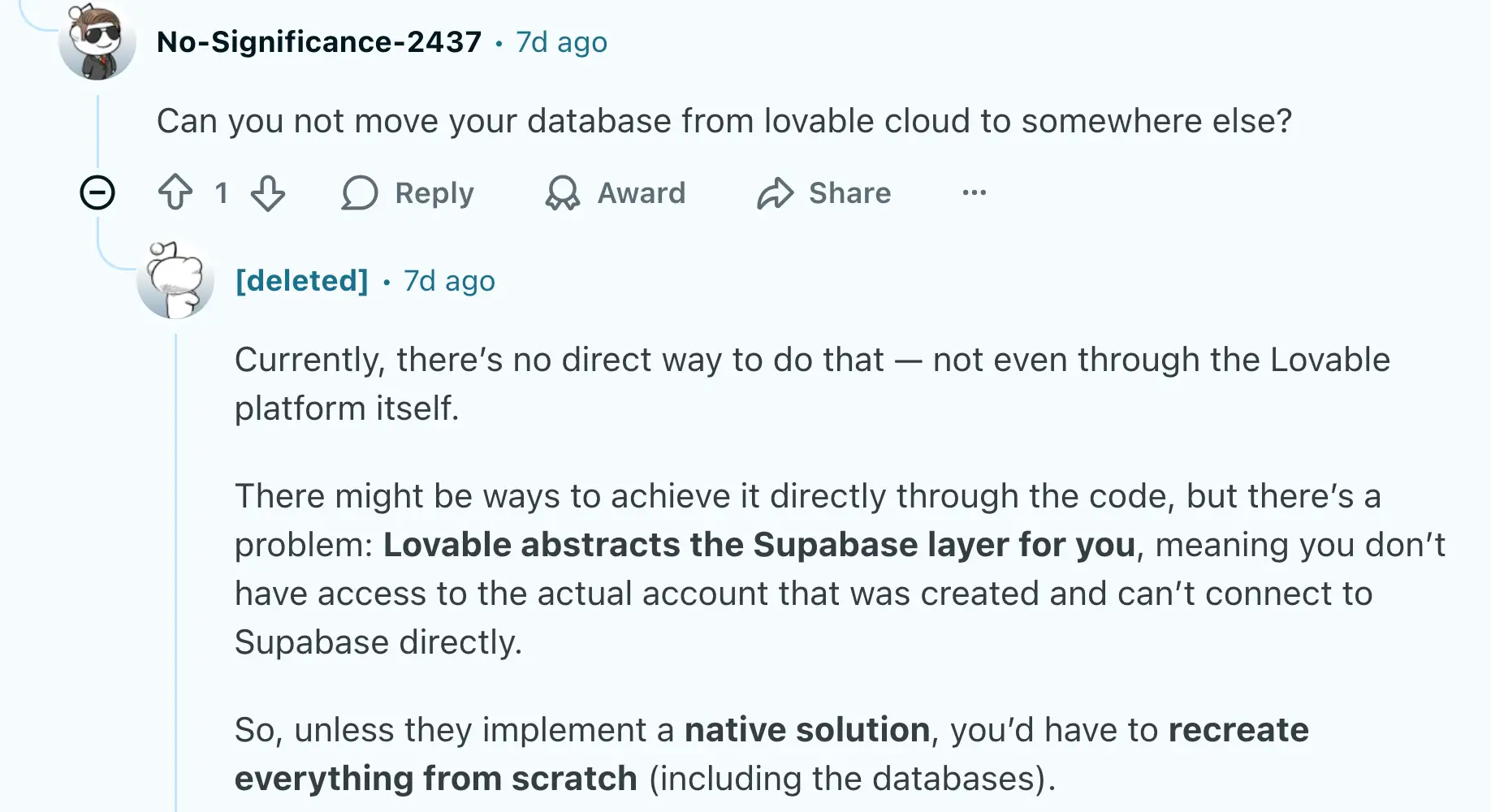
Once generated, apps are hosted automatically through Lovable Cloud, giving teams a live preview link they can share or test instantly. You can publish prototypes, gather feedback, or export the full React/TypeScript code to GitHub for continued development. However, users note that Lovable abstracts its Supabase layer, meaning you don’t have direct access to your database account. Here’s an example of the many such discussions on Reddit:
What Lovable is best for
Lovable is best for early-stage teams and startups that want to turn ideas into working prototypes fast with minimal setup and back-end code they can extend later.
You can use Lovable to:
- Validate product ideas quickly by generating a working version you can share with clients, investors, or teammates without touching code.
- Collaborate across roles where designers, founders, and marketers can adjust layouts, copy, or visuals in real time, keeping everyone aligned in one shared workspace.
- Create developer-friendly front-ends that export as clean React/TypeScript code, so engineers can pick up and refine the app later for full production use.
- Test and deploy prototypes fast, using built-in live previews or direct GitHub export to integrate with your existing workflow.
Lovable limitations
While Lovable offers speed and developer-ready flexibility, users note several practical limits that surface during extended use, especially for complex projects or teams relying heavily on AI generation.
Key limitations:
- Credit usage scales fast: Each AI prompt, layout regeneration, or component adjustment consumes credits. Heavy iteration can drain the monthly quota, pushing teams to upgrade sooner than expected.
- Limited visual control: While AI polishes layouts well, customization beyond what’s generated, like advanced responsive tweaks or pixel-perfect design, often requires manual edits in code.
- Occasional instability in generation: Reddit users mention that larger or more complex prompts sometimes timeout or generate inconsistent components, especially with heavy data logic.
- Team collaboration capped on lower plans: Real-time editing is supported, but team seats and roles are limited until you move up to higher tiers.
Lovable pricing
Lovable uses a credit-based pricing model, where each AI generation, edit, or regeneration uses credits. You can start for free and scale as you build more complex prototypes.
- Free: $0/month, includes 5 daily credits (up to 30/month), public projects, and unlimited collaborators.
- Pro: Pro: $25/month, includes 100 monthly credits, credit rollovers, custom domains, private projects, user roles and permissions, and the option to remove Lovable branding.
- Business: $50/month, adds SSO, personal projects, internal publishing, design templates, and the ability to opt out of data training, ideal for larger teams or agencies.
- Enterprise: Custom pricing, includes dedicated support, custom connections, group-based access control, and custom design systems.
All paid plans unlock additional AI credits and advanced collaboration features, while higher tiers add governance and branding control for larger organizations.
How much does Lovable actually cost?
Lovable’s pricing depends on how much you use its AI to build or regenerate your app. Each prompt, design change, or layout update consumes credits, so costs scale with iteration frequency rather than app complexity.
Here’s how that plays out in practice:
- Hidden cost of AI generation: Regenerating entire pages or fixing design issues can consume several credits at once. Users report that 30–40% of their monthly allowance often goes to revisions, especially when fine-tuning UI.
- Collaboration is cost-efficient: Credits are shared across unlimited collaborators, so adding teammates doesn’t raise subscription costs — only total AI usage does.
- Scaling to Business or Enterprise: Larger teams often upgrade for governance (SSO, data-training opt-out) or design-system control rather than credit limits.
In short, Lovable stays affordable for small teams prototyping quickly, but costs can rise for design-heavy workflows or frequent regeneration cycles, especially if you rely on AI to polish layouts repeatedly.
Base44 vs Lovable: Pricing comparison
Both platforms use usage-based pricing models, but they charge for different things. Base44 bills based on AI message and integration credits, while Lovable charges for AI generation credits shared across users. The difference comes down to how each platform defines activity: Base44 tracks app logic and backend usage; Lovable measures design and regeneration activity.
Key differences:
- Cost scaling: Base44’s costs grow with backend activity (sending emails, API calls, or data updates), while Lovable’s costs grow with frontend regeneration and design edits.
- Predictability: Base44 credits don’t roll over, and hitting the cap stops app operations until renewal. Lovable allows credit rollovers on paid plans, making usage slightly easier to manage.
- Collaboration: Lovable includes unlimited collaborators on all tiers. Base44 doesn’t cap users, but its pricing scales faster for active teams that use a lot of integrations.
- Long-term cost control: Both models work for quick experiments, but credit-based billing becomes harder to forecast once apps go live or grow.
If you’re scaling past prototypes and need predictable costs month to month, Softr offers a steadier alternative, with transparent plan limits and AI credits that are only used when you choose to use AI-powered features.
Base44 vs Lovable Reddit discussions
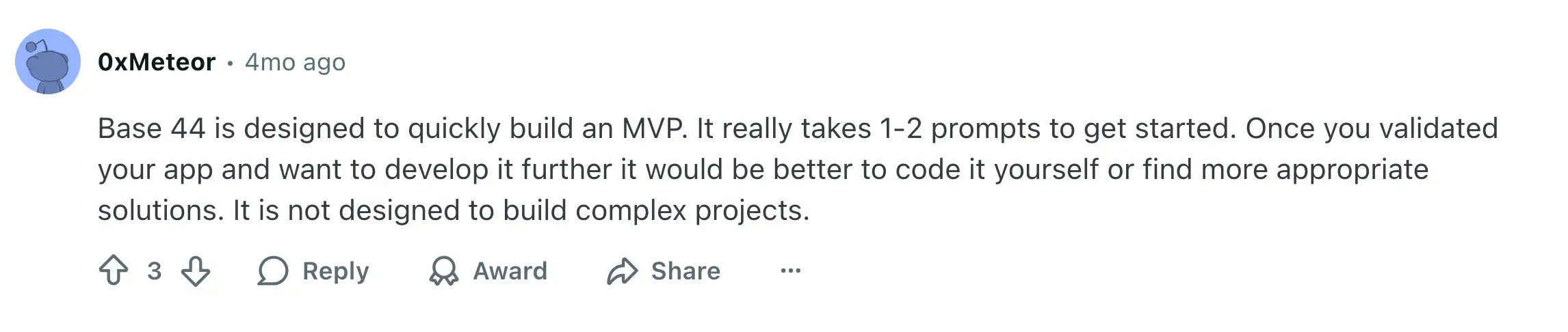
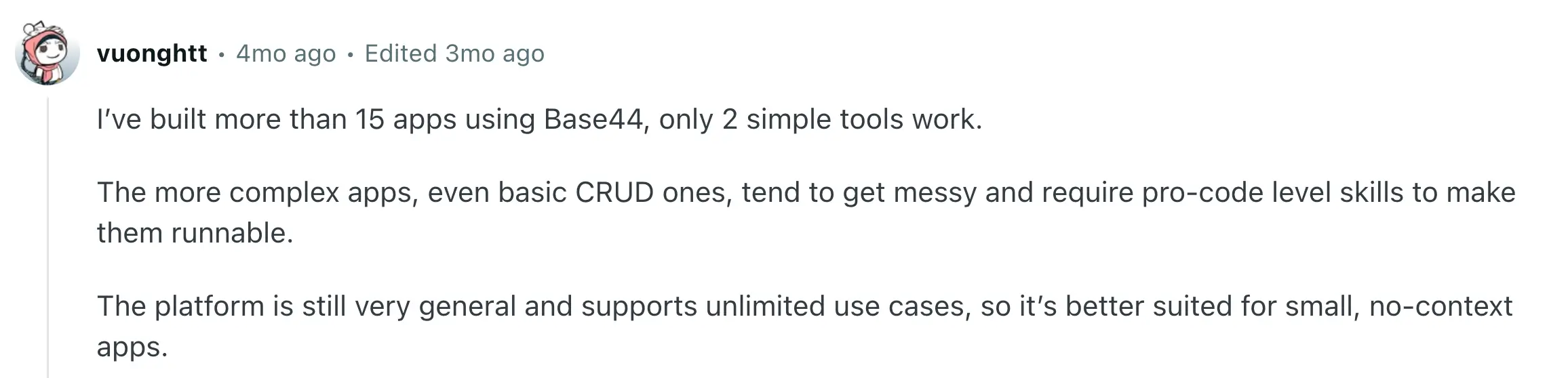
Here’s what Redditors highlight when comparing Base44 with Lovable:
{{cta-1}}
Base44 vs Lovable summary
Both Base 44 and Lovable use AI to turn plain-language prompts into working apps, but they approach app building from different angles. Each stops short of what growing teams eventually need.
Base44 focuses on speed and simplicity. It’s built for non-technical users who want to turn an idea into a hosted MVP or client demo quickly. It automatically handles databases, authentication, and live deployment, making it easy to get something online fast. But its closed infrastructure, limited customization, and credit-based pricing make it less practical once teams need more control or scalability.
Lovable, by contrast, gives you editable React and TypeScript code, AI-polished layouts, and real-time collaboration through Lovable Cloud. It’s a solid fit for design-led teams that want to iterate visually and later hand off production-ready code to developers. Still, it lacks direct database ownership, deeper backend functionality, and predictable costs for continuous iteration.
In short:
- Base44 is best for fast, hosted MVPs and client demos that need minimal setup.
- Lovable suits teams who want developer-ready prototypes they can evolve into full products later.
Softr — the best Base44 vs Lovable alternative for building full-stack business apps with AI

Softr is a full-stack no-code platform that lets you build secure, production-ready business apps — no code, no endless re-prompting, and no dependency on hosted back-ends you don’t control.
Unlike Base44 or Lovable, which focus on rapid prototyping and code generation, Softr brings everything under one roof: a relational database, front-end builder, automation engine, all generated instantly from a prompt with the AI Co-Builder. If you’d rather prompt from Claude or ChatGPT, the Softr MCP builds the same stack from there.
You can start with Softr Databases or connect to external sources like Airtable, Google Sheets, and Notion, then build apps like intranets, CRMs, portals, or dashboards: complete with authentication, role-based permissions, and workflows.
1. Reliable, production-ready app building with the AI Co-Builder
Most AI app builders stop at prototypes. Softr changes that.
With secure authentication, granular permissions, and built-in databases, every Softr app you buld with AI is deployable and ready for daily business use. This means you can safely move to production without rewriting or migrating anything.
Unlike Base44, which limits back-end control, or Lovable, which exports only front-end code, Softr gives you a fully managed stack where data, logic, design, and automation live together.
2. Built-in databases and live data connections
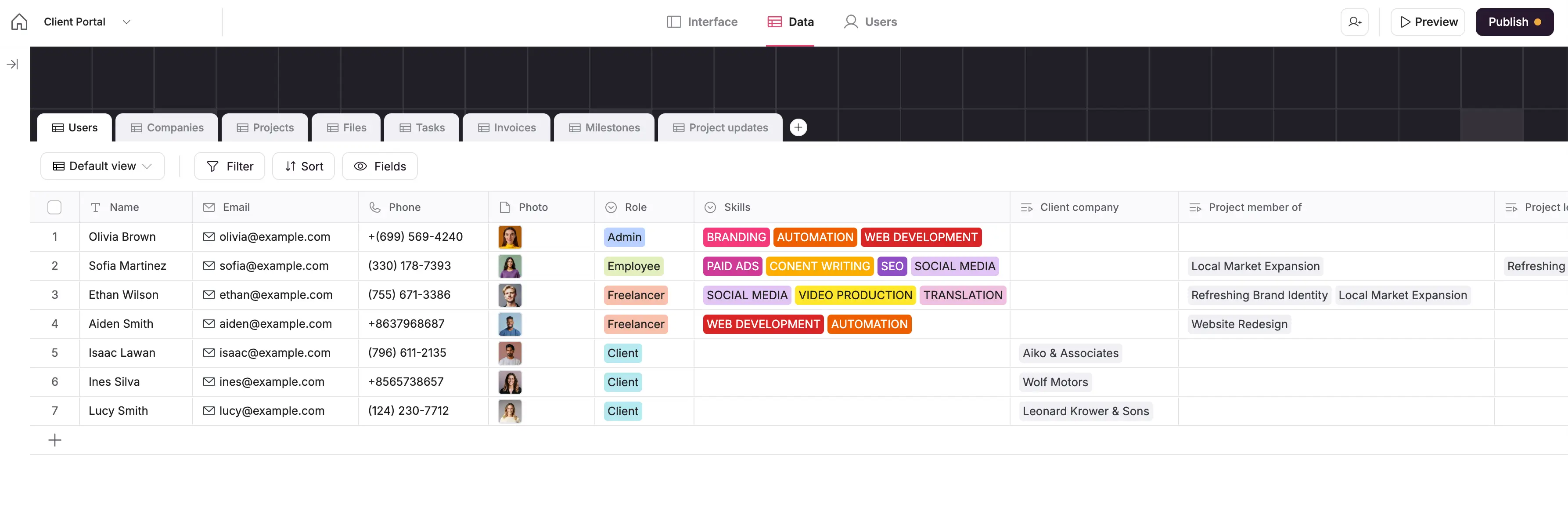
Base44 hides your data in its closed infrastructure, and Lovable requires developers to connect APIs manually.
Softr combines both worlds: a spreadsheet-style Softr Database with relational power. Link records, build filters, and sync live data from over 21+ native sources. Your data stays connected and editable in real time, so teams can build faster without technical overhead.
3. Native workflows

With Softr Workflows, you can automate any process: approvals, notifications, data updates, and even add AI steps to summarize text, call APIs, or analyze records.
Base44 limits automation to simple in-app scripts, and Lovable doesn’t include any built-in workflow engine. Softr lets you design flows directly in-app, triggered by user actions or data changes, so operations stay smooth without third-party tools like Zapier or Make.
4. Enterprise-grade security and permissions
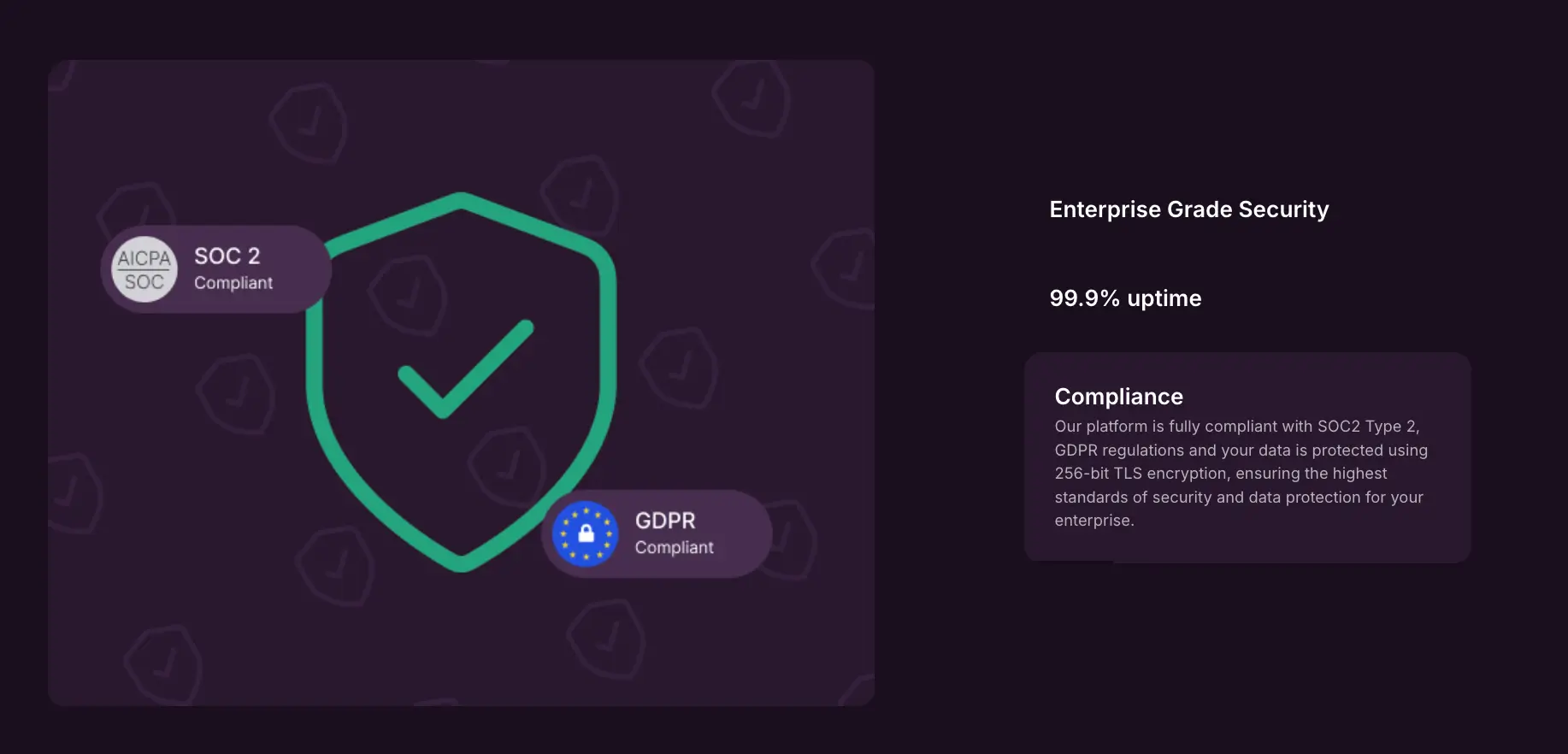
Softr offers SOC 2-compliant hosting, SSL, and SSO/SAML (in Enterprise).
You can define roles, restrict data views, and manage visibility across clients, teams, or departments. Neither Base44 nor Lovable provides granular user permissions or enterprise-level governance out of the box.
5. Custom branding and ready-made templates
Choose from 90 + professionally designed templates, from client portals to project trackers, all fully customizable.
While Base44 and Lovable rely on generated layouts that often need tweaking, Softr’s templates come pre-built with database structure and sample data, helping you launch faster and stay on brand.
6. Built-in user management and onboarding flows
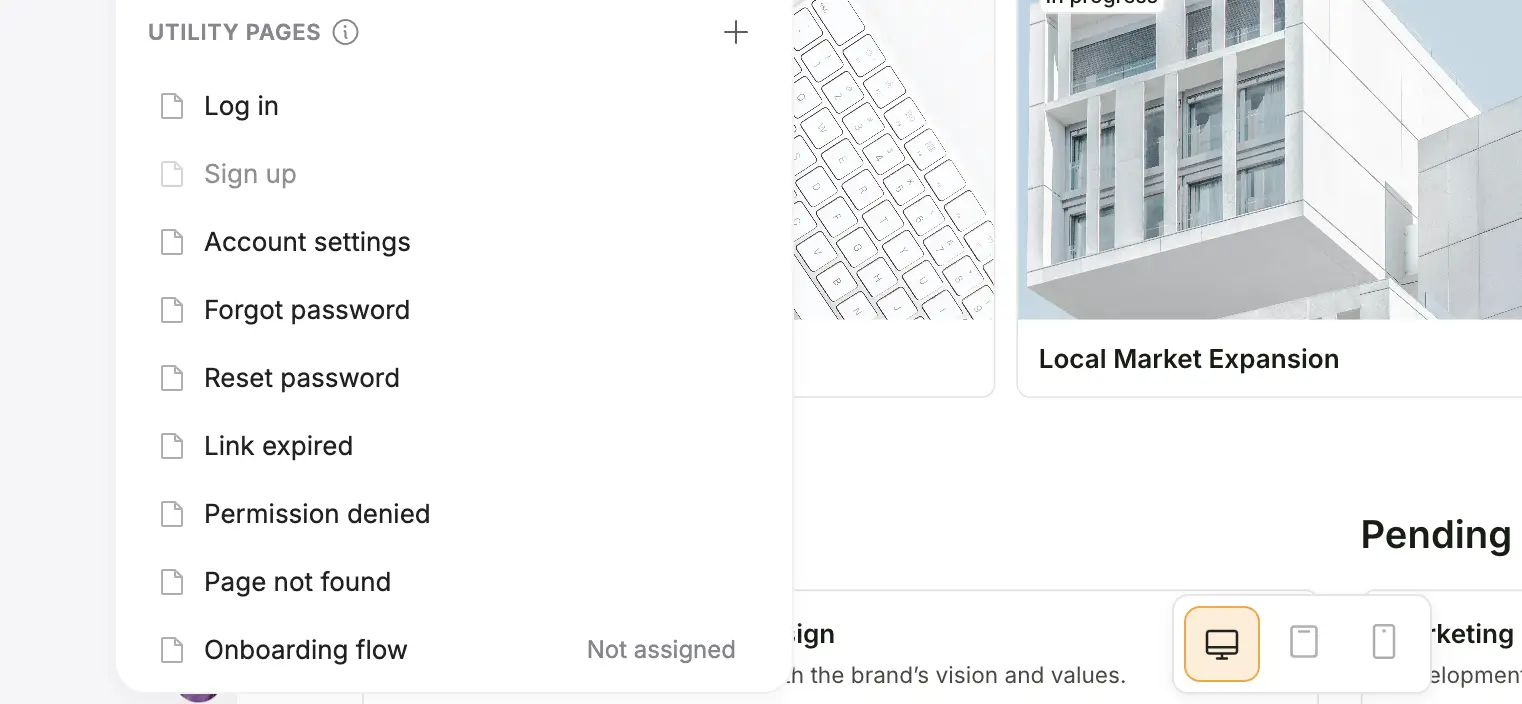
Softr includes authentication, account settings, and password recovery pages that you can brand and customize.
Base44 enforces its default login screens, and Lovable leaves authentication to developers.
With Softr, you can onboard clients, partners, or employees securely — no manual coding required.
7. Database AI Agents & Ask AI
Softr’s AI works inside your data. You can use Database AI Agents to categorize, summarize, or analyze records automatically, and Ask AI lets users query live app data in plain English (e.g., “Which clients have overdue invoices?”).

Base44’s AI builds UIs, and Lovable’s AI refines designs. Softr’s AI delivers actionable insights directly from your data.
8. Responsive, mobile-ready apps
Everything built in Softr automatically adapts to desktop, tablet, and mobile, or can be published as a Progressive Web App (PWA).
Base44 still struggles with mobile responsiveness, and Lovable’s generated UIs often need code cleanup for smaller screens.
9. Predictable, transparent pricing
Softr’s pricing is flat and predictable. Every plan includes a monthly AI credit allowance, so you can try the AI Co-builder and Vibe Coding block at no cost.
- Free: Unlimited apps, with access to Softr Workflows and Softr Databases, 5 app users, 5 AI credits, and 5,000 database records
- Basic: $19/month for unlimited apps with 42+ integrations, Team: 5 + Client: 5 app users, 10 AI credits, and 50K records
- Pro: $99/month for unlimited apps with 45+ integrations and custom code, Team: 10 + Client: 50 app users, 50 AI credits, and 500K records
- Business: $329/month for unlimited apps with 52+ integrations, Team: 30 + Client: 100 app users, 100 AI credits, and 1M records
- Enterprise (custom pricing, contact sales)
What Softr is best for
Softr is built for teams that need to move past prototypes and into secure, AI-powered business apps that run day to day without trading speed for stability.
You can use Softr to:
- Generate client and partner portals, CRMs, or internal tools that connect data, people, and processes in one secure space with full control over permissions and visibility.
- Automate daily operations through built-in workflows, AI Agents, and integrations, replacing credit-based triggers or manual scripts with reliable, reusable automations.
- Create live dashboards and reporting apps that stay synced with your existing data sources — no extra setup, no database rebuilds.
- Empower non-technical teams to create and update apps confidently, while maintaining guardrails for data security and access control.
- Scale from prototype to production on one platform, without migrating databases, rewriting logic, or worrying about usage caps.
In short, Softr gives you what Base44 and Lovable start but can’t sustain: a single, scalable platform where your data, logic, and design stay connected as your business grows.
Base44, Lovable, or Softr?
Comparing Base44 vs Lovable, we can notice that both make app creation faster, but they stop at different milestones. Base44 helps you launch a hosted MVP quickly. Lovable lets you refine and export clean code for developer handoff. Yet neither offers the data control, security, or scalability needed to power real, daily business operations.
That’s where Softr fits in. It brings together the speed of AI-generated building with the reliability of a full-stack platform, complete with databases, workflows, and permissions, so your apps can move from idea to daily use without hitting a ceiling.
👉 Try Softr for free and start creating production-ready business apps with AI.
Frequently asked questions
Is there anything better than Lovable?
Is Base44 really good?
What is the difference between v0 and Lovable?