


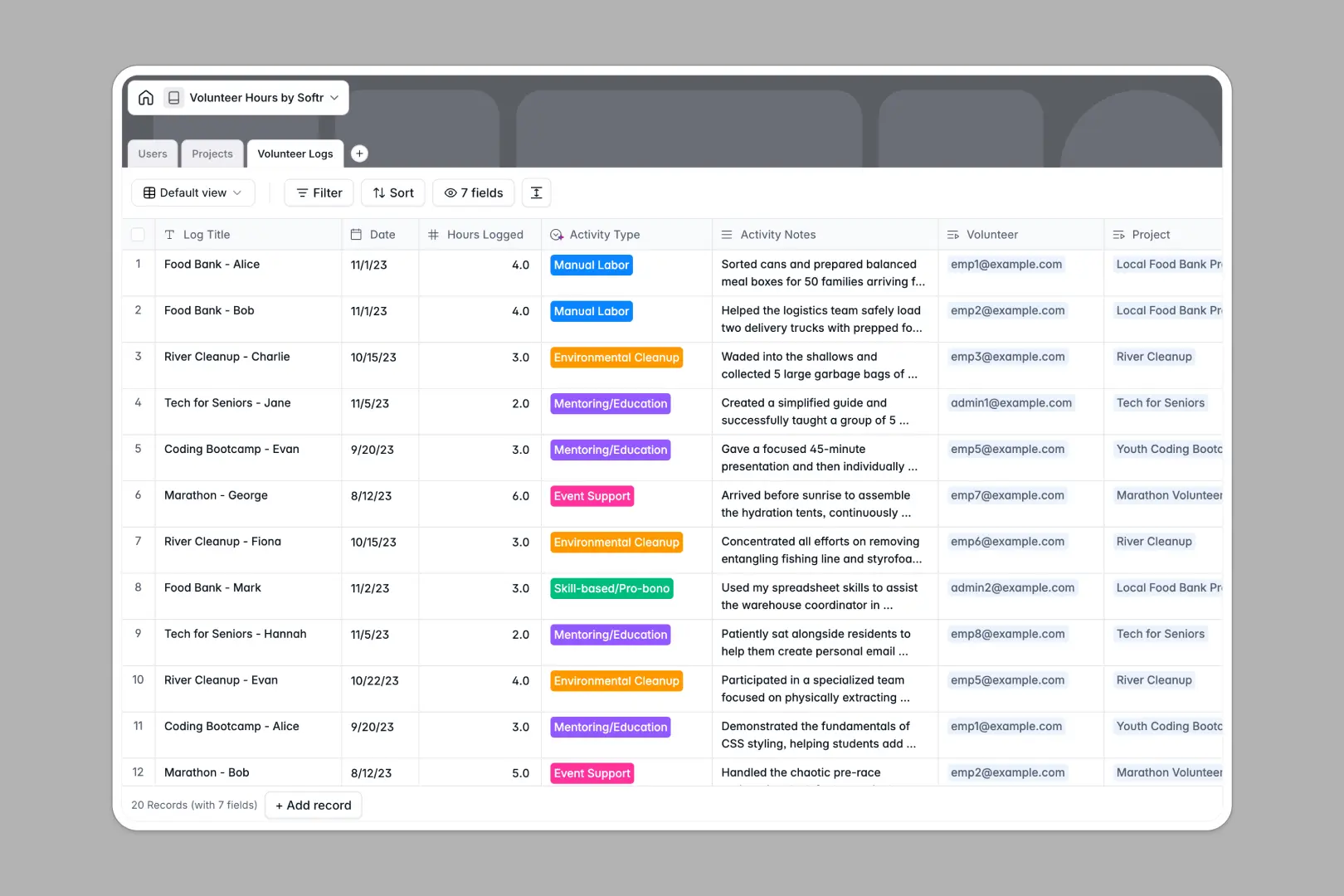
Your Volunteer Hours Database at a glance
Track employee service hours, organize projects, and calculate totals instantly.
It securely connects users, projects, and daily volunteer logs in one place without relying on fragile formulas.
Built-in AI features automatically categorize logged activities, summarize project briefs, and research organization details directly from the live web.
Why volunteer hours get messy in spreadsheets
Spreadsheets start fine for logging hours, but quickly become a frustrating mess of broken formulas, duplicated names, and mixed date formats.
What a structured database changes
Every column has a clear type, ensuring hours stay numbers, dates stay dates, and roles remain strictly fixed.
You can link daily logs directly to specific employees and projects without copy-pasting data across rows. As your team grows and programs expand, the tallies stay perfectly accurate.
This robust, relational structure is exactly what Softr Databases are designed for.
What you can do with this template
Easily log daily volunteer hours, calculate total community impact per project, and view total volunteering time rolled up per employee.
Built-in AI agents automatically classify activity types based on notes and pull organization information straight from the web, eliminating repetitive manual entry.
-
Users
Manage employee profiles and track their total volunteer hours and roles
-
Projects
Catalog community projects with AI-powered summaries and organization briefs
-
Volunteer Logs
Log service time with AI-automated classification of volunteer activities
Who is this Volunteer Hours database for
This template is designed for teams prioritizing corporate social responsibility and community impact.
- HR Managers: Streamline employee volunteering records and calculate department-wide totals effortlessly.
- CSR Coordinators: Manage active projects, vet organizations, and track the exact impact of community initiatives.
- Team Leads: Monitor team participation and approvals without chasing people down for manual updates.
How to take it further
Start by customizing the database structure to fit your exact workflow. You can easily add new departments or tweak the volunteer activity categories to match your program's goals.
Next, import your existing volunteer records using a simple CSV upload. It takes seconds to transition your historical data away from old tracking methods.
When your team is ready, you can use a no-code interface builder to turn this raw data into a full employee portal.
By adding custom permissions, employees will only see their own logged hours, while administrators get a global dashboard of all active projects. A well-structured database makes building this front-end completely effortless.
-
1
-
2
-
3
-
4
Frequently asked questions
-
What is a volunteer hours database?
-
Why use a no-code database to build a volunteer tracking system?
-
How can AI help managing data for volunteer hours?
-
Can I build an app with this volunteer hours database?
-
Is this Volunteer Hours template free?
-
How is a volunteer hours database different from an Excel spreadsheet?
Start building today. It's free!
Build and launch your first app in under 30 minutes.