


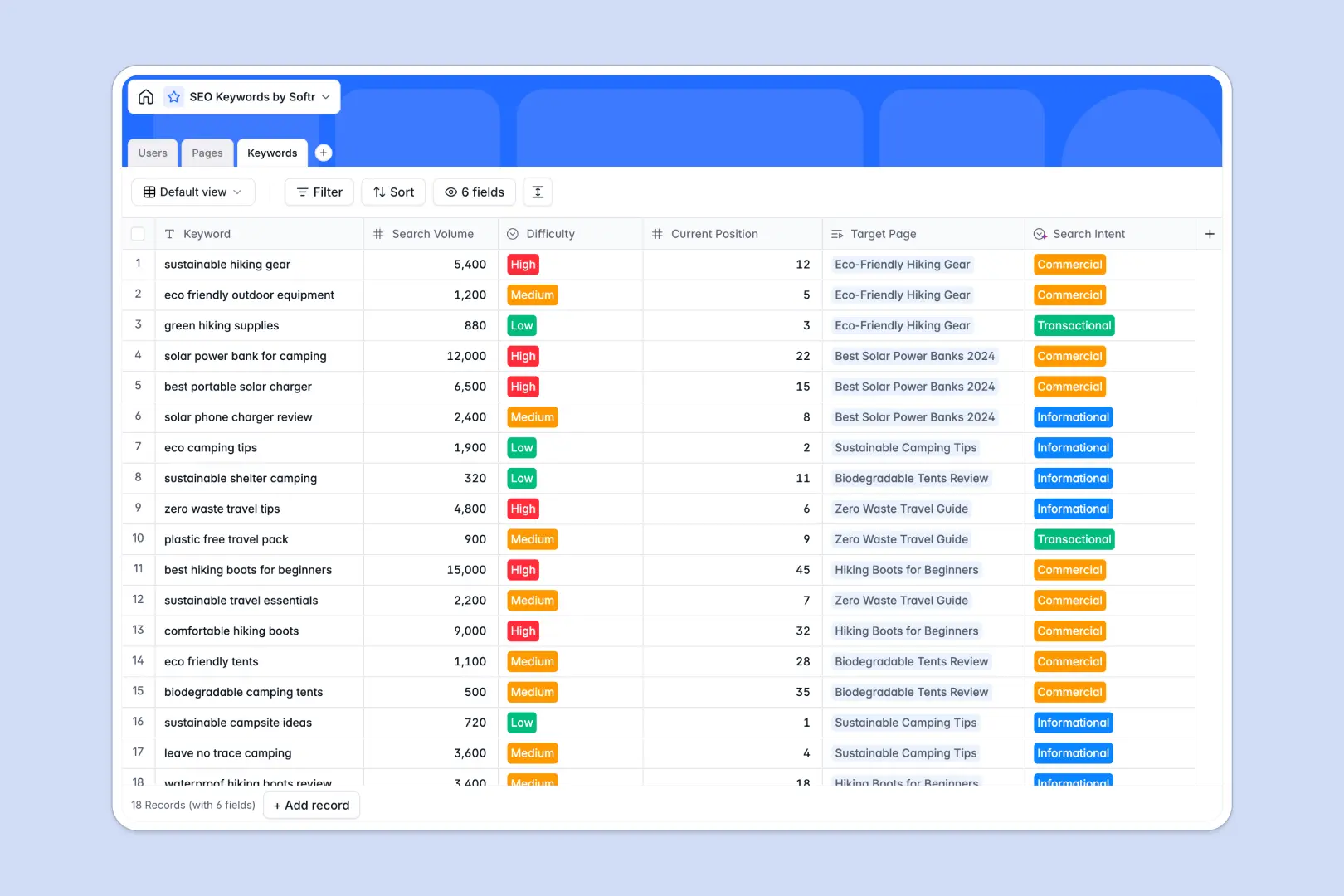
Your SEO Keywords Database at a glance
This template organizes your search strategy by linking target keywords directly to the content you're building. It gives your marketing team a clear view of exactly what to write and track.
Three clearly connected tables handle the heavy lifting: Users, Pages, and Keywords. When you assign target keywords and a writer to a page, all related metrics flow together automatically.
Built-in AI assistants classify search intent instantly as you work. They naturally browse the live web to generate complete content briefs and write catchy meta descriptions based on your targets.
Why an SEO keywords spreadsheet gets messy
Managing SEO in basic rows and columns inevitably leads to chaos as your content library grows. Duplicated keywords, misaligned search intent, and disconnected content briefs quickly drag down your publishing velocity.
What a structured database changes
Instead of dealing with fragile vlookups and endless copy-pasting, a native database enforces strict column types so data stays perfectly organized. You can securely link multiple keywords to a single page without breaking your view.
This is exactly what Softr Databases are designed for. As your content operation scales, your SEO data remains highly structured, connected, and ready for your exact workflows.
What you can do with this template
Instantly connect specific writers to pages and track every piece of content from early drafts to publication. You'll always know exactly who owns what and which exact search terms they are targeting.
You also have access to powerful AI fields that scale your workflow effortlessly. The moment a new keyword is tracked, the system can automatically classify its intent and draft a highly structured content outline.
-
Users
Manage SEO staff and content writers with roles and assigned pages
-
Pages
Track website optimization using AI to generate content briefs and meta tags
-
Keywords
Monitor search terms with AI classification for search intent and volume
Who is this SEO Keywords database for
This system is built for content teams who need to scale their organic search strategy reliably.
- SEO Managers: Map keywords to specific pages and cleanly track ranking difficulties in one unified view.
- Content Writers: Access precise AI-generated outlines and see exact word count goals before typing a single word.
- Marketing Directors: Oversee the entire content pipeline from ideation to publication without chasing down spreadsheet links.
How to take it further
Customizing this setup is entirely effortless. You can quickly add new fields to track live backlinks or modify the dropdown statuses to perfectly match your team's editorial calendar.
Don't start from scratch if you already have a massive keyword list. Simply use a fast CSV import to instantly populate your existing keywords, search volumes, and current positions.
When your team outgrows a backend view, you can seamlessly build a full application on top of this data. Turn this native database into an external content portal where freelance writers can log in to view their assignments.
By establishing proper users and permissions, you guarantee that writers will only ever see the specific pages and workflow stages assigned to them.
-
1
-
2
-
3
-
4
Frequently asked questions
-
What is an SEO keywords database?
-
Why use a no-code database to build an SEO tracking tool?
-
How can AI help managing data for SEO keywords?
-
Can I build an app with this SEO keywords database?
-
Is this SEO Keywords database free?
-
How is this template different from an SEO keywords spreadsheet?
Start building today. It's free!
Build and launch your first app in under 30 minutes.