


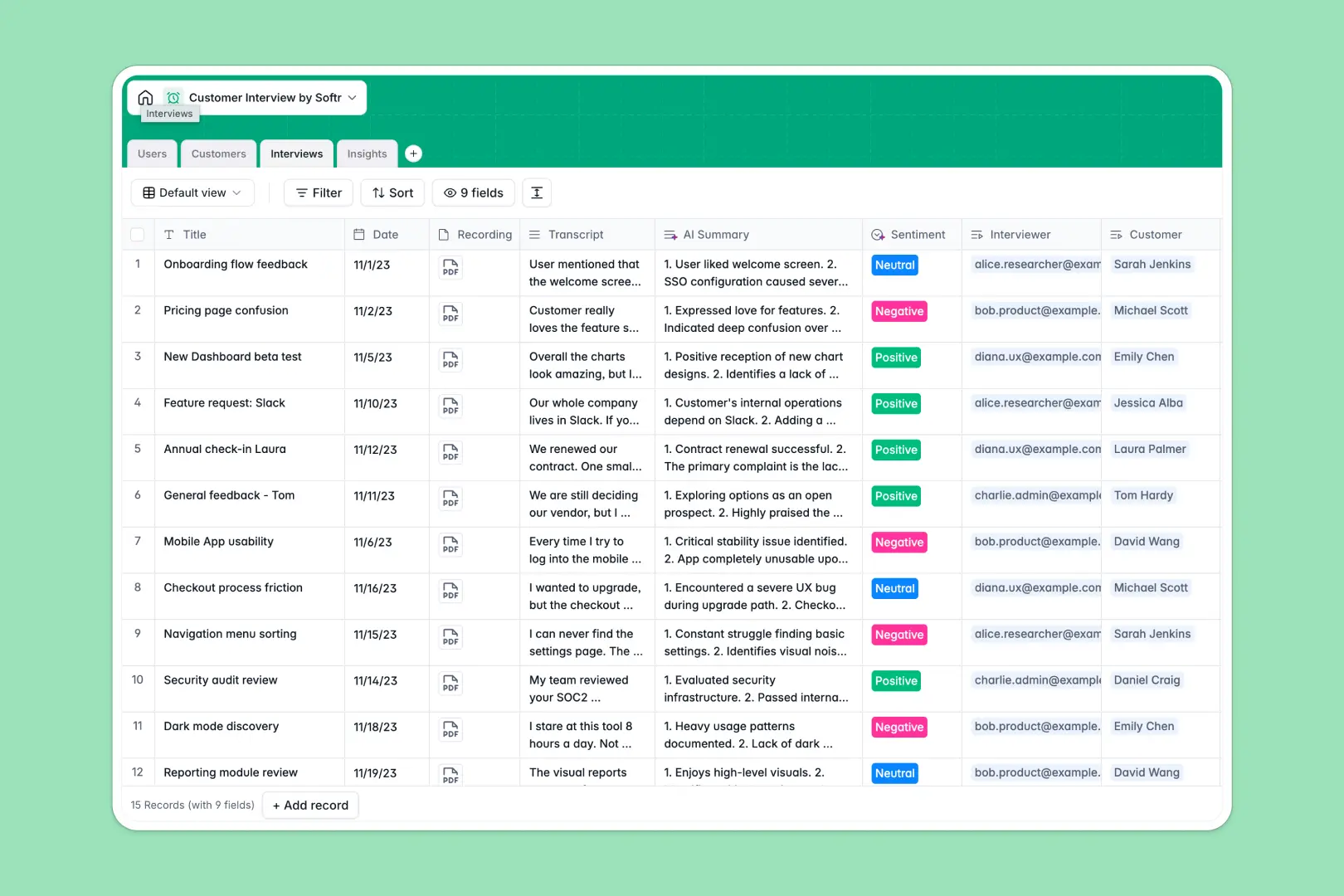
Your Customer Interview database at a glance
This template replaces messy spreadsheets by giving you a structured home for every discovery call and customer profile.
It natively links Customers to their specific Interviews, and automatically rolls up actionable Insights so nothing gets lost in an obscure tab.
Built-in AI agents do the heavy lifting by automatically searching the web to write company descriptions, summarizing transcripts, and detecting sentiment.
Why customer feedback gets messy in spreadsheets
Tracking qualitative research in a customer interview spreadsheet quickly devolves into endless rows of copy-pasted notes and broken formulas.
What a structured database changes
Spreadsheets force you to cram transcripts, customer details, and action items into a single row, creating messy data as you scale. Instead, a proper database keeps objects separated but natively connected, so you can link one interview to multiple actionable insights effortlessly.
This is exactly what Softr Databases are designed for, keeping your research operations clean and reliable.
What you can do with this template
Upload call recordings and paste raw transcripts directly into the system, letting AI automatically generate a 3-bullet summary and tag the sentiment.
Categorize abstracted insights like feature requests or usability issues, linking them back to exact source interviews for clear context.
-
Users
Manage internal team members, their research roles and assigned call logs
-
Customers
Track interviewees with contact info and AI-generated company descriptions
-
Interviews
Store call transcripts with AI for sentiment analysis and key summaries
-
Insights
Categorize themes and feedback extracted from various customer sessions
Who is this Customer Interview database for
This system is built for teams conducting continuous discovery and user research.
- Product Managers: Turn anecdotal feedback into prioritized feature requests linked directly to the asking customer.
- UX Researchers: Keep recordings, transcripts, and usability insights perfectly organized across multiple interview rounds.
- Founders: Track prospect sentiment during early discovery calls without paying for complex research tools.
- Customer Success: Log account feedback, praise, and ongoing pain points to share with the broader team securely.
How to take it further
Customize the database: You can easily tweak the structure to fit your exact process. Add new select options to the Insight Category field, or modify AI prompts to extract specific feedback.
Import your existing data: Ditch your old customer interview spreadsheet by uploading it directly via CSV. Your existing customer directory and historical notes will map cleanly into the new tables.
Build a full app around it: When you're ready to share these insights cross-functionally, you can build a customized interface on top of this data. Using Softr's users and permissions, you can ensure researchers can edit interviews while leadership only sees read-only summaries.
-
1
-
2
-
3
-
4
Frequently asked questions
-
What is a customer interview database?
-
Why use a no-code database over a customer interview spreadsheet?
-
How can AI help manage data for customer interviews?
-
Can I build an app with this customer interview database?
-
Is this Customer Interview database free?
-
How does the AI summarize transcripts automatically?
Start building today. It's free!
Build and launch your first app in under 30 minutes.