


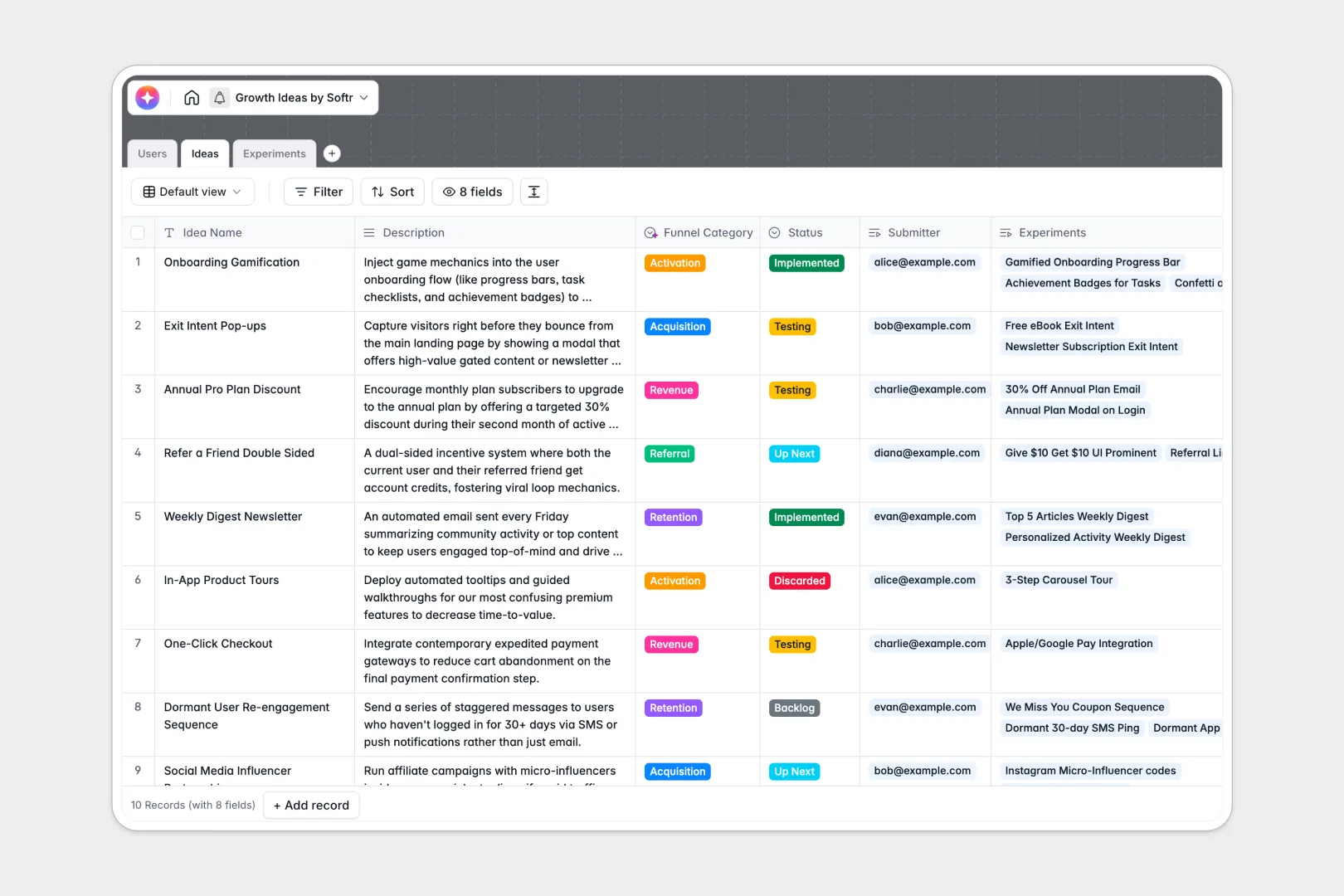
Your Growth Ideas database at a glance
This template helps growth teams track every concept from initial idea to completed experiment. It keeps your backlog clear and ensures results become actionable insights.
Users submit concepts into the Ideas table, which natively connects to tactical Experiments. You can instantly see who owns each test, its launch date, and whether the outcome was a success or failure.
Thanks to built-in AI, the database automatically categorizes your ideas into specific funnel stages. It also synthesizes your experiment results into recommended next steps instantly.
Why managing growth ideas in spreadsheets breaks down
Tracking hypotheses, statuses, and results across scattered spreadsheets usually leads to messy data. As your team runs more tests, filtering through hidden rows and broken formulas makes it impossible to see what actually moved the needle.
What a structured database changes
A rigid structure ensures dates remain dates, statuses stay perfectly consistent, and long-text hypotheses don't break your views. Nothing gets accidentally deleted or overwritten as your team scales.
Instead of fragile VLOOKUPs, you can link related records directly—connecting a single core idea to multiple tactical experiments naturally. This is exactly what Softr Databases are designed for.
What you can do with this template
Pre-configured views let you monitor your entire backlog and see exactly which tests are live, pending, or concluded. You can map out your entire growth funnel efficiently.
Using built-in Database AI agents, the system automatically writes actionable bullet points based on your hypothesis and results. Your team knows exactly what steps to take next without hours of manual synthesis.
-
Users
Manage team profiles, access levels, and assignments for growth initiatives
-
Ideas
Store growth concepts with AI categorization into funnel stages for prioritization
-
Experiments
Track test results using AI to generate recommended next steps for growth teams
Who is this Growth Ideas database for
This system is designed for teams running continuous testing and optimization cycles.
- Growth Managers: Track the status of every active experiment and measure pipeline momentum accurately.
- Marketing Teams: Submit new concepts and log them by specific funnel stages effortlessly.
- Product Teams: Review tactical experiment outcomes to make data-driven iteration decisions.
- Founders: Gain a bird's-eye view of what is currently being tested to drive revenue.
How to take it further
You can easily customize this database to fit your team's unique testing framework. Modify the funnel categories, add new status tags, or adjust the AI prompts to extract different insights entirely.
Import your existing backlog of ideas seamlessly. Upload a CSV of past tests so your historical data connects immediately to your new workflow.
When your team scales, you can build a full app directly on top of this structure. Turn this database into an internal portal where external stakeholders can submit ideas and view live dashboards.
By managing users and permissions, you can ensure contributors only edit their designated experiments. Everything remains secure while admins control the global strategy.
-
1
-
2
-
3
-
4
Frequently asked questions
-
What is a growth ideas database?
-
Why use a no-code database to build a growth tracking system?
-
How can AI help managing data for growth ideas?
-
Can I build an app with this growth ideas database?
-
Is this Growth Ideas template free?
-
How is a growth ideas database different from Google Sheets?
Start building today. It's free!
Build and launch your first app in under 30 minutes.