


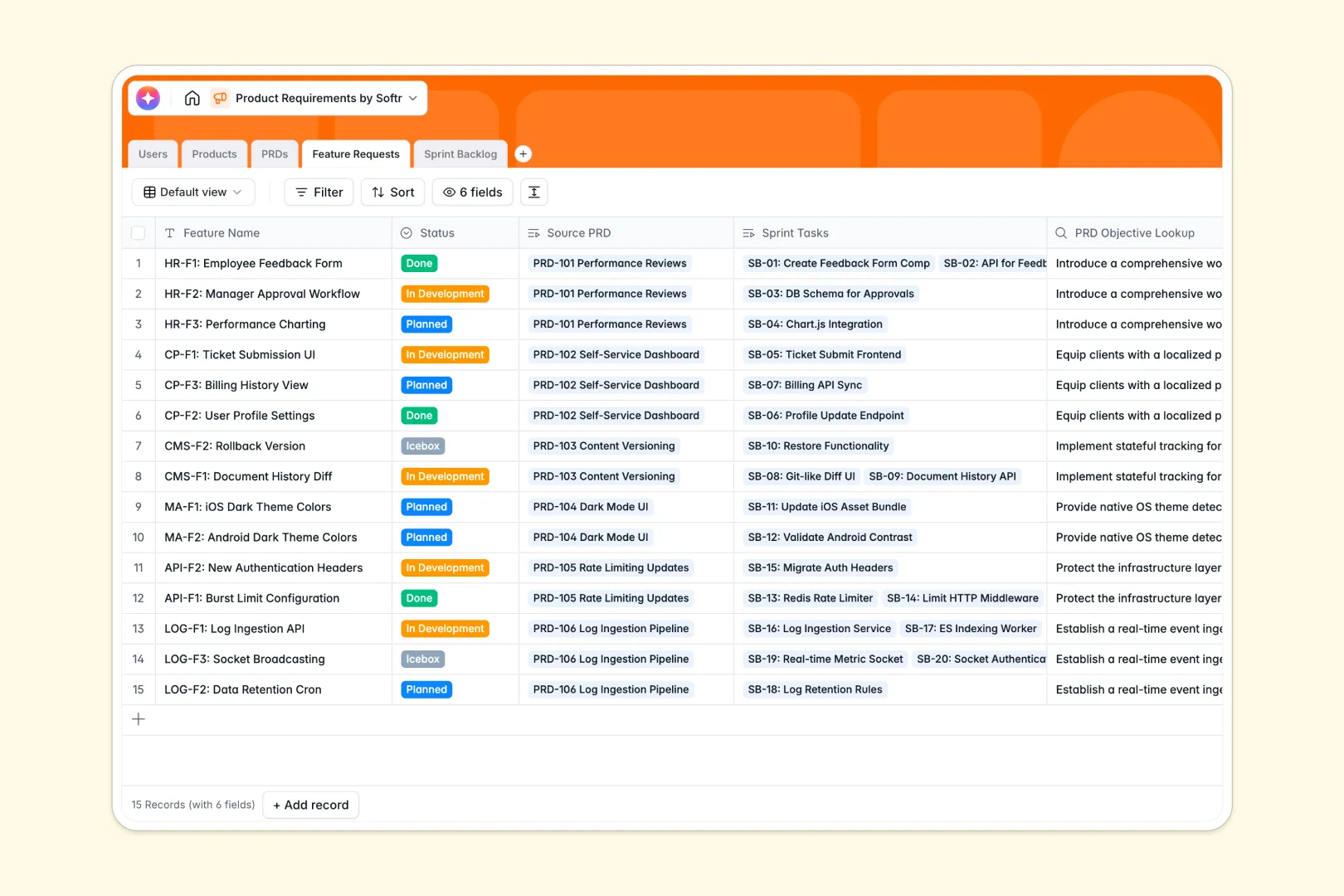
Your Product Requirements database at a glance
This template acts as a unified central repository for all product specifications, team members, and developmental tasks. It bridges the gap between high-level project objectives and daily engineering operations.
The setup maps products to explicit requirement documents, which then generate individual feature specs and task-level sprint items. Because roles are structurally defined, team ownership over every phase of product execution remains completely clear.
Built-in automation capabilities draft automatic summaries, requirements list, and acceptance criteria on demand. This saves hours of manual drafting directly within your data workspace.
Why tracking product requirements in Google Sheets breaks down
Product management relies on deep context and connected tasks, yet spreadsheets treat all data as flat, isolated rows. When feature definitions live in one cell and engineers pull tasks from another sheet, things quickly fall out of sync.
Without validation, critical details get overwritten, and engineers end up working on stale specifications. The visual representation of how a sprint task links to a product objective gets buried in complex lookup formulas.
What a structured database changes
A structured setup prevents format breaking and enforces consistency by mapping tasks natively to features. Data inputs stay typed and correct, meaning team attributes, draft statuses, and launch priorities never conflict.
This is exactly what Softr Databases are designed for. By establishing native visual relationships instead of fragile cell formulas, you can track cross-functional work without any fear of data corruption.
What you can do with this template
You can organize your entire hierarchy from high-level digital products to specific developer tasks in a single cleanly sorted repository. The structure acts as an interactive workspace that lets teams review, edit, and update draft statuses in real time.
This template also includes automatic text generation that can draft core feature summaries and baseline acceptance criteria instantly. This turns your tracking system into an intelligent asset that generates accurate foundational text as soon as your goals change.
-
Users
Manage team profiles, roles, and assignments across development cycles
-
Products
Define high-level product modules, categories, and designate owners
-
PRDs
Draft specifications with AI-generated summaries to align objectives
-
Feature Requests
Develop technical requirements using AI to translate PRDs into features
-
Sprint Backlog
Track tasks with AI-powered acceptance criteria and effort estimates
Who is this Product Requirements database for
This collaborative layout helps product teams coordinate planning and implementation details smoothly.
- Product Managers: Draft clean, structured requirements linked directly to specific products.
- Engineering Leads: Track actionable backlog tasks while reviewing accurate technical specs downstream.
- Designers: Maintain full visibility on incoming feature flows and structural objectives.
How to take it further
Customize the database
You can adapt the predefined structure within moments to fit your unique methodology. Add customized select fields for technical disciplines, rename development tracking stages, or map separate test metrics to your existing feature records.
Import your existing data
Move your initial specs and user directories directly into this system via CSV file import or API connection. It lets you centralize scattered documents into one single source of truth without starting from absolute zero.
Build a full app around it
When you want to deliver this data to external stakeholders, you can easily develop customized interfaces. This lets you hide raw tables behind secure users and permissions rules.
Different teams see only the tasks or products assigned directly to them. This ensures a clean, distraction-free environment for both external clients and developer teams.
-
1
-
2
-
3
-
4
Frequently asked questions
-
What is a product requirements database?
-
Why use a no-code database to build a product requirements system?
-
How can AI help managing data for product requirements?
-
Can I build an app with this product requirements database?
-
Is this Product Requirements template free?
-
How does this template keep product specs structured better than Google Sheets?
Start building today. It's free!
Build and launch your first app in under 30 minutes.