


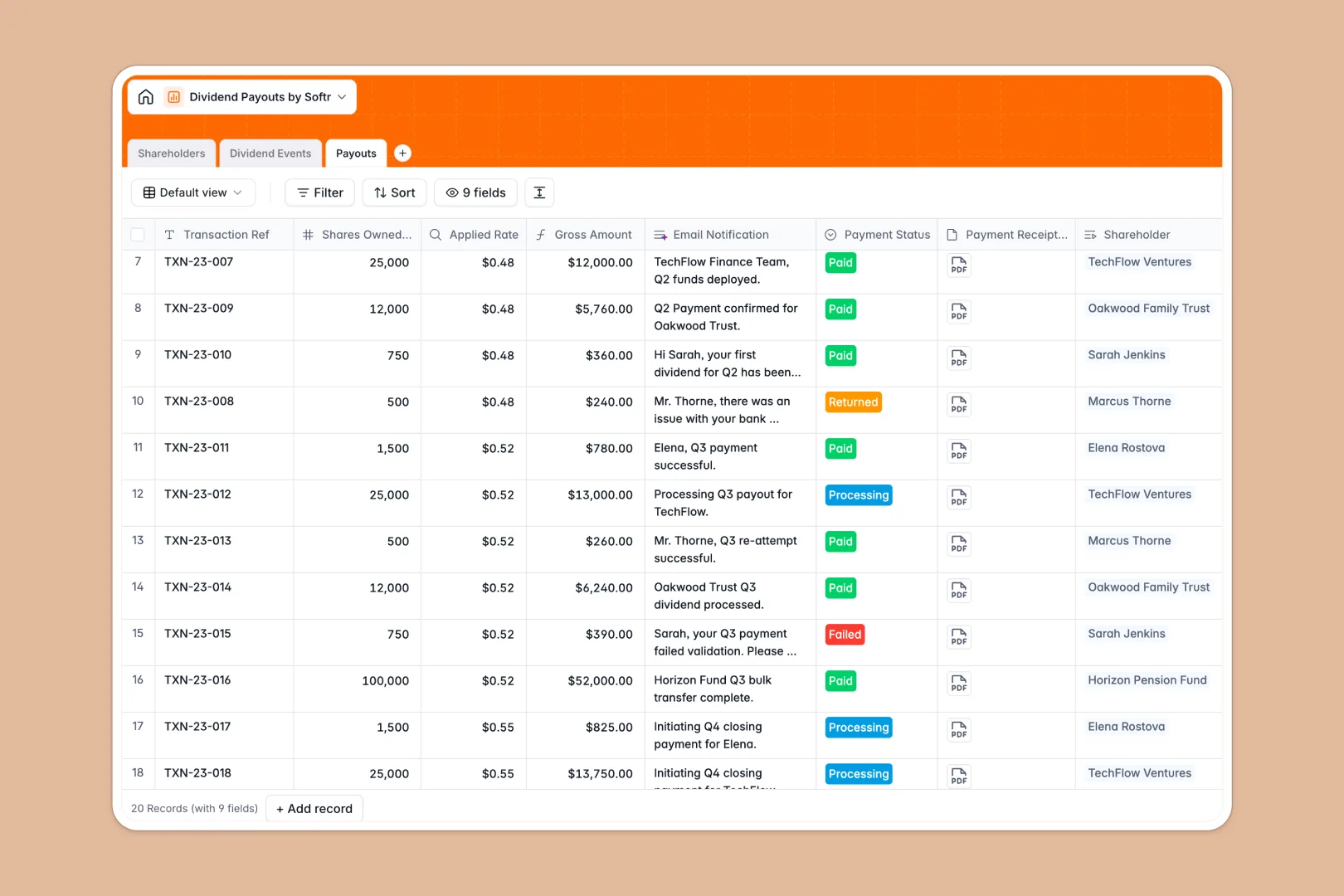
Your Dividend Payouts database at a glance
This template manages your equity distributions from board declaration to disbursement. It centralizes shareholder registries, tracks dividend events, and accurately calculates individual payout amounts.
The system links Shareholders directly to Dividend Events through dedicated Payouts records. Lookups pull per-share rates instantly, while automatic formulas calculate the gross amount owed based on shares owned at the record date.
Built-in AI fields draft investor distribution announcements, research corporate entity backgrounds, and write personalized payment confirmation emails for each recipient.
When a single shared workbook risks silent distribution errors
Distributing capital requires absolute precision, but maintaining dividend records in desktop workbooks frequently causes version conflicts. When multiple finance leads email separate files, banking details drift, calculations diverge, and sensitive equity figures get exposed to unintended recipients.
What a structured database changes
A structured database enforces strict data integrity across your entire cap table. Numeric share counts remain numbers, transaction receipts stay attached to the exact payout record, and relational links eliminate copy-pasted formulas.
Calculations like gross amounts update automatically based on linked dividend rates, preventing broken references when rows move. This reliable foundation is exactly what Softr Databases provide for financial operations.
What you can do with this template
Declare a distribution event once and generate itemized shareholder payout lines with real-time status tracking from processing to paid. Native rollups summarize total distributed capital per event and cumulative payouts per investor.
With integrated Database AI agents, you can automatically generate investor updates and shareholder payment notifications directly within your tables.
-
Shareholders
Manage shareholders and share counts with AI-researched entity profiles
-
Dividend Events
Track dividend distribution declarations and draft AI investor updates
-
Payouts
Process individual payout records and generate AI payment notifications
Who is this Dividend Payouts database for
This database helps finance and legal teams execute equity distributions with complete accuracy:
- Finance Directors: Oversee company-wide distribution events and monitor total capital distributed with automated rollups.
- Cap Table Managers: Maintain clean shareholder records, banking details, and historical distribution logs in one place.
- Family Offices: Track complex equity distributions across individuals, pensions, and family trusts without manual calculation errors.
- Startup Founders: Execute investor payouts cleanly with transparent record dates, payment statuses, and downloadable receipts.
How to take it further
You can easily tailor this template to match your corporate governance structure. Add custom tax withholding fields, include secondary banking details, or configure specific approval stages for your treasury team.
If you already manage investor records elsewhere, bring your data over instantly. Use CSV imports for bulk share counts or connect via API to sync transactions with your external accounting software.
When your team is ready, generate an app with AI on top of this database in seconds. You can provide private investor portals with strict users and permissions, allowing shareholders to review their payout history and download payment receipts while keeping the full cap table hidden.
-
1
-
2
-
3
-
4
Frequently asked questions
-
What is a dividend payouts database?
-
Why use a no-code database to build a dividend payouts system?
-
How can AI help managing data for dividend payouts?
-
Can I build an app with dividend payouts database?
-
Is this Dividend Payouts database free?
-
How is a dividend payouts database different from a desktop Excel file?
Start building today. It's free!
Build and launch your first app in under 30 minutes.