


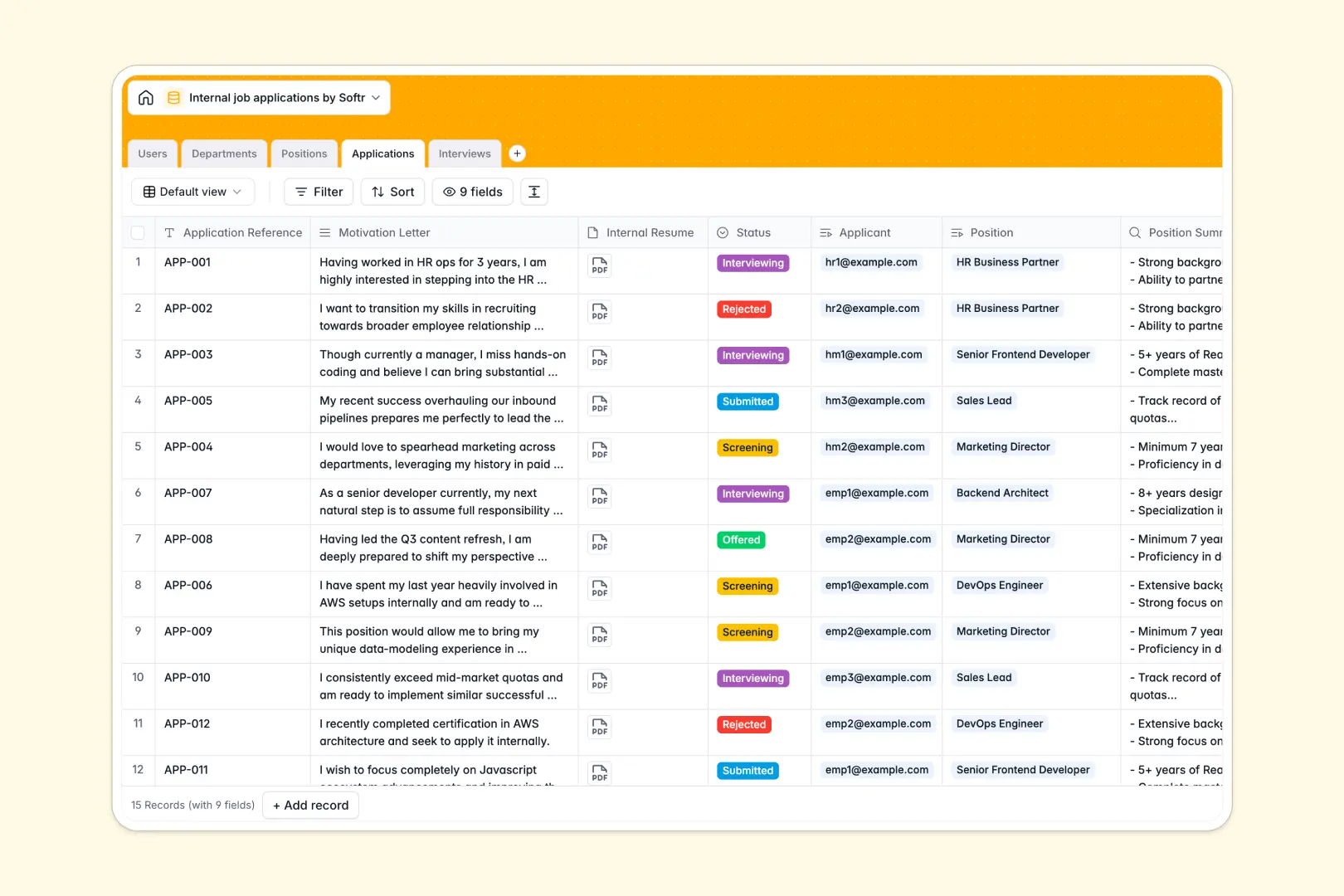
Your Internal Job Applications database at a glance
This template gives HR teams and hiring managers a clean, structured way to track internal talent mobility. It centralizes open positions, employee applications, and interview feedback so nothing gets lost in disorganized email threads.
Because it is built on a relational structure, everything natively connects. You can instantly see which employees belong to which departments, map applications to specific open roles, and track interview outcomes automatically.
Built-in AI agents also act on your data automatically to eliminate manual screening. The database evaluates candidate motivation letters against role requirements, extracts concise role summaries, and synthesizes raw interview notes into clear feedback.
Why managing internal job applications gets messy in Excel
When internal hiring scales, keeping track of resumes, changing role requirements, and scattered interview notes across rigid Excel rows quickly breaks down. Columns get cluttered with walls of text, and sensitive candidate files inevitably get misplaced.
What a structured database changes
Instead of duplicating employee data across different spreadsheet tabs, a structured system uses clear, native connections. Every application naturally links to the right employee, the hiring manager, and the open position without relying on fragile formulas that break easily.
It also keeps your data types strictly enforced as your roster grows. Resumes are stored as actual attachments, application statuses are protected dropdowns, and feedback is securely bound exclusively to specific interview stages.
This is exactly what Softr Databases are designed for. You get a real system of record that scales with your company while keeping internal hiring organized, compliant, and easy to navigate.
What you can do with this template
You can immediately log open positions, track internal candidate submissions, and schedule upcoming interviews without complex manual setup. The template is logically mapped out and ready to capture complex connections right out of the box.
Using native AI features, you can also effortlessly automate manual hiring work. The system will automatically generate concise bullet points for long job descriptions and assess candidate alignment in real time.
-
Users
Manage employee profiles, contact details, roles, and hiring involvements
-
Departments
Organize business units and departmental structures with assigned personnel
-
Positions
Catalog open roles with AI-powered summaries of requirements and status
-
Applications
Track submissions with AI-driven candidate matching to evaluate alignment
-
Interviews
Log meeting feedback with AI synthesis of key takeaways from notes
Who is this Internal Job Applications database for
This system is built for teams that prioritize internal talent development and want to streamline the transition process.
- HR Admins: Maintain a single source of truth for open roles, employee applications, and company mobility tracks.
- Hiring Managers: Review screened applications, evaluate AI profile matches, and log structured interview feedback effortlessly.
- Department Heads: Monitor internal talent pipelines proactively and coordinate role transitions seamlessly.
How to take it further
Customize the database
You can easily tailor this template to your specific internal hiring rituals. Add new application status stages or adjust the AI prompts to evaluate candidates based on your own company's cultural values.
Import your existing data
Move away from legacy spreadsheets permanently by uploading your current open roles and employee roster via straightforward CSV import. You can also connect via API to sync employee profiles continuously from your existing HR software.
Build a full internal app around it
When you are ready to scale, you can transform this database into a secure internal mobility application. You can easily build out a custom portal where employees can safely browse departments and apply for open positions.
Because your operations are perfectly categorized, adding robust users and permissions takes just a few clicks. This inherently ensures hiring managers only see applications for their assigned roles, while employees strictly see their own private application statuses.
-
1
-
2
-
3
-
4
Frequently asked questions
-
What is an internal job applications database?
-
Why use a no-code database to build an internal hiring tool?
-
How can AI help managing data for internal job applications?
-
Can I build an app with an internal job applications database?
-
Is this Internal Job Applications template free?
-
Why do internal applications get messy in Excel?
Start building today. It's free!
Build and launch your first app in under 30 minutes.