


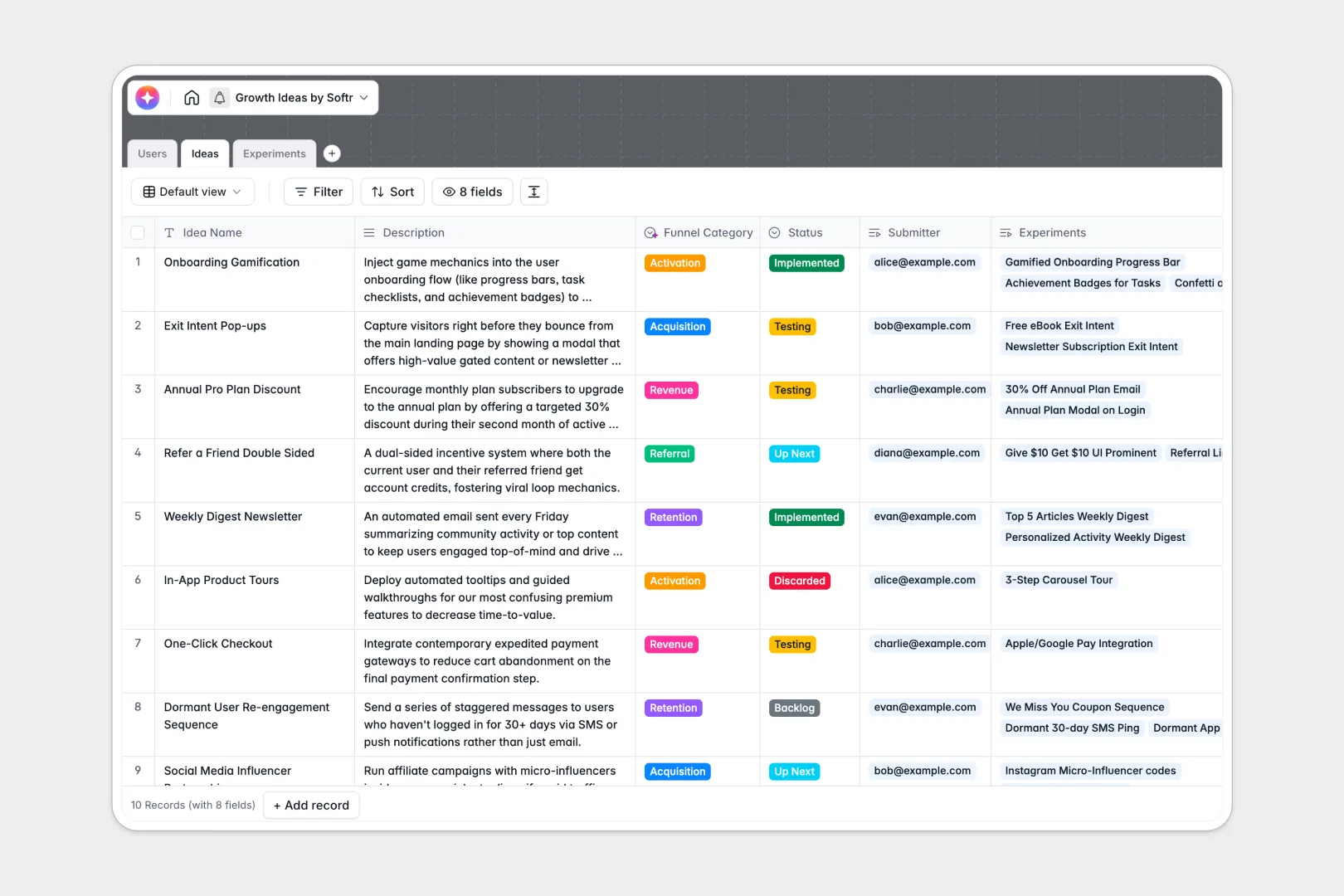
Your Growth Ideas Database at a glance
Track every concept from backlog to concluded experiment in one unified system. This template ensures your team’s ideas are securely captured and directly tied to measurable tests.
Three cleanly connected tables—Users, Ideas, and Experiments—replace disconnected tabs entirely. You can instantly see which team member submitted an idea and roll up exactly how many active experiments are assigned to it.
Built-in AI automatically sorts backlog ideas into core funnel categories based on your written description. When a test concludes, it can also instantly synthesize your hypothesis and results into actionable next steps.
Why tracking growth ideas in Excel breaks down
When scaling growth initiatives, static spreadsheet rows get messy fast. Brainstorms get lost, tests lose their hypotheses, and you can't reliably map finalized results back to the original concept.
What a structured database changes
Relational mapping takes the chaos out of testing. Instead of copying and pasting cells to update a status, individual experiments natively link to your overarching ideas without breaking formulas.
Column types enforce structure so dates remain dates and rollup counts stay perfectly accurate. This is exactly what Softr Databases are designed for—keeping critical strategy data intact as your velocity increases.
What you can do with this template
Log brilliant concepts immediately and spin them into tactical experiments with zero friction. You can visually separate what is merely a draft versus what is actively live without digging through endless sheets.
Native Database AI agents eliminate tedious manual analysis along the way. The system auto-categorizes your marketing funnel focus and drafts post-mortem recommendations automatically, keeping your team focused on executing the next test.
-
Users
Manage team members with access roles and track their growth experiment ownership
-
Ideas
Store growth concepts with AI categorization into funnel stages for strategic planning
-
Experiments
Execute ideas using AI to generate key next steps from hypothesis and result data
Who is this Growth Ideas database for
Built specifically for teams moving too fast to rely on fragile spreadsheets.
- Growth Managers: Track the exact lifecycle of an idea from a backlog concept to a concluded live test.
- Marketing Teams: Quickly sort active campaigns by funnel acquisition stages and share documented results.
- Founders: Get immediate visibility into which experiments are succeeding or failing without asking for updates.
How to take it further
Make this template perfectly match your internal testing framework. You can quickly edit the funnel categories or modify the experiment status dropdowns to fit your team's specific language.
Moving off your messy spreadsheet is entirely painless. Just upload a CSV to instantly map your historical experiments into this properly unified structure.
When your volume of ideas scales, you can easily build a full team portal around this foundation. A well-structured backend makes it incredibly simple to attach friendly layouts for your different departments.
By layering proper users and permissions, you can let external contractors submit new ideas safely while restricting experiment ownership to trusted administrators.
-
1
-
2
-
3
-
4
Frequently asked questions
-
What is a Growth Ideas database?
-
Why use a no-code database to build a growth tracking system?
-
How can AI help manage data for growth experiments?
-
Can I build an app with this growth database?
-
Is this Growth Ideas template free?
-
How is a growth database different from Excel?
Start building today. It's free!
Build and launch your first app in under 30 minutes.