


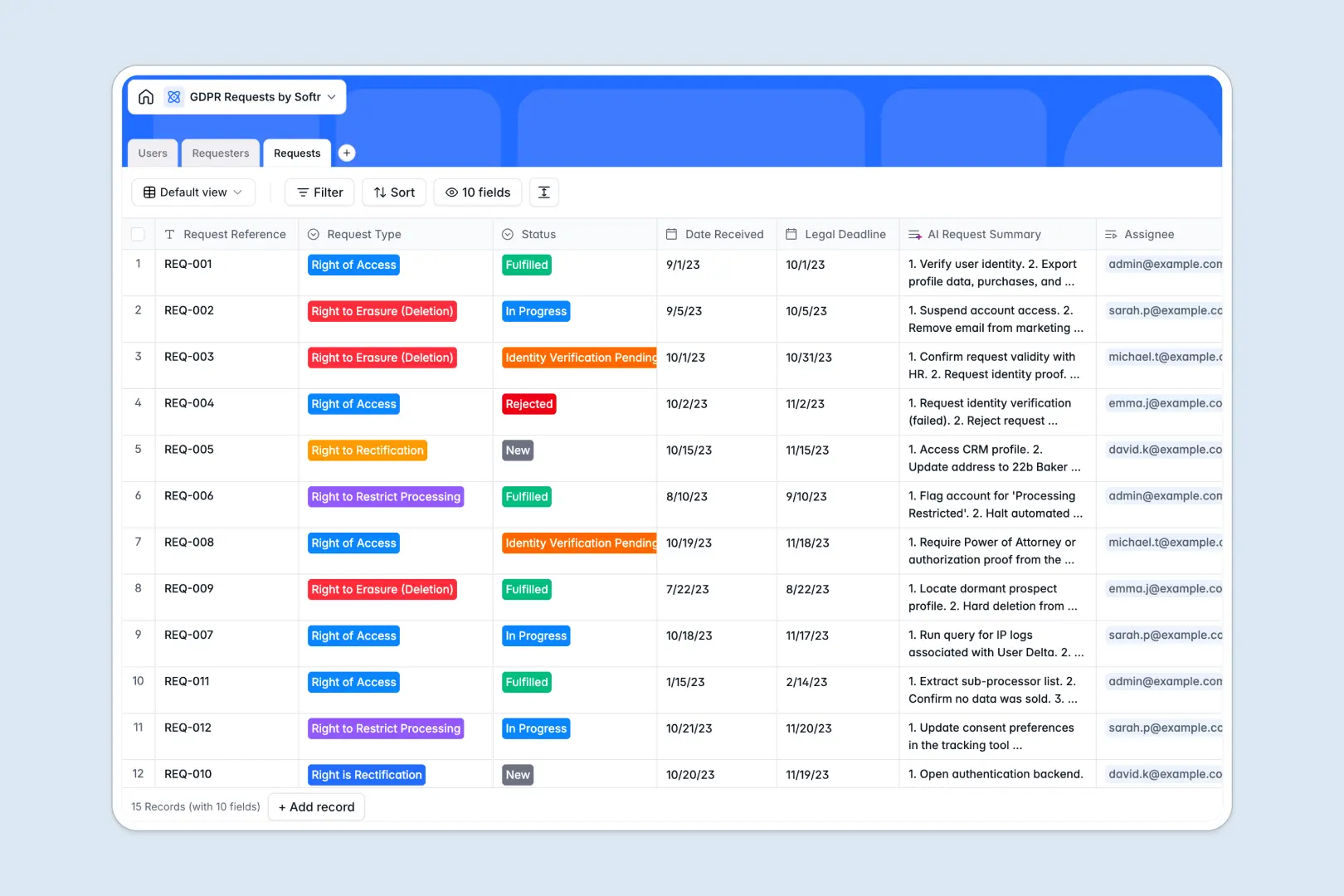
Your GDPR Requests Database at a glance
Track every privacy request, monitor legal deadlines, and securely manage data subjects in one compliant workspace.
Manage internal staff responsible for privacy actions, link external requesters to their specific cases, and securely upload evidence of resolution directly to the record.
Built-in AI automatically reads long request descriptions and instantly extracts the exact actionable steps needed to fulfill them.
Why GDPR requests get messy in Excel
Managing privacy compliance in a spreadsheet quickly turns into an automated nightmare. When you rely on Excel, legal deadlines are easily missed, and highly sensitive data gets scattered across unprotected tabs.
What a structured database changes
In a relational system, data stays pristine and connected. You can link a subject's erasure request directly to their verified identity profile without fragile formulas or messy copy-pasting.
This is exactly what Softr Databases are designed for. Every column enforces a strict type, so deadlines stay as dates, status dropdowns remain consistent, and attached resolution evidence is stored safely on the record.
What you can do with this template
Forget manually parsing long, complex data demands from users. With built-in Database AI agents, your workspace instantly summarizes request descriptions into clear, actionable fulfillment steps.
You can seamlessly track identity verification status, assign specific cases to your internal privacy agents, and monitor if your team is within the legal deadline from a single, organized view.
-
Users
Manage internal staff profiles, roles and assignments for privacy requests
-
Requesters
Store data subject profiles with identity verification and request history
-
Requests
Track GDPR actions from intake to fulfillment with AI-generated step summaries
Who is this GDPR Requests database for
This structured workspace is built for compliance, legal, and operations teams managing data subject rights.
- Data Protection Officers: Monitor the entire privacy pipeline and ensure critical legal deadlines are never missed.
- Legal & Compliance Teams: Maintain a secure, centralized audit trail of incoming requests and resolution evidence.
- Customer Support: Log right-to-access and erasure tickets efficiently while assigning them to the right internal privacy agent.
How to take it further
Customizing this database is incredibly simple. You can easily add new request types, adjust the status dropdown to match your internal workflow, or create new fields to track country-specific privacy laws.
Getting started is immediate and completely seamless. You can efficiently import your existing backlog of privacy requests or customer directory via CSV, ensuring no historical data is left behind.
Instead of just tracking internal tasks, you can transform this system into a secure compliance portal. By connecting your database to Softr's interface builder, you can quickly create an app where users log in to securely submit and manage their own privacy requests.
You have deeply granular control over users and permissions to keep everything safe. This ensures internal staff only see the requests explicitly assigned to them, while external subjects only ever access their own private data.
-
1
-
2
-
3
-
4
Frequently asked questions
-
What is a GDPR requests database?
-
Why use a no-code database to build a GDPR management tool?
-
How can AI help managing data for GDPR requests?
-
Can I build an app with this GDPR requests database?
-
Is this GDPR Requests template free?
-
Why is a database better than Excel for tracking GDPR compliance?
Start building today. It's free!
Build and launch your first app in under 30 minutes.