


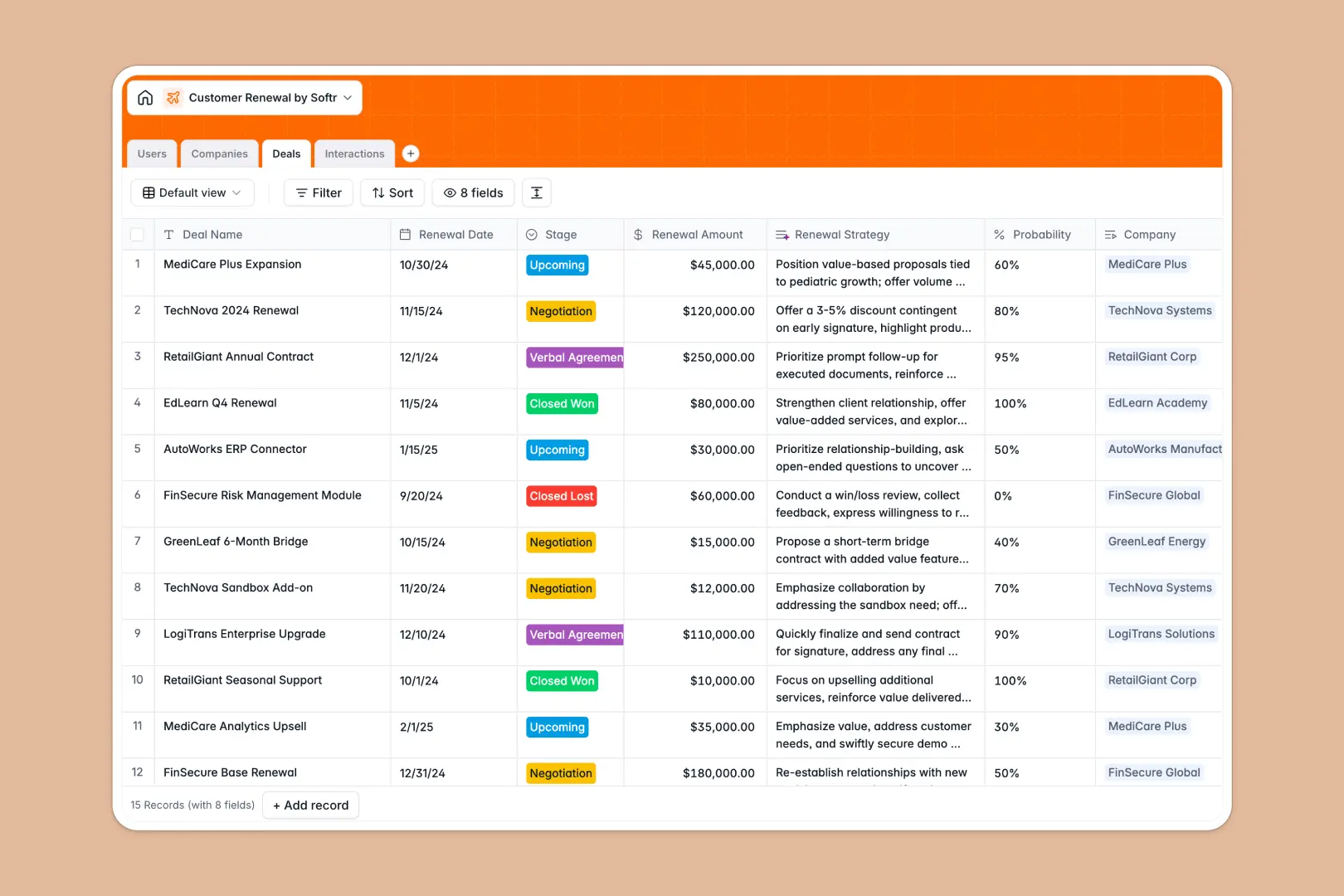
Your Customer Renewal Database at a glance
The Customer Renewal Database helps account managers track upcoming deals, log interactions, and monitor overall account health in one centralized place.
It connects your customer companies directly to specific renewal deals and meeting notes, replacing scattered workflows with a reliable, connected system.
Built-in AI automatically researches company segments directly from the web, generates negotiation workflows, and rapidly extracts action items from your call notes.
Why tracking renewals in Excel breaks down
Managing customer retention and renewals in spreadsheets quickly becomes chaotic. As your client base grows, keeping track of scattered interactions, updated health scores, and shifting contract dates across multiple rows leads to missed opportunities and broken workflows.
What a structured database changes
Unlike flat spreadsheets, a structured database keeps your pipeline organized by connecting records naturally. You can link a recent QBR or phone call directly to a company and its active renewal deal without relying on fragile VLOOKUPs.
This is exactly what Softr Databases are designed for. Every column enforces clear formatting, ensuring deal amounts stay as currency, dates remain strictly filterable, and health scores use standardized tags.
What you can do with this template
You can log every customer ticket, accurately track deal probabilities, and calculate total contract values across all managed accounts instantaneously.
Thanks to native Database AI agents, this template also works in the background automatically. It pulls industry data from the live web and analyzes the sentiment of your meeting notes to flag churn risks early.
-
Users
Manage internal account managers with their roles and assigned customer accounts
-
Companies
Track client health with AI-powered industry classification and company research
-
Deals
Monitor renewal stages and use AI to suggest targeted negotiation strategies
-
Interactions
Log customer meetings using AI for sentiment analysis and action item extraction
Who is this Customer Renewal Database for
This customizable template is built specifically for revenue generation, relationship management, and success teams.
- Customer Success Managers: Track account health scores and monitor interaction history before diving into reviews.
- Account Executives: Keep a close eye on upcoming renewal dates, deal probabilities, and negotiation stages.
- Sales Leaders: Get a bird's-eye view of total contract values and at-risk accounts across the entire department.
How to take it further
Start by customizing the database to match your exact sales process. You can easily adjust the deal stages, tweak the health score categories, or add new columns to track product usage metrics.
Next, import your existing data so your team sees immediate value. You can upload a CSV of your current active accounts or use the API to sync recent renewals directly into your tables without missing a beat.
When your process scales, you can build a full app around it. Create a secure internal tool where managers interact easily with the data backend.
By leveraging built-in users and permissions, you can ensure Account Managers only see and edit their assigned companies, while admins get full ecosystem visibility. A well-structured database makes launching these custom apps effortless.
-
1
-
2
-
3
-
4
Frequently asked questions
-
What is a customer renewal database?
-
Why use a no-code database to build a customer renewal tool?
-
How can AI help managing data for customer renewals?
-
Can I build an app with this customer renewal database?
-
Is this Customer Renewal Database free?
-
Why is a renewal database better than Excel?
Start building today. It's free!
Build and launch your first app in under 30 minutes.