


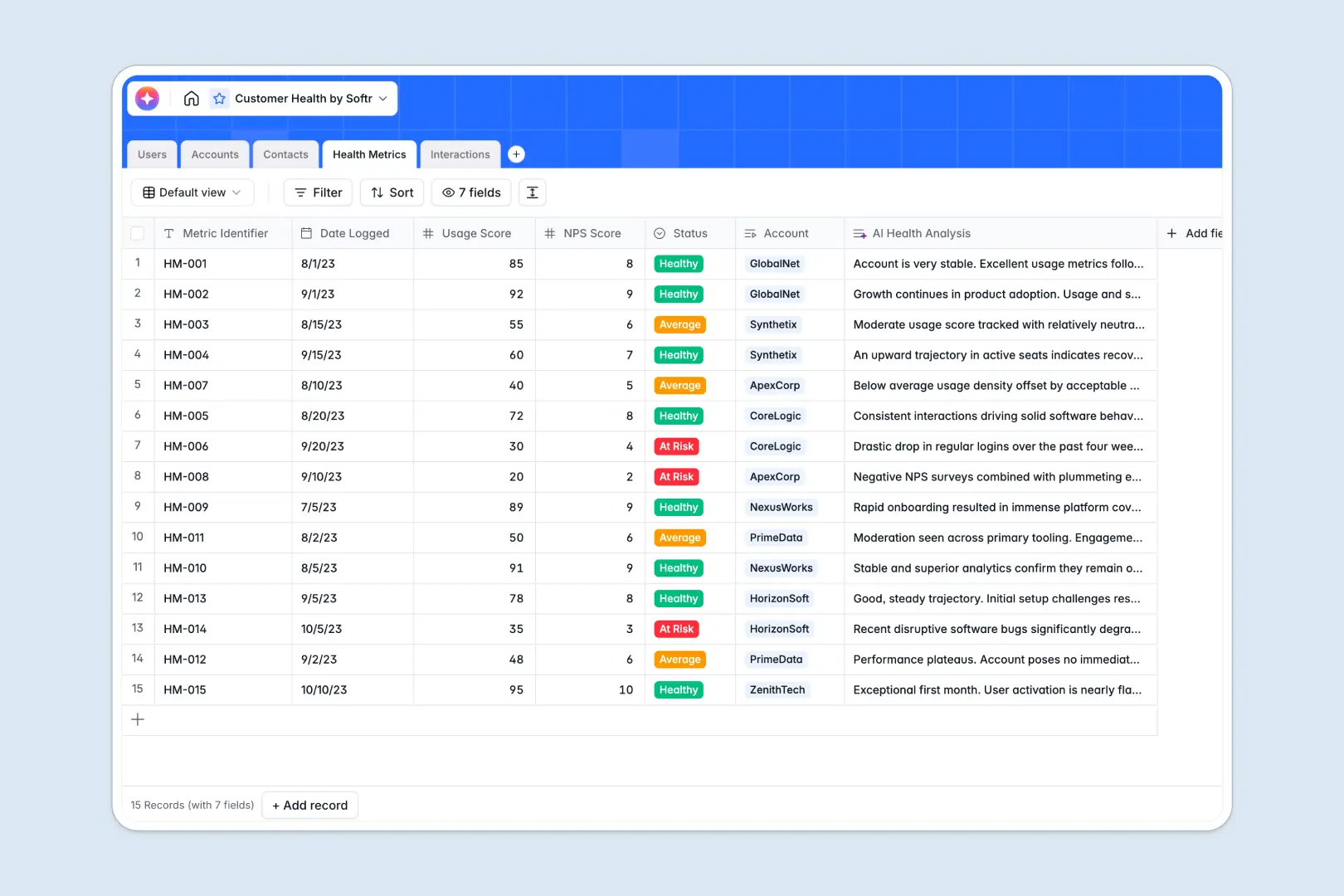
Your Customer Health Database at a glance
Tracking overall client sentiment and mitigating churn shouldn't mean digging through scattered notes. This database centralizes your accounts, champions, and health scores so CSMs stay proactive.
It links five key tables—Users, Accounts, Contacts, Health Metrics, and Interactions. Log a support escalation or QBR once, and it automatically updates the specific contact and broader account history.
Built-in AI automates the heavy lifting. The database instantly pulls company overviews from the web, summarizes account risk levels, and extracts action items directly from meeting notes.
Why managing customer health in spreadsheets breaks down
Spreadsheets quickly become chaotic when tracking customer success. Pasting meeting notes into tiny cells is frustrating, and linking an escalation to multiple contacts requires messy, fragile formulas.
What a structured database changes
A structured database gives every piece of data a dedicated home. Dates stay formatted perfectly, statuses are locked to specific choices, and interactions link seamlessly without a single VLOOKUP.
This is exactly what Softr Databases are built to handle. As your portfolio grows, your data stays clean, organized, and entirely connected.
What you can do with this template
You can instantly view a complete timeline of interactions and health metrics for any given enterprise, professional, or starter account.
Powered by Database AI agents, this template automatically evaluates churn risk and defines next steps from call notes. This ensures your CS team stays focused on the client, not the admin work.
-
Users
Manage Customer Success Managers and admins including roles and accounts
-
Accounts
Track customer companies with AI-powered overviews and overall health
-
Contacts
Maintain a directory of client stakeholders and champions for each account
-
Health Metrics
Monitor account performance using AI to analyze risk and sentiment scores
-
Interactions
Log client meetings and use AI to automatically extract vital action items
Who is this Customer Health Database for
This template provides immediate structure for teams managing client retention and success:
- Customer Success Managers: Track day-to-day interactions and monitor account health metrics over time.
- CS Leaders & Directors: Get a bird's-eye view of portfolio risk, NPS scores, and team performance.
- Account Managers: Keep a detailed directory of key stakeholders and identify internal champions effortlessly.
How to take it further
Because this is a native Softr Database, you can adjust it to match your exact processes. Add new fields, tweak the health statuses, or adjust the dropdown options for interaction types like onboarding and QBRs.
If you are migrating from a messy spreadsheet or legacy CRM, you can easily pull in your past data via CSV upload or API push.
When your team is ready, you can transform this raw database into a fully custom internal tool. Using Softr's interface builder, you can create a custom front-end dashboard for your team.
By configuring users and permissions, you easily ensure that each CSM only sees the specific accounts and health metrics assigned directly to them. A well-structured database makes this kind of app development effortless.
-
1
-
2
-
3
-
4
Frequently asked questions
-
What is a customer health database?
-
Why use a no-code database to build a customer health tool?
-
How can AI help managing data for customer health?
-
Can I build an app with customer health database?
-
Is this customer health database free?
-
How is a customer health database different from a spreadsheet?
Start building today. It's free!
Build and launch your first app in under 30 minutes.