


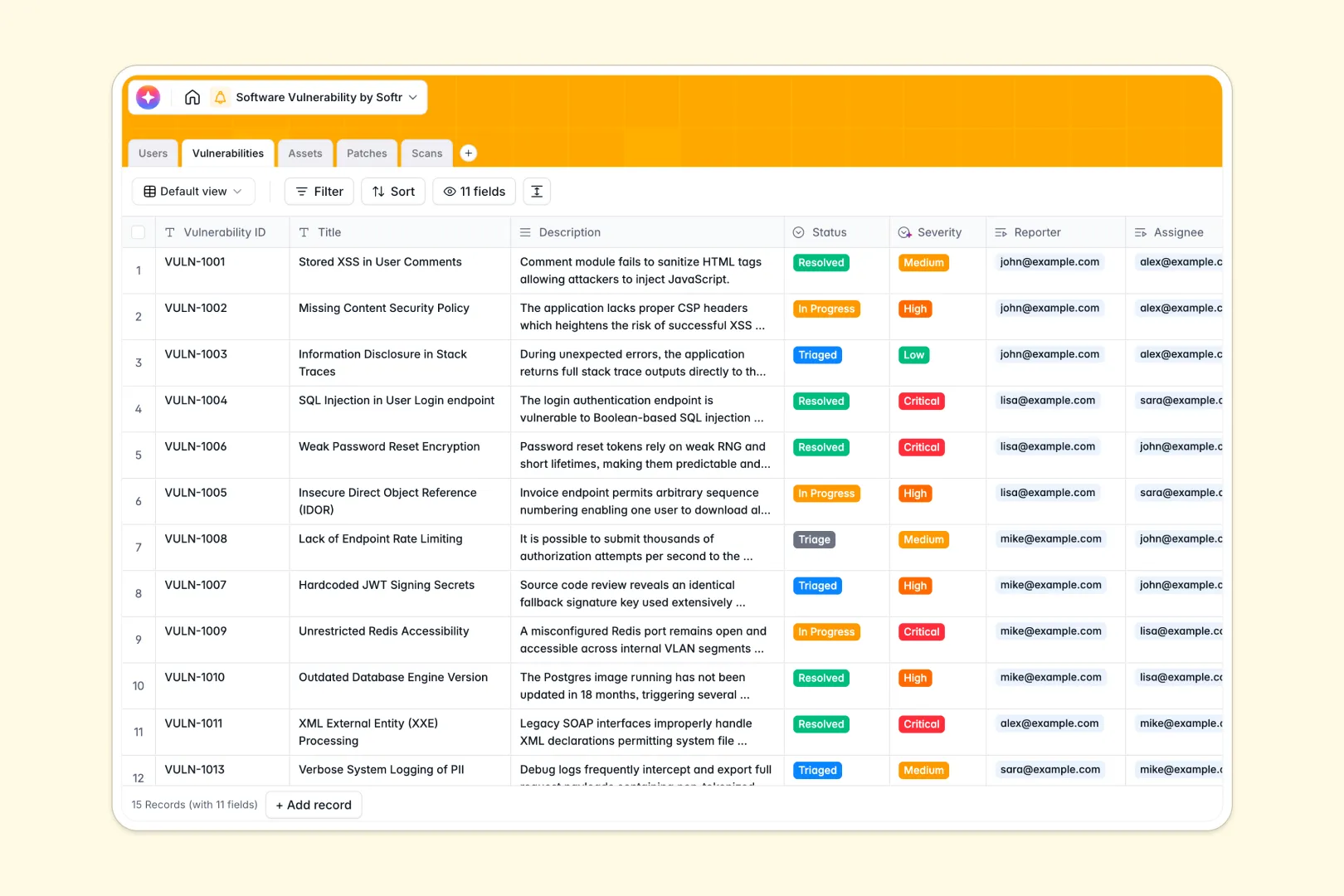
Your Software Vulnerability database at a glance
This template helps security operations, developers, and internal risk teams systematically log, analyze, and track software security flaws. Gain complete visibility over your threat surface in one unified space.
Keep track of vulnerabilities, critical business assets, automated scans, and active patches across different environments. Every vulnerability is linked to the exact team member responsible, making sure that coordination on critical issues runs without friction.
Because this template relies on smart database engineering, it comes with built-in automation. The built-in artificial intelligence summarizes complex vulnerability descriptions for your executive team and automatically categorizes vulnerability risk tiers so you can focus on what is critical.
What to check before building your software vulnerability base in Airtable
If you work on an active engineering or IT team, you need a single place to track system patches and security warnings. While starting with a relational tool makes total sense, there are critical limitations to keep in mind when tracking sensitive risk data in Airtable.
What changes with a database built for apps
Security response teams often have different stakeholders, including compliance managers, external risk researchers, engineers, and leadership. Under standard collaboration structures, sharing database access with teams or external experts forces you into expensive per-seat pricing models that scale aggressively.
This is exactly what Softr Databases solve by offering unlimited database collaborators out of the box. Additionally, enterprise-level vulnerability tracking easily runs into record capacity limits on basic database tiers, whereas Softr provides higher limits and a faster API.
Most importantly, vulnerability data shouldn't be exposed directly to all database viewers. Rather than building raw tables that require third-party tools to secure, a database with custom apps and granular access layers allows you to present filtered information directly to developers, partners, and auditors.
What you can do with this template
- Track assets and vulnerabilities jointly: View software assets side-by-side with open security warnings to see immediately which production resources are exposed.
- Enrich data automatically: Leverage built-in Database AI agents to run real-time web lookups for vendor advisory pages as new assets are added.
- Standardize raw data reports: Map automated security scan logs down to specific systems, maintaining a structured, auditable history of vulnerability records.
-
Users
Track team members managing vulnerabilities, contacts, and access levels
-
Vulnerabilities
Track bugs with AI-generated summaries and AI-evaluated severity scores
-
Assets
Manage monitored components using AI to gather vendor security advisory data
-
Patches
Deploy software updates with release notes drafted automatically by AI
-
Scans
Log run times and raw report files of security assessment pipelines
Who is this Software Vulnerability database for
- SecOps & Security Teams: Keep a clean, central repository of validated security events and system impact maps.
- Engineering Managers: Assign patches directly to developers and monitor software release deployment health.
- IT & Compliance Auditors: Retain automated system scan logs and documented patch releases to prove compliance posture.
- Product Security Researchers: Log incoming vulnerabilities, draft executive summaries, and track the status of bug fixes.
How to take it further
Customize the database
You can easily tailor this template to your team's workflow within the native Softr Database. Adjust vulnerability status tags, add custom severity options, or connect specific compliance frameworks like SOC2 or ISO 27001 to your tracked assets.
Import your existing data
Move away from disconnected spreadsheets and text lists. You can easily import your current inventory of software assets, open issues, and patch history instantly using a CSV upload or configure automated ingestion pipelines using the API.
Build a full app around it
Once your data is clean, you can easily use the AI app generator to generate a custom, secure portal on top of this database. Build tailored user interfaces for research teams to report bugs, and customized Dashboards where engineers see only their assigned patches.
By leveraging users and permissions, you can ensure that developers can only edit issues assigned directly to them, while leadership receives clean executive dashboards. Building workflows directly connected to your data saves hours spent on manual reporting.
-
1
-
2
-
3
-
4
Frequently asked questions
-
What is a software vulnerability database?
-
Why use a no-code database to build a software vulnerability system?
-
How can AI help managing data for software vulnerabilities?
-
Can I build an app with this software vulnerability database?
-
Is this software vulnerability template free?
-
How is this template different from an Airtable template?
Start building today. It's free!
Build and launch your first app in under 30 minutes.