


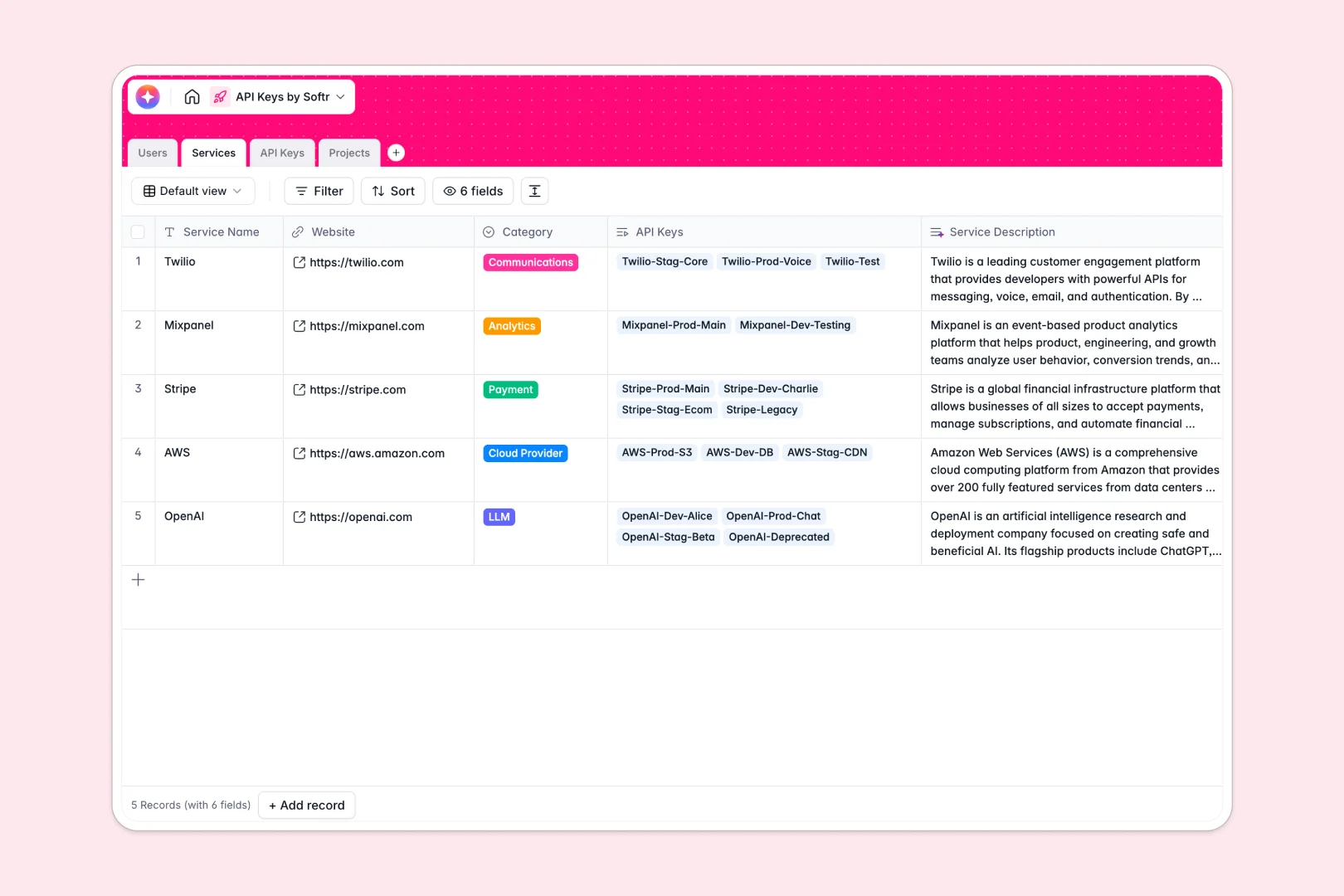
Your API Keys database at a glance
Securely centralize and track your development credentials, third-party services, and internal users in one centralized hub.
Keep key assignments organized by linking your raw keys directly to specific projects, responsible team members, and integrated services.
Automate key classification using built-in AI to evaluate operational risk levels and summarize service categories instantly.
What to check before building your API keys base in Airtable
Managing technical credentials requires maximum security, real-time access control, and seamless collaboration. While building an API keys tracking system of this scale in Airtable is structured, several operational thresholds are worth considering before you start.
What changes with a database built for apps
Traditional systems charge per collaborator, which adds up quickly when multiple developers and project managers need to inspect or update record statuses. Using Softr Databases grants you unlimited collaborators, allowing you to invite your entire development and product teams without paying extra seat fees.
Credential management also scales rapidly as your projects diversify. Softr supports up to 200,000 records per database and features a robust API that is 10 times speedier than legacy platforms, ensuring seamless performance.
What you can do with this template
This template is ready for immediate deployment. You can track status fields like active, revoked, or expired and let custom intelligence evaluate risk levels based on the key environment.
It features built-in Database AI agents that auto-generate service descriptions and blueprints. This gives you self-maintaining tables that help prevent compliance drift.
-
Users
Track team members with roles, contact info, and system access levels
-
Services
Manage third-party providers with AI-generated business summaries
-
API Keys
Centralize credentials with AI-powered security risk classification
-
Projects
Organize applications requiring credentials with AI-crafted blueprints
Who is this API Keys database for
This database is built for technical teams looking to streamline credential distribution securely.
- DevOps Engineers: Standardize credential registration, assign ownership to team members, and track rotation schedules.
- Engineering Managers: Keep high-level overviews of active projects, connected platforms, and active environment risk.
- Product Owners: Understand which third-party APIs are integrated without digging through direct source code.
How to take it further
Tailor your status tags, add custom risk categories, and modify security clearance fields. You can adjust all properties instantly in this native Softr database.
Bring your current inventory of credentials over with a secure CSV upload. Alternatively, sync real-time status updates using a secure API connection.
When your workflows grow, you can easily build an app on top of this structure. Use the co-builder to instantly generate an internal credential portal.
You can then enforce strict users and permissions rules. This ensures that developers can only view their assigned keys, while administrators maintain complete global oversight.
-
1
-
2
-
3
-
4
Frequently asked questions
-
What is an API keys database?
-
Why use a no-code database to build an API keys system?
-
How can AI help managing data for API keys?
-
Can I build an app with an API keys database?
-
Is this API Keys Database template free?
-
How is this template different from an Airtable template?
Start building today. It's free!
Build and launch your first app in under 30 minutes.