State of AI Report: 40 statistics for businesses in 2026


We’re way past the point of businesses just testing the water when it comes to AI. Adoption has scaled across all departments—not just IT and software engineering—and teams are running processes, building tools, and automating workflows with AI at every step. And while not every organization is approaching adoption the same way, the data points in one direction: AI is becoming foundational to how most modern businesses operate.
We've brought together the latest research and statistics to give you a clear picture of the state of generative AI for business in 2026, from agents and vibe coding to integration challenges and a look at what comes next.
AI is transforming how businesses build software
Building software used to mean hiring dedicated engineering teams and spending months on development. Today, AI tools and vibe coding—where non-developers can generate applications through natural language prompts—have upended that process. But there are limits to how far vibe coding can take you.
- Three out of four large organizations—those bringing in over $20 billion in annual revenue—have now piloted or scaled generative AI for software development. (Capgemini)
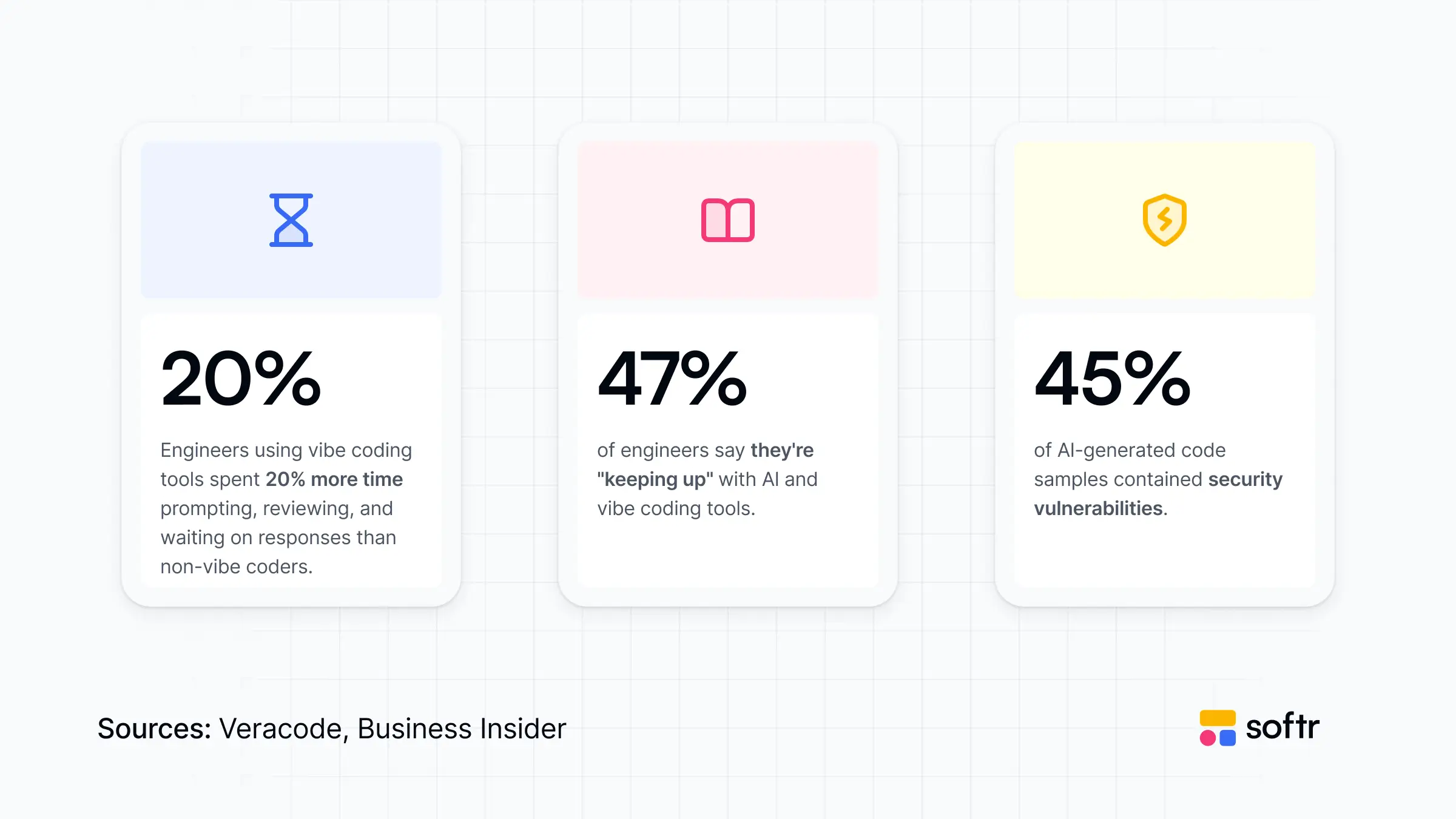
- Nearly half of software engineers (47%) say they’re “keeping up” with AI and vibe coding tools, while around 18% say they’ve opted out of using AI for coding entirely. (Business Insider)
- In a coding test, engineers using AI vibe coding tools spent 20% more time prompting models, reviewing outputs, or waiting on responses — making them less productive overall than non-vibe coding participants. (Business Insider)
- In a study of over 100 LLMs, 45% of AI-generated code samples surfaced security vulnerabilities. (Veracode)
- 63% of those using vibe coding tools are non-developers. (Vercel)
- 44% of vibe coders use it to generate UI elements, 20% to build apps, and 11% to create personal websites. (Vercel)
- Only about 33% of developers say they’d feel very confident using vibe coding tools to build and maintain business-critical apps. (Bubble)
👉 Vibe coding gets you to a demo, Softr gets you to production: Unlike AI coding tools that hand off fragile, unmaintained code, Softr's AI Co-Builder generates complete, working software that's secure and ready for real users from day one.
AI agent adoption is on the rise
While AI for consumers is still largely about interacting with general-purpose LLMs—asking questions, drafting text, generating images and videos—the business world is moving decisively toward AI agents: systems that can plan and execute multi-step workflows with minimal human input.
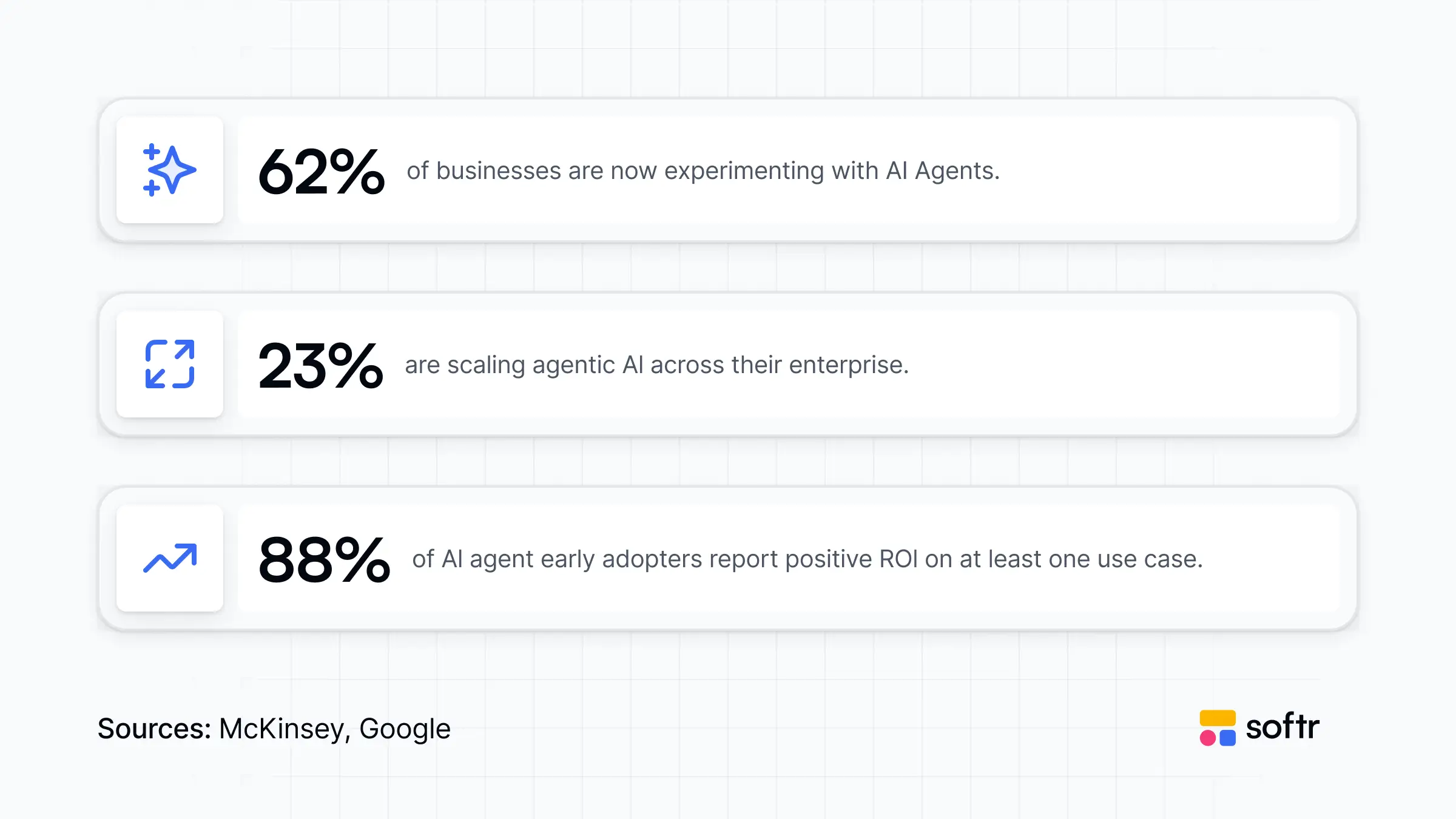
- As of November 2025, 62% of businesses have begun to at least experiment with deploying AI agents, and 23% are scaling an agentic AI system within their enterprise. (McKinsey)
- Over 4 in 5 business leaders plan to have integrated AI agents by 2027. (Capgemini)
- Broken down by industry, AI agent use is most common in media and communications, tech, and healthcare sectors. (McKinsey)
- Per Google’s 2026 report, nearly 4 in 5 (88%) early adopters of AI agents are seeing positive ROI on one or more generative AI use cases. (Google)
- Customer service is the most popular use case for agentic AI, and 49% of organizations have now deployed customer service AI agents. (Google)
- While agent use is growing, 66% of business executives say human-AI collaboration has resulted in productivity and decision quality gains. (Capgemini)
👉 Softr's AI is built for everyday use, not just experiments: With the AI Co-Builder, Database AI Agents, and Ask AI, your team can create business apps, automate workflows, and query live data in a single platform.
Businesses are shifting toward custom AI solutions
Since off-the-shelf AI tools don’t often meet the specific needs of complex organizations, businesses are increasingly turning to custom-built or in-house solutions. Many teams want the freedom to build AI tools and agents that align with their actual workflows.
- More than 3 in 4 enterprises (78%) use or plan to build in-house generative AI tools instead of relying on third-party software. (Writer)
- 39% of employees say they want the opportunity to build or design their own AI tools to use at work. (Writer)
- 83% of companies consider sovereign AI moderately to extremely important for their strategic planning, with 43% rating it as a critical priority. (Deloitte)
- 85% of businesses expect to customize AI agents to better align with their use cases. (Deloitte)
- Despite many teams showing interest in custom AI, 77% of executives still prefer proprietary AI for performance and integration reasons. (Capgemini)
- 44% of businesses buy off-the-shelf AI solutions, 31% build AI in-house, and another 25% mix buying and building on a case-by-case basis. (Capgemini)
Non-technical teams are becoming AI power users
The data shows that AI has quickly become democratized in the workplace — and not just for developers or IT departments. Across marketing, HR, finance, legal, and operations teams, workers are integrating AI into their workflows at a rapid pace.
- Employee AI use is widespread across all teams—not just tech-oriented ones—with worker access to AI tools rising by 50% in 2025. (Deloitte)
- As of November 2025, Investment in AI adoption for sales and marketing teams (63%) has surpassed investment for IT operations departments (55%) in all regions. (Capgemini)
- Sales and marketing teams are even more optimistic about the possible economic value of AI than software engineers — predicting 28% total share of total economic value vs 25%. (McKinsey)
- Cross-departmentally, employees are three times more likely to be using AI than executive leaders expect. (McKinsey)
- 41% of US employees state they would increase their daily usage if they had better access to AI tools at work. (McKinsey)
👉 Softr puts the power to build in the hands of every team: Whether you're in sales, marketing, HR, finance, or operations, Softr lets you build and run AI-powered systems without any technical background or developer assistance.
Integration challenges are a barrier to AI deployment
Massive growth in the AI space means there are now a massive number of AI tools and vendors to choose from. For businesses, this can lead to teams using (and paying for) a sprawling mix of AI apps that don’t talk to each other. To avoid integration headaches, many organizations are working to consolidate their tech stacks.
- 94% of executives report that they’re not fully satisfied with the generative AI vendors they’re using. (Writer)
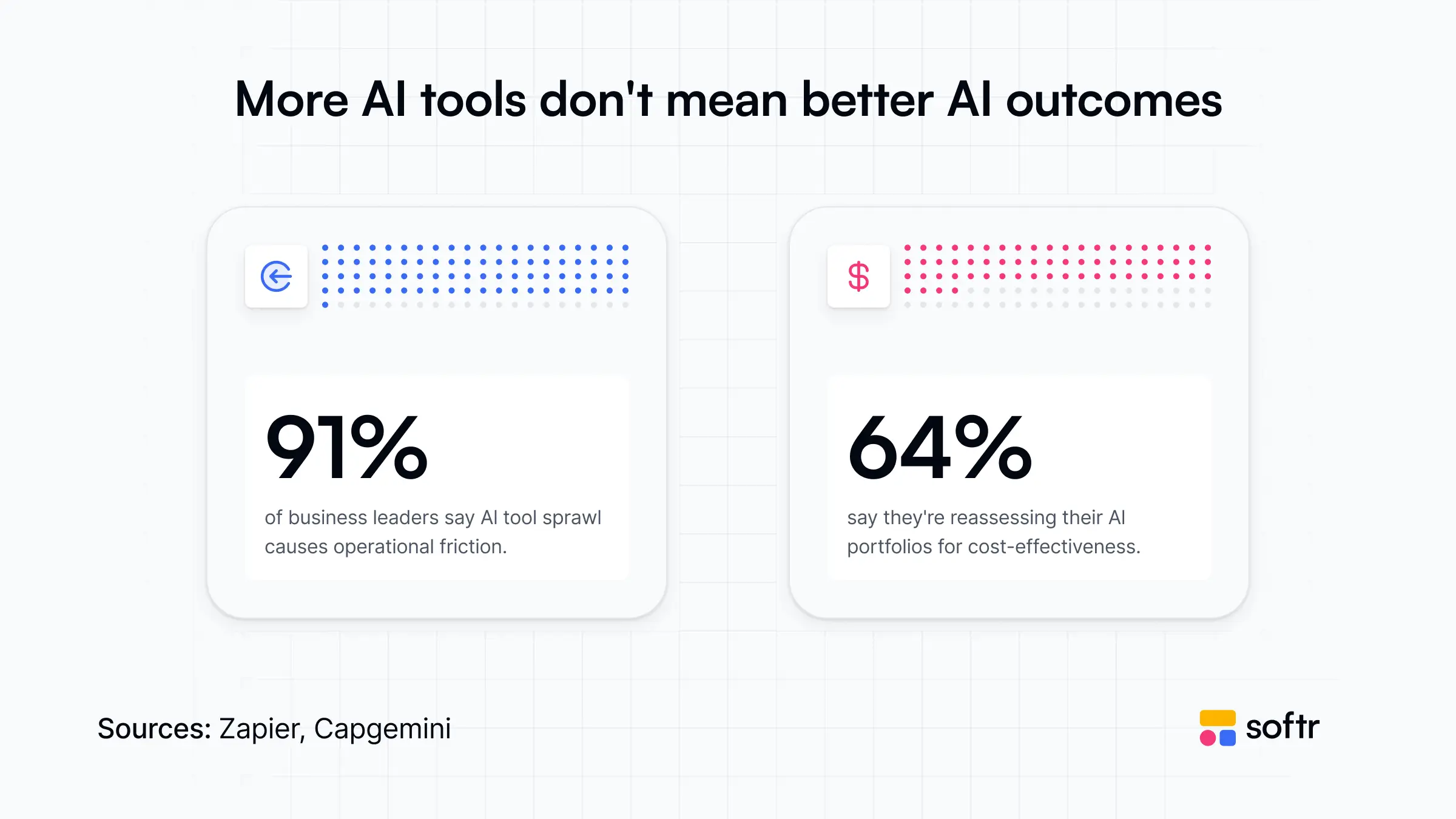
- 91% of enterprise leaders say they’re experiencing some degree of friction due to AI tool sprawl. (Zapier)
- 1 in 4 organizations report high costs as a result of managing separate AI tools. (Zapier)
- 64% of businesses say they’re reassessing their AI portfolios to ensure the tools they use are cost-effective and aligned with overall strategy. (Capgemini)
- 30% of North American businesses list issues with compatibility and legacy systems as top barriers to AI adoption. (McKinsey)
- Another 42% of businesses specifically note difficulty integrating AI with existing systems as a key blocker to scaling AI. (McKinsey)
👉 Softr replaces the sprawl with a single platform: Instead of stitching together disconnected AI tools, you get AI-powered app building, databases, workflow automation, and integrations all in one place.
Many businesses still have AI security and governance concerns
AI adoption is accelerating fast, and that’s given rise to concerns about proper security and governance guardrails. For most businesses, deploying AI raises questions about data exposure and privacy, compliance, and who is accountable when something goes wrong.
- As of now, just 21% of businesses report having a mature governance model for AI agents. (Deloitte)
- Employees’ top concern about generative AI is the potential for cybersecurity and privacy risks (73%), trumping model quality and consistency (46%) and workforce displacement (30%). (Deloitte)
- 38% of leaders state that they lack trust in the security protocols of AI vendors. (Zapier)
- 54% of businesses list AI data control as a priority, particularly to ensure sensitive or regulated data remains secure. (Capgemini)
- Gartner predicts that, by 2027, over 40% of AI-related data breaches will occur due to improper use of generative AI tools. (Gartner)
👉 Apps built with Softr AI are secure by default: Softr is SOC 2 Type II certified and GDPR compliant, with audit logging, role-based access and permissions, and server-side rules enforced automatically.
AI shows no signs of slowing down
Even as organizations grapple with tool sprawl, integration challenges, and unproven returns, most leaders are doubling down on AI adoption. Studies show we can expect to see a significant increase in business AI use and investments even within the next couple of years.
- Over 9 in 10 business leaders say they expect to continue investing in AI at the same or higher levels even if they don’t see positive ROIs in the next 12 months. (BCG)
- The number of companies using agentic AI at least moderately is set to rise from 23% to 74% in just two years. (Deloitte)
- More than half of businesses (53%) see AI as a long-term capability tool with an investment horizon of five or more years. (Capgemini)
- 75% of tech-centric businesses expect AI to have a significant impact on their organization in the long-term — even as short-term uncertainty looms. (Capgemini)
- 4 in 5 organizations plan to shift their AI strategy to focus on foundational capabilities like data and infrastructure over the next two to three years. (Capgemini)
Build AI tools your business can rely on with Softr
The data is clear: AI adoption is deepening, broadening, and accelerating. But it's far from frictionless. Many teams are navigating tool sprawl, integration hurdles, security concerns, and a growing gap between what off-the-shelf AI and vibe coding tools promise and what they really deliver.
Businesses that can expect to see the most value going forward are being intentional about how their AI tools integrate, how they're governed, and how accessible they are to every team (not just technical ones).
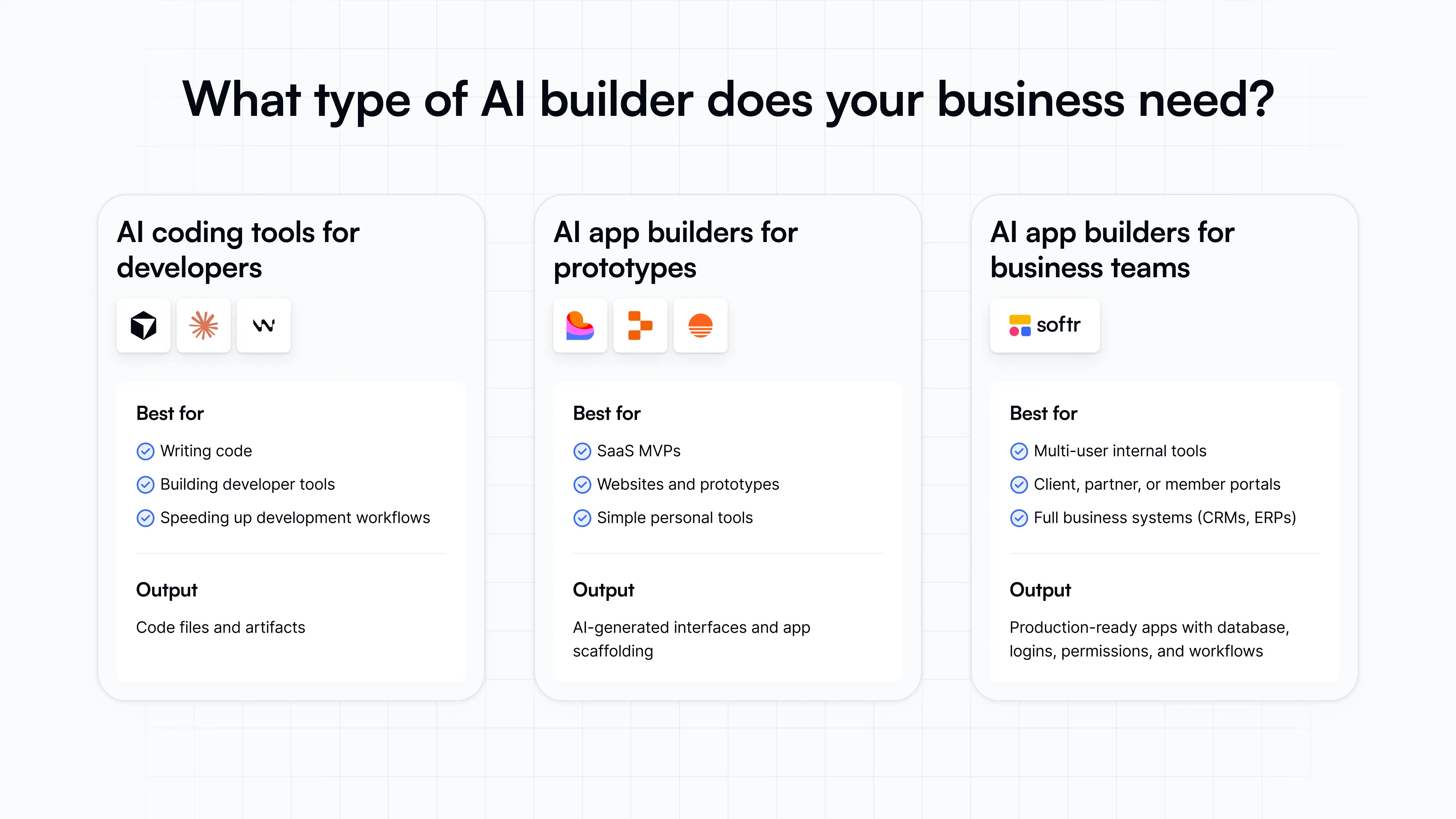
Instead of stitching together siloed AI tools, Softr gives teams a unified, no-code platform for building software, automating workflows, and managing data at scale — without the bugs and security risks of pure vibe coding. Build AI systems your business actually needs, on a foundation it can rely on.
Try Softr free and use the AI Co-Builder to generate a fully-functional app—interface, database, and business logic—in minutes.