How to build a no-code MVP for SaaS startups


[.blog-callout]
TL;DR
- An MVP is the smallest version of your product that real users can try, built to validate an idea before you invest heavily in it.
- The classic five-step loop still applies in 2026: research, business model, feature prioritization, build, and feedback.
- Building without code is the fastest and cheapest path. Describe your idea to Softr's AI Co-Builder and get a working app with a database, authentication, and permissions in minutes.
- An MVP built on Softr isn't a throwaway prototype. It ships production-ready, so the same app can evolve into the software your business runs on every day. [.blog-callout]
Starting a business once seemed like an unattainable goal, requiring massive cash investment and technical expertise. With the rise of no-code and AI app builders, anyone with a computer and enough motivation can now build and launch real software.
But where to start? Whether you're validating a startup idea or building a tool your team needs, this guide will help you understand what an MVP is, how to build one without code, and (just as important) how to make sure what you build can grow with you instead of being thrown away after launch.
If you'd rather skip straight to building, grab a free app template and customize it to your idea.
Let's get started!
What is an MVP?
A Minimum Viable Product (MVP) is the first version of a product or feature, with just enough functionality to be used by early adopters, who can in turn provide feedback. The concept was created in 2001 by Frank Robinson, and popularized by Eric Ries in his book The Lean Startup a decade later.

In essence, an MVP is a "pure" version of a business idea, taken to its most simple state, used to confirm whether that idea is good or not by sharing it with potential customers. Think of some of these simple examples that reflect the idea behind an MVP:
- Do you think you're a good cook and want to open a restaurant to share your sushi crepes' original recipe? Start by sharing a stand at a local food market and giving out free samples.
- Do you want to build an app for barbershops to book and manage appointments, with a payment interface and music playlist? Find the most pressing issue you can solve for barbers and focus on that first.
- Are you hoping to open a jewelry store with your custom creations? Start by approaching local stores that can sell your current inventory so you don't have to invest in renting right off the gate.
Do you get the idea? This is a massive shift from the way entrepreneurs or businesses have traditionally gone about launching new products. Let's compare the old and new ways of doing things to understand the reasoning behind the MVP methodology and why it makes sense.
One important update to the classic MVP playbook, though: an MVP no longer has to be disposable. With modern platforms, the version you use to validate your idea can be the same app you scale with real users, which changes the math considerably. We'll come back to this.
The old way to build a business
To start a new business, traditional businesses would typically invest a lot of money (sometimes their entire life savings for some entrepreneurs) and resources upfront. They would then take months or even years to focus on building it, before releasing it into the world when they consider it to be perfect and ready to hit the market.
Pros:
- The ability to release a finished, polished product in the end
Cons:
- Very expensive, this method requires a lot of people and cash over a significant period of time
- Extremely dangerous to build something in a bubble without real-world validation from users. What if no one wants it?
Best for:
- Massive enterprises with big internal (and maybe confidential) projects
- Companies with millions of dollars to spare in R&D
The new way to build a business
Modern businesses, and especially lean teams, have adopted the agile methodology, an approach to software development and project management consisting in working on small, consumable deliverables instead of huge projects.
For founders and operators, this means working on a minimum viable product (MVP) version of a project, focusing on a single key feature, constantly iterating according to user feedback, and eventually pivoting (remodeling the entire core product) if necessary.
Pros:
- Fast way to figure out if an idea is worth pursuing.
- A great method to understand the core value of your project.
- Financially responsible. If an idea doesn't stick, you should move on.
Cons:
- Not for the faint of heart. It takes a lot of energy and self-reflection to be able to truly embrace.
Best for:
- Small, agile teams or founders.
- SaaS startups and lean businesses with little upfront investment.
- Teams validating an internal tool or portal before rolling it out company-wide.
The second option likely makes more sense for you if you're reading this. So let's take a look at what an MVP development cycle can look like.
The 5 steps framework to build a successful MVP
Building a Minimum Viable Product (MVP) is an instinctive iterative process. Nothing groundbreaking here, but the important thing is to keep to some key principles which, trust us, is easier said than done:
- Keep it short and simple: By definition, this should stay a truly simple product
- Set up a business structure: At the MVP stage, you can act as your own registered agent to set up your LLC, helping establish legal separation and credibility early on.
- Trust your users: As hard as it might be sometimes, they're the ones that will potentially pay. So listen to them.
- Think of the money: Monetization might come back and bite you down the line. This shouldn't be the main focus, but have a plan (or several) in mind.
- Know when to let go: Not every project will work out, and that's fine.
These apply throughout the entire process, which we've broken down into 5 steps.
Research (market + customer)
Ideally, you should be building something that addresses a problem you've faced yourself. This is probably the most logical way to go about it.
But regardless of whether you're familiar with the pain points on a personal level or not, you must conduct thorough market and customer research to validate whether your idea (and/or your focus for the MVP) is worth pursuing. There are several ways to go about this:
- Surveys sent out to relevant communities and/or using dedicated tools.
- Interviews with potential users, in person or online.
- Competitor research using platforms like G2 or Capterra.
If you really want to go full-on startup mode, you can even leverage Softr to create landing pages without code for your upcoming product (before you even start working on it) and spread the word online to see if interest is spiked at all. This is a great way to validate your idea without investing much time and energy at all.
Business model definition
This is a bit controversial but could save you a lot of blood, sweat, and tears in the long run (a bit dramatic, sorry).
A flawed business model is one of the top reasons why startups fail, and it's no wonder. With the amount of energy it takes to build a product, gather a team, set communication, and more, it's really easy for monetization to take a backseat and become an afterthought. Additionally, founders are often idealistic and believe providing a great product should be their number one priority.
This is a great sentiment and a commendable way to approach things but can become a double-edged sword when it comes to business.
While you don't need to have a 4-year financial forecast ready by the time you build your MVP, having a business model in mind is instrumental in how the user experience will be shaped and shouldn't be left to the last minute. Something to keep in mind.
Feature prioritization
Going back to your overall idea, chances are you have a full-fledged, complex product in mind. But whether that idea is a customer relationship management tool with payment processing abilities or a vendor portal with built-in document management, you need to simplify it.
The entire goal of an MVP is to strip down your idea to its core value, in order to validate whether this is something users might be interested in.
It is a difficult but very valuable exercise, which will force you to refine your idea and project. Not only will this allow you to focus on what matters most, but it will also help you formulate a clear value proposition. Ask yourself these questions:
- What problems are you solving?
- What are your users currently doing to address this problem?
- Why should they change the way they're currently doing things? What's in it for them?
- What makes your approach different?
These questions will help you define things and break down your idea further. And remember the principles we mentioned earlier: Talk to your users, and trust their answers, even if it means accepting your idea is, well, not that good.
Product development
Time to get your hands dirty! This is supposed to be the fun part but can turn into a world of pain without the right methodology. A lot of companies and entrepreneurs stay stuck at this stage and never manage to release anything.
This is where our principles will once more come in handy. Remember that the goal is to release something, not to put out a perfect version of your product. Reid Hoffman, the founder of LinkedIn, has a famous quote that reflects the mindset you should be in:
"If you are not embarrassed by the first version of your product, you've launched too late."
When it comes to the practical aspects of building your MVP, head to the next section to go into detail about your options.
Feedback (and back to the top)
That's it, your MVP is ready! Now is the time to share it with users and gather feedback to see if your idea is a good one, if you should adjust, or if it's really not that pressing of an issue for your audience.
In order to validate your idea, there are multiple ways you can get feedback:
- Running customer interviews, either in test groups or with individuals
- Creating online marketing campaigns using landing pages and ads to get users to sign up
- Sharing your MVP with other makers in online communities such as Indie Hackers, Facebook communities, or launching on Product Hunt.
Be careful about that last point, however. Even though we love how online communities have been instrumental in our success, you have to be mindful that feedback on your MVP should primarily come from your target audience. If your product is aimed at senior citizens, for example, feedback from other startup founders shouldn't hold as much weight as live usability testing with people that would actually use your product.
There are plenty of ways to get feedback on your MVP, depending largely on the nature of your project and your target audience.
How to build an MVP?
There are three main ways you can go about building your MVP: Developing it yourself with developers, externalizing to an agency, or building it without code. Let's look at each scenario:
Developing an MVP in-house
Most "legacy" companies and enterprises go for this solution when building a new feature. For smaller startups and lean teams, however, it might not be the wisest choice.
Pros:
- Totally tailor-made
Cons:
- Very expensive: developer costs, hosting, etc
- Technical: Do you have the skills or team to build an app from scratch?
- Time-consuming: Can quickly turn into a huge undertaking, defeating the purpose of an MVP (moving fast and iterating)
Externalizing the development
Another option is to deal with an external agency to build your MVP for you. While costly, this has some benefits.
Pros:
- Access to developers for a lesser price
- Very customizable
Cons:
- Expensive: Web development agencies come at a hefty price tag
- Quality: You'll have to resort to someone else building your product and will likely need to make some compromises along the way
- Time: This option can also take a significant amount of time
Building an MVP without code
This last option is our favorite (did you guess?). Using an AI no-code solution such as Softr, startups, operators, and entrepreneurs can build their MVP without technical knowledge, at a fraction of the cost.
Pros:
- Affordable: Softr pricing starts with a free-forever plan
- Non-technical: Anyone can start building without prior technical experience
- Fast: The AI Co-Builder turns a description into a working app in minutes, so you spend your time refining, not configuring
- Production-ready: Authentication, permissions, and hosting are built in, so your MVP can take real users from day one
Cons:
- Effort: You do have to build it yourself, though AI does most of the work for you
- Fit: If your end goal is a consumer SaaS product with deeply bespoke architecture, a no-code MVP is great for validation but you may eventually want custom development for the long run
In conclusion, it all depends on your objectives, product, and target audience. Find out what works best for your specific business and goals to decide whether to use no-code, low-code, or code development.
How to build an MVP without code
Softr is a full-stack platform for building business software without code: it gives you the interface builder, native Softr Databases, Softr Workflows for automation, and built-in AI, all in one place. If your data already lives elsewhere, Softr also connects to 20+ data sources, including Airtable, Google Sheets, HubSpot, and a REST API connector.
That full-stack foundation is exactly what makes a Softr MVP different from a prototype. Every app ships with authentication, user groups and permissions, secure server-side data handling, and hosting already in place. You hit publish and your app is live, with no environment variables to configure, no hosting platforms to compare, and no infrastructure to size as usage grows.
"I was surprised by how much I was able to build in a single night: login, gated content, dynamic lists, and a clean front-end, all without writing a single line of code. If I want to change a layout, adjust visibility rules, or tweak styling, I can do it in minutes and immediately see the result. That speed is huge for validating ideas." - Verified G2 reviewer
Here's how the build itself works.
Step 1: Generate your app with the AI Co-Builder
The fastest path is to describe what you need to the AI Co-Builder. From the Softr dashboard, select Generate with AI, explain your idea in plain language, answer a couple of clarifying questions, and the AI builds a complete application: database tables with relationships and sample data, pages with navigation, blocks matched to your use case, and user groups with the right permissions.
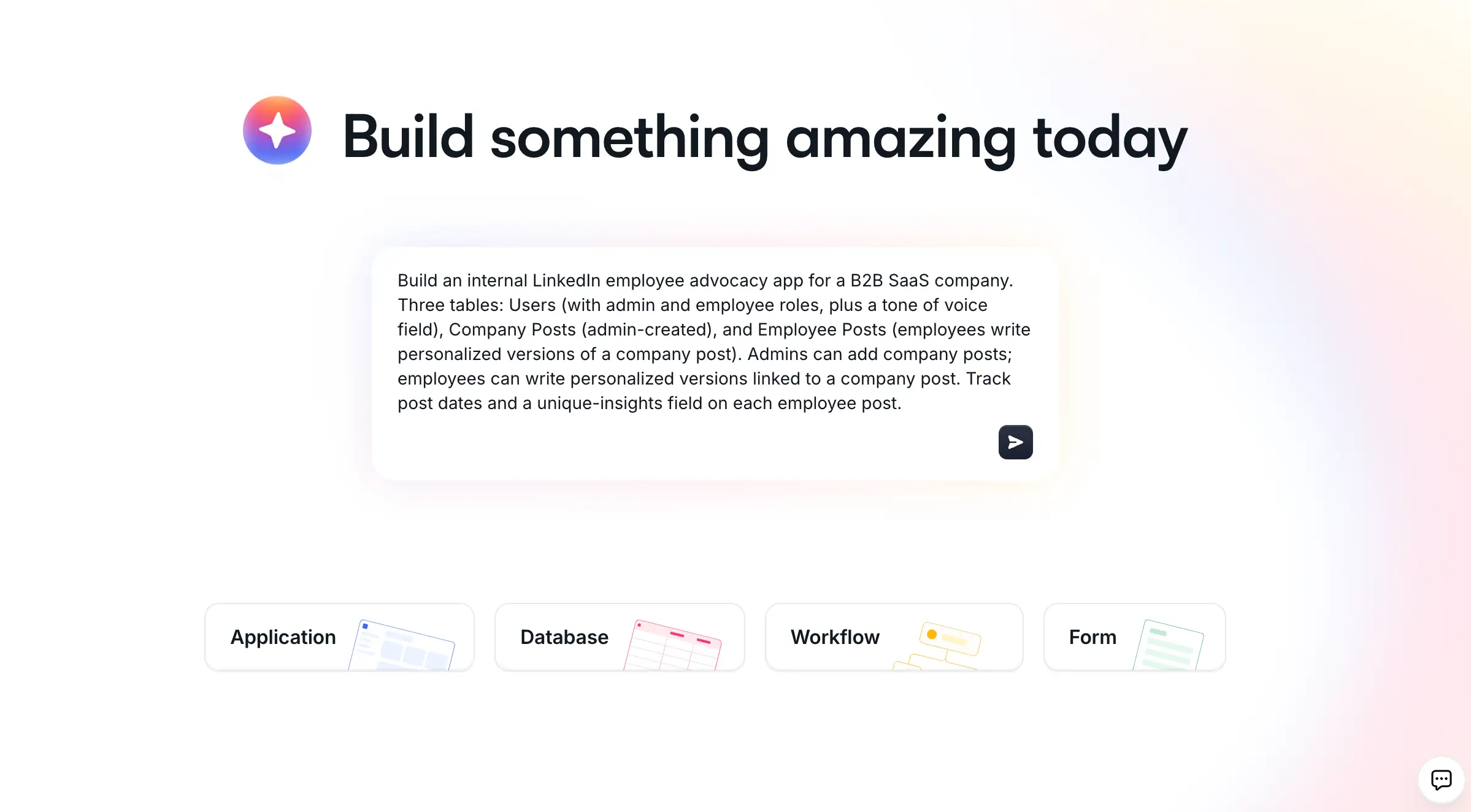
Prefer a different starting point? You can also start from a pre-built app template for your use case, or build from scratch on a blank canvas. You can also build the MVP from Claude or Cursor through the Softr MCP. Whichever path you choose, everything the AI creates is fully editable visually, and everything you build manually can be modified by the AI later. You're never locked into prompting.
Unlike vibe-coding tools that generate thousands of lines of fragile code, the AI Co-Builder composes your app from battle-tested native blocks. That's why the result works on mobile, validates forms, and handles logins correctly from the first generation.
Step 2: Structure your data
Success in Softr is 80% data structure, so start with your database. Define one table per object (Users, Projects, Orders), link related records across tables, and let rollups handle calculations. You can create tables and fields manually in the database editor, or describe your data structure to the Database AI Co-Builder and it will generate the tables, fields, and relationships for you.
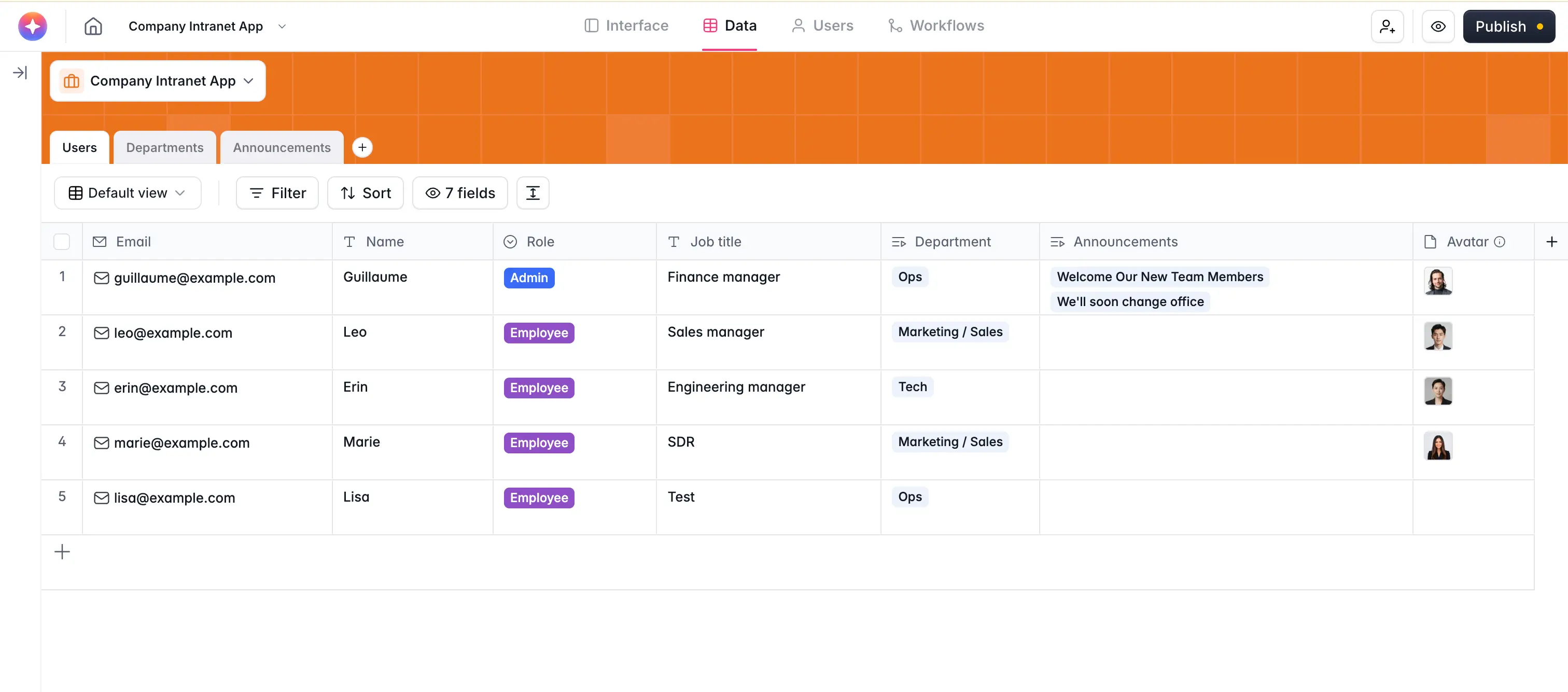
Step 3: Build your interface and permissions
Arrange pre-built blocks (tables, lists, kanbans, calendars, forms, charts) to create your pages, and customize the design through the global theme. You can add blocks manually, or ask the in-editor AI Co-Builder to do it by describing what you need ("add a kanban board showing tasks by status").
And when your MVP needs a custom component that doesn't exist as a standard block (a pricing calculator, an interactive timeline), the Vibe Coding block generates it with AI. It inherits your app's theme, connects securely to your data, and exposes visual settings so you can tweak it without re-prompting. Pre-built blocks cover most of what a business app needs; Vibe Coding handles the rest.
Then set up your user groups and users and permissions: who can sign up, what each group can see, and which actions they can take. This is what turns a demo into an app you can safely put in front of real users.
Step 4: Automate your logic and launch
Connect your app's logic with Softr Workflows, which trigger directly from UI interactions like button clicks and form submissions ("new signup" → "send a welcome email and notify the team in Slack"). You can build workflows visually, or describe the automation to the Workflow AI Co-Builder and it will assemble the logic for you. If you already rely on external tools like Zapier, Make, or n8n, Softr has native integrations for those too.
When you're ready, hit publish. Your MVP is live, hosted, and able to scale, and you can start collecting that all-important user feedback the same day.
Your MVP doesn't have to be a throwaway
Here's the part of the MVP playbook that has genuinely changed. Traditionally, an MVP was scaffolding: you validated the idea, then threw the prototype away and rebuilt "for real." That rebuild was a hidden tax on every validated idea.
An MVP built on Softr skips that tax. Because the foundation (authentication, permissions, database, hosting) is production-grade from the start, the same app simply grows: add a field, change a permission, build a new page, or onboard a new user group, without re-prompting an AI or breaking what already works. Plenty of teams that started with a quick validation app on Softr now run their core operations on it, from client portals to CRMs to internal tools.

So when you scope your MVP, it's worth thinking one step past validation: which business applications will your idea need around it once it works? With a platform that handles production from day one, "what we validate with" and "what we run on" can be the same thing.
Start building your MVP today
Building an MVP is still the smartest way to figure out whether that one idea you've had for a while is worth pursuing. The difference in 2026 is that you no longer have to choose between speed and substance: describe your idea, get a working app, put it in front of real users this week, and keep evolving it as the feedback comes in.
To see the full process in action, follow our walkthrough on building a business app with AI in under 10 minutes, or pick a client portal template and make it yours. Get started with Softr for free and start building today.
Frequently asked questions
What is an MVP?
Can I build an MVP without code?
How much does it cost to build a no-code MVP?
Is a no-code MVP production-ready?
How long does it take to build an MVP with Softr?