Email isn’t built for legal work. It’s easy to miss messages, send the wrong file, or lose track of what’s been shared. That’s why more law firms are turning to client portals: secure, online spaces where clients can log in to see case updates, upload documents, and get what they need.
Client portals for law firms give you more control over how information is shared and who sees what. They help reduce back-and-forth, improve security, and make your firm easier to work with.
Picking the right portal matters because it directly affects your efficiency, client satisfaction, and compliance with data security standards. The right tool can save hours per week and make your firm feel more modern and responsive.
Best client portals for law firms overview
| Best for | Standout features | Pricing | |
|---|---|---|---|
| Softr | Law firms that want full control over client access, layout, and data sources | Custom user permissions, client login, document sharing, real-time sync, responsive design, pre-built legal template | Free for 5 users; Paid plans from $19/month (Team: 5 + Client: 5 app users) |
| Clio | Firms that want client messaging inside a full legal platform | Messaging per matter, document and e-signature sharing, calendar sync, full legal management suite | No free plan EasyStart: $49 per user/month |
| Smokeball | Firms that want secure messaging with back-office automation | Secure messaging, auto portal updates, document automation, Outlook calendar sync, OCR, daily digests | Quote-based pricing From $149/user |
| Casepeer | Personal injury firms needing CRM, intake, and SMS built in | Secure portals, SMS/email updates, intake forms, case tracking, visual timelines, PI-specific workflows | No free plan, Basic - $79/user/month |
| Caret Legal | Firms needing built-in automation and billing with a basic portal | Document automation (HotDocs), integrated accounting, biometric-secured portal, calendar events, basic portal types | No free plan, Quote-based tiers |
| Lawmatics | Firms that want CRM and marketing with a client portal | Modern portal, CRM + intake forms, internal calendar, email/SMS campaigns, logic-based forms | No free plan, Quote-based tiers (Essential, Premium, Enterprice) |
| Case Status | Firms that want mobile-first client updates and engagement tracking | Mobile-first app, automated updates, secure messaging, NPS surveys, review prompts, integrates with Clio/MyCase/Filevine | No free plan,Custom, quote-based pricing |
| MyCase | All-in-one legal suite with portal, billing, and communication | Secure portal, messaging + SMS, billing/payments, calendar/task mgmt, full-text doc search, document templates | Free trial, Basic: $39/user |
What is a law firm client portal software?
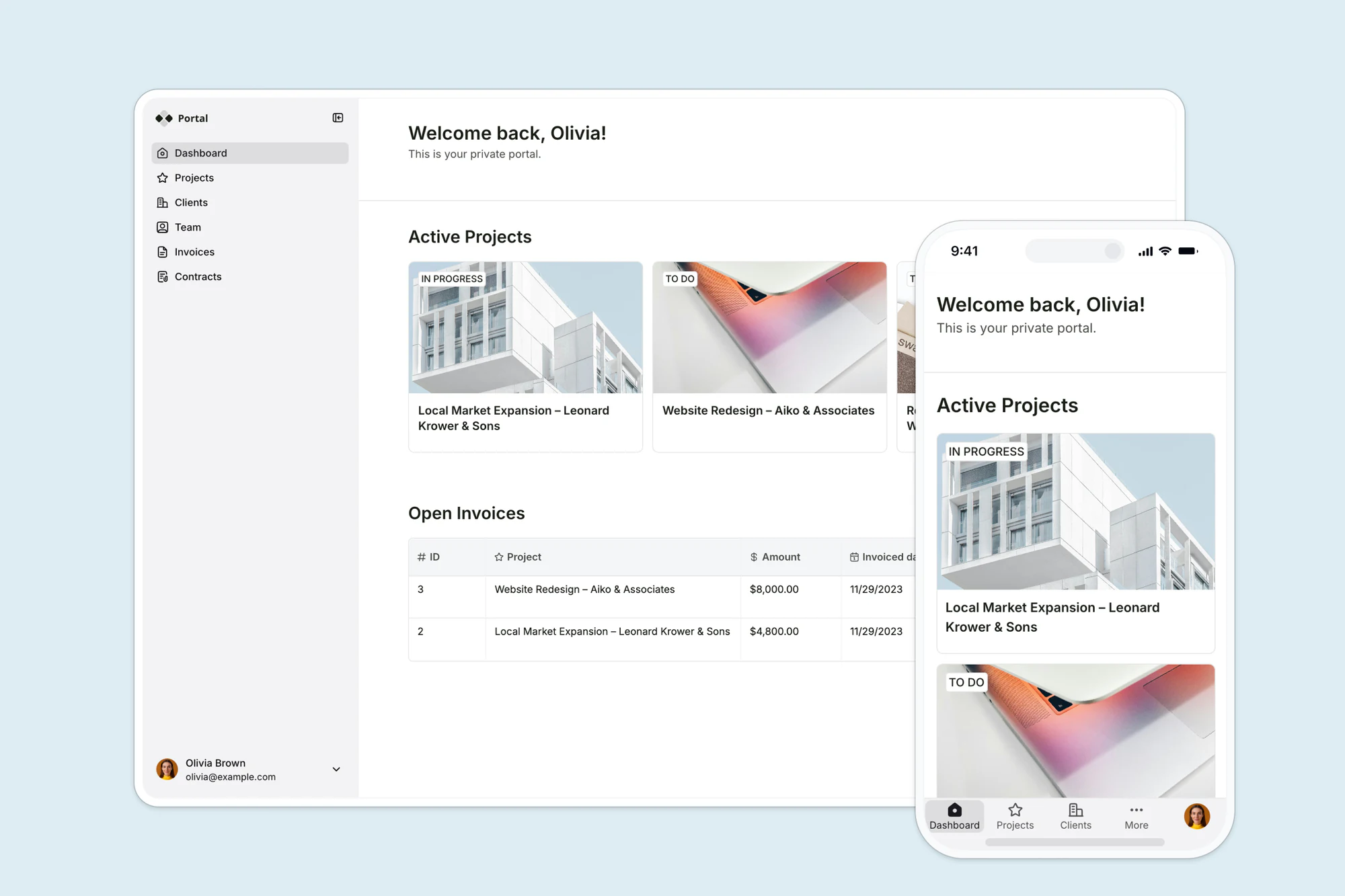
A client portal for law firms is a secure online platform that lets attorneys and their clients communicate, share case documents, and track progress from one central place instead of relying on scattered emails or phone calls. It gives clients 24/7 access to updates, invoices, messages, and files, and helps legal teams organize information, streamline communication, and protect sensitive data. This software is essential for improving transparency, reducing administrative work, and keeping clients informed and engaged throughout their legal matters.
What to look for in a legal client portal
Some client portals are built for law firms. Others are all-around tools you can customize.
Before you choose one, make sure it aligns with how your firm actually works, and keeps client data secure. Here’s what to look for:
- Easy to use and update: Your team shouldn’t need a developer or IT help to launch the portal or make changes. No-code platforms or intuitive editors are essential if you want to stay agile.
- Secure document sharing and e-signature support: A legal client portal should offer a secure way for you and your clients to upload, view, and sign documents. Look for tools that support file access control, allow clients to sign contracts through integrations like DocuSign, and keep all records organized in one place.
- Granular access control: Client confidentiality matters. You need to control exactly who sees what, by client, case, or role.
- Custom layouts for legal content: From court dates to contracts, legal work involves more than just file storage. Choose a portal that lets you structure pages clearly, with sections for case updates, invoices, forms, or client tasks, and not just a folder of uploads.
- Calendar and timeline visibility: Law firms need to communicate key dates like hearings, meetings, and deadlines.
- Flexible pricing that supports growth: Many legal tools charge per user, which can quickly add up. Look for flat-rate plans or tools that include generous external user limits, especially if you’re working with dozens of clients or expect to scale.
"Managing external partners through emails and spreadsheets is a nightmare. A portal allows you to only surface the information that is relevant to them and make approvals on the fly." - Shiran Brodie, Head of Marketing at Softr
1. Softr: best for building a secure legal portal with full control
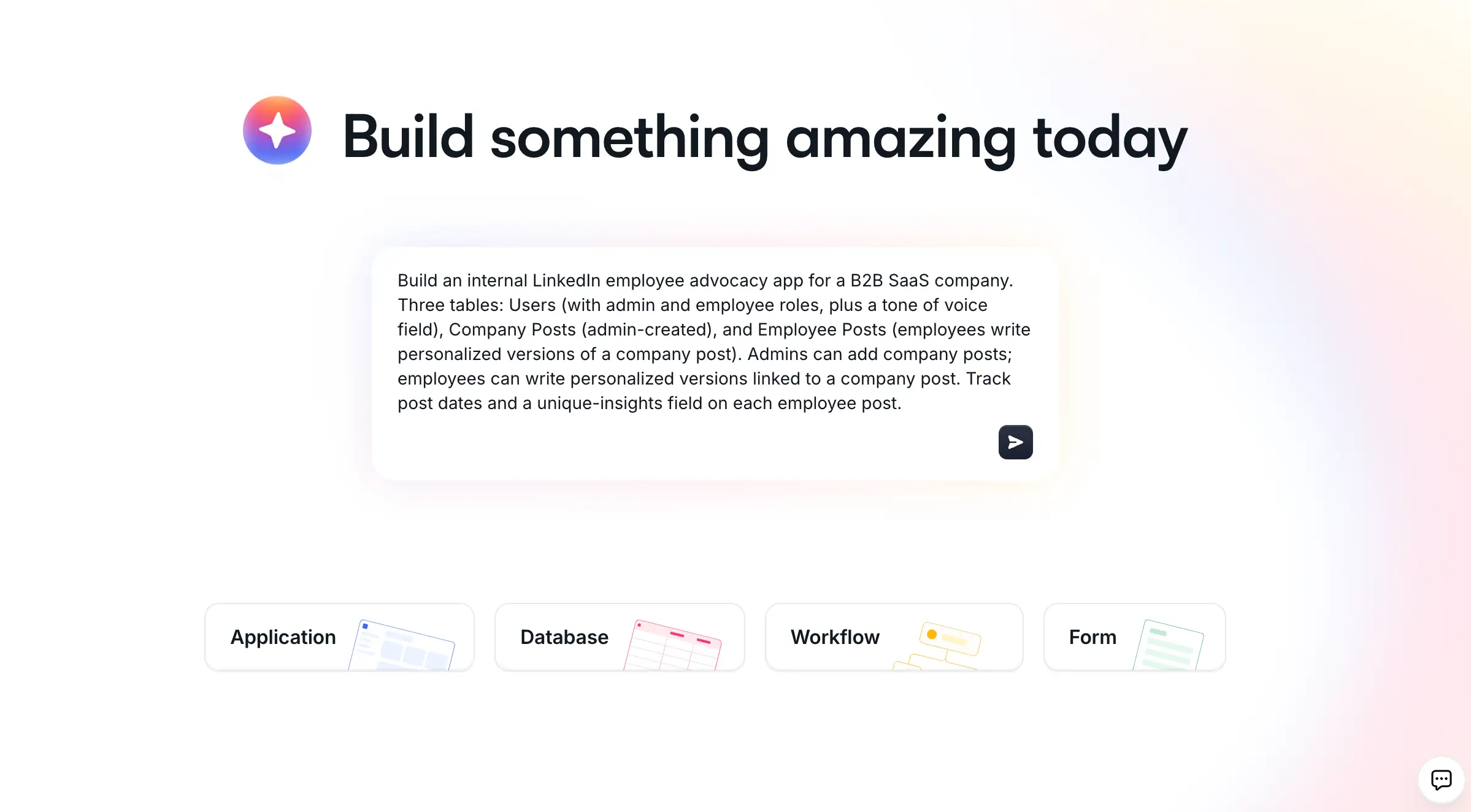
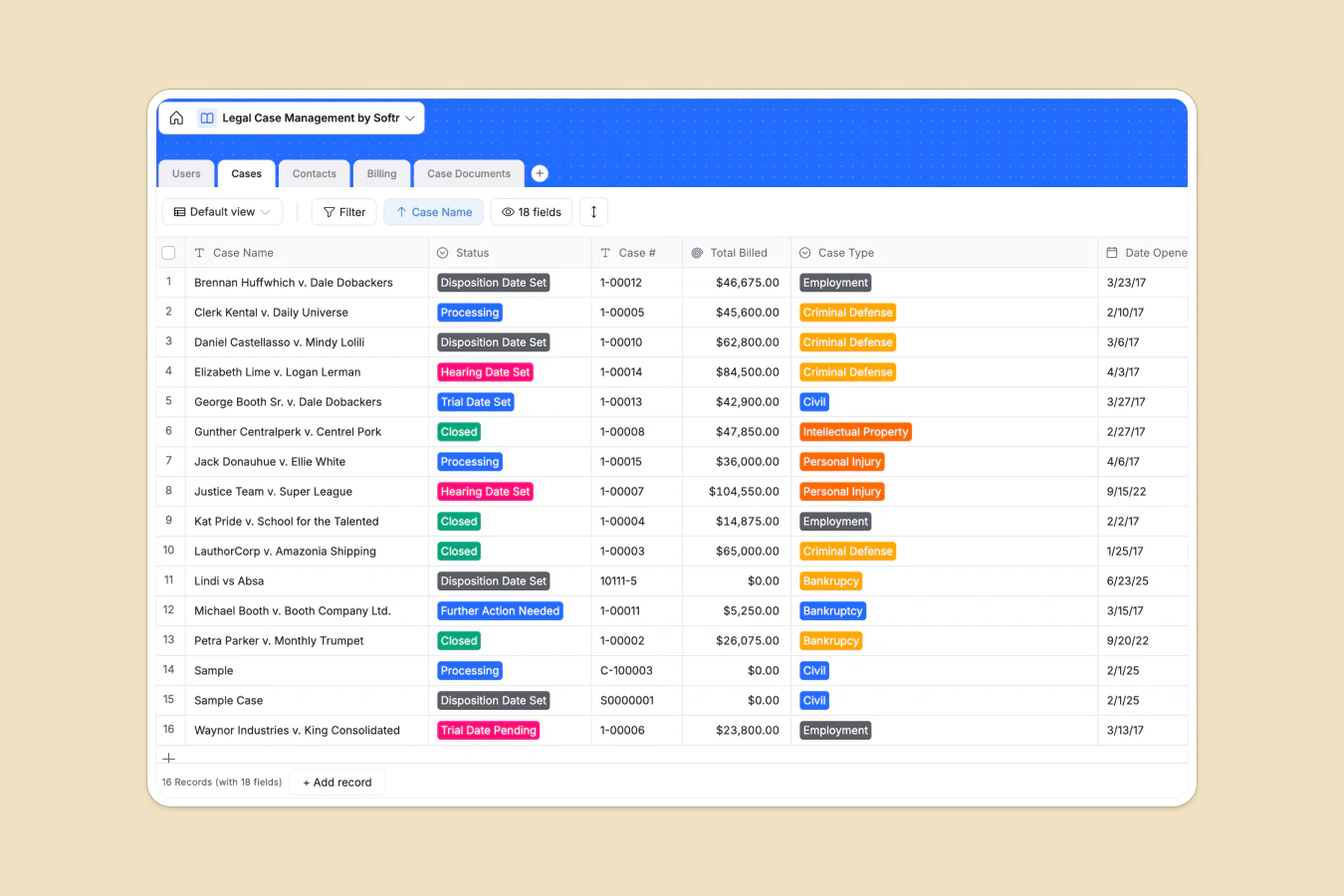
Softr is an AI-powered no-code platform that lets law firms build custom client portals with granular permissions, flexible layouts, and secure document sharing. The fastest way to start is to describe your portal to the AI Co-Builder, which generates a working database, pages, and user groups from a single prompt. You can also start from the ready-to-use Legal Case Management template, which centralizes case files, client access, billing, and task tracking, or build manually if you prefer full control from step one.
For data, you can manage everything in Softr Databases, Softr's native relational database, or connect to 21+ data sources you already use, like Airtable, Notion, and Google Sheets. Once your case data is connected, Softr Workflows can automate what happens next, for example notifying a client the moment a document is uploaded to their case.
Softr best features:
- 21+ native data integrations: Connect to Airtable, Google Sheets, HubSpot, Notion, monday.com, Supabase, SQL databases, BigQuery, and more, or use Softr's native relational database to securely store your legal data.
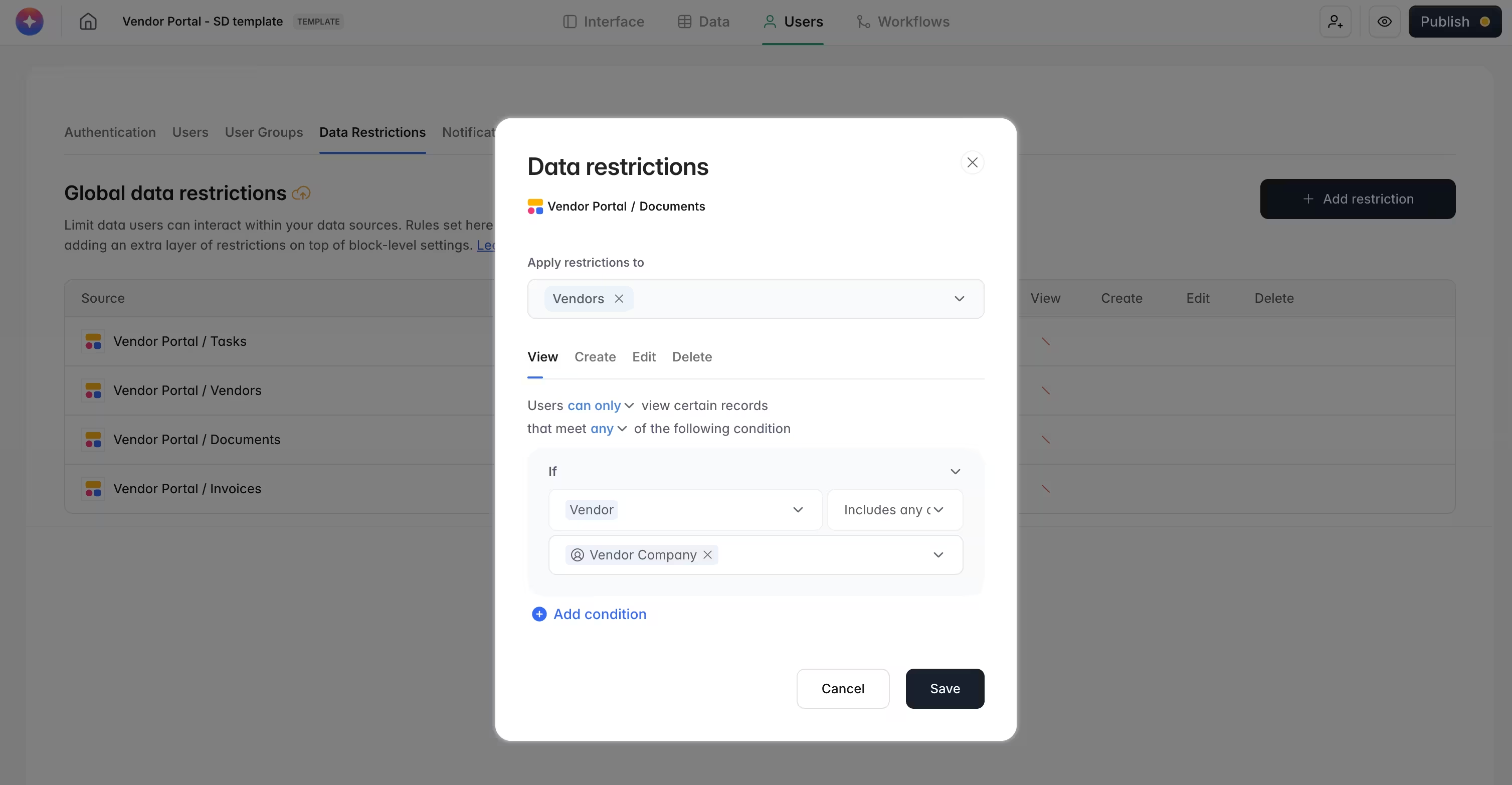
- Custom user groups & granular permissions: Set detailed permissions so clients and lawyers only view their own case updates, documents, and invoices.
- Client login and secure access: Let clients log in to view case updates, upload documents, and track billing, with no risk of cross-access.
- Case file organization: Manage all case-related files, notes, and updates in one place, with visual views to track case progress.
- Centralized billing, forms, or resources: Include invoice views, intake forms, or client help content, all within the same interface.
- Responsive design: Your portal works on any device and can be shared as a mobile app via Softr's PWA feature.
- Custom pages with the Vibe Coding block: For anything the pre-built blocks don't cover, like a custom intake calculator or a branded case timeline, the Vibe Coding block generates a custom component from a plain-language prompt, already connected to your data and respecting your permissions.
- Ask AI: Add a built-in chat assistant that helps users search their legal data and get answers instantly (respecting all in-app permissions).
Softr pros and cons
Softr pros:
- Fast and easy to set up: Generate a working portal with the AI Co-Builder, start from pre-built templates, or use the drag-and-drop builder manually. Ideal for small teams that don't want a complex setup.
- Works with your data: Manage everything directly in Softr Databases, or connect to Airtable, Notion, Google Sheets, HubSpot, and more.
- Consolidated tools and costs: Softr lets you create client portals, team intranets, and internal workflow tools in the same platform, saving money on multiple software licenses.
- Friendly for non-technical teams, with room for advanced logic (API, custom code, AI).
- Built-in AI: Use Ask AI to help users find information faster, and Database AI Agents to automate data enrichment, extract data from uploaded PDFs, and generate summaries.
- Priced for external users, not internal seats: App-user pricing scales to dozens or hundreds of clients without the per-seat costs that make legal suites expensive to grow.
Softr cons:
- Legal-specific needs like trust accounting or time tracking may require integrations or workarounds.
- Softr does have SOC2 and GDPR compliance, but it’s not a full compliance suite for highly regulated legal environments.
Pricing
Softr offers flexible pricing plans, so you can build a legal portal at any tier:
- Free for up to 5 users total
- Paid plans start at $19/month (Team: 5 + Client: 5 app users, billed annually)
- Pro: Starts at $99/month (Team: 10 + Client: 50 app users, billed annually)
- Business: Starting at $329/month (Team: 30 + Client: 100 app users, billed annually)
- Enterprise (custom pricing, contact sales)
2. Clio: best for firms that want client messaging inside a full legal practice platform

Clio is a leading legal practice management system, trusted by thousands of firms. It combines case management, billing, and client communication in a single cloud-based platform, making it easy to keep everything in one place.
The client portal comes with the Essentials plan and above, giving clients secure access to messages, documents, invoices, and calendar events via the “Clio for Clients” app or web login.
Clio best features
- Secure messaging and documents: Create private portals per matter to exchange messages and files securely
- eSignature support: Use Clio’s built-in signing tools or connect to DocuSign.
- Calendar sync: Automatically sync meetings, hearings, and deadlines with Google Calendar or Outlook
- Complete practice management: Includes time‑tracking, billing, trust accounting, task workflows, CRM, and reporting
Clio pros and cons
Clio pros
- All-in-one legal software: everything from intake to invoice under one roof
- Unlimited custom portals per client matter; secure, encrypted messaging
- Integrated e-signing and payment processing through Clio’s ecosystem
Clio cons
- Portal layout is limited to messaging and file folders, with no customization.
- Clio branding stays on the portal, with no white-label option.
- Costs escalate quickly; essential features are only in higher-tier plans.
Pricing
- EasyStart: $49 per user/month, entry-level plan for basic firm management tools.
- Essentials: $89 per user/month, adds secure client portal, integrations, and more.
- Advanced: $119 per user/month, automation, reporting, and priority support.
- Expand: $149 per user/month, includes Clio Grow (client intake & CRM tools) as part of the plan.
3. Smokeball: best for firms that want secure messaging with back-office automation
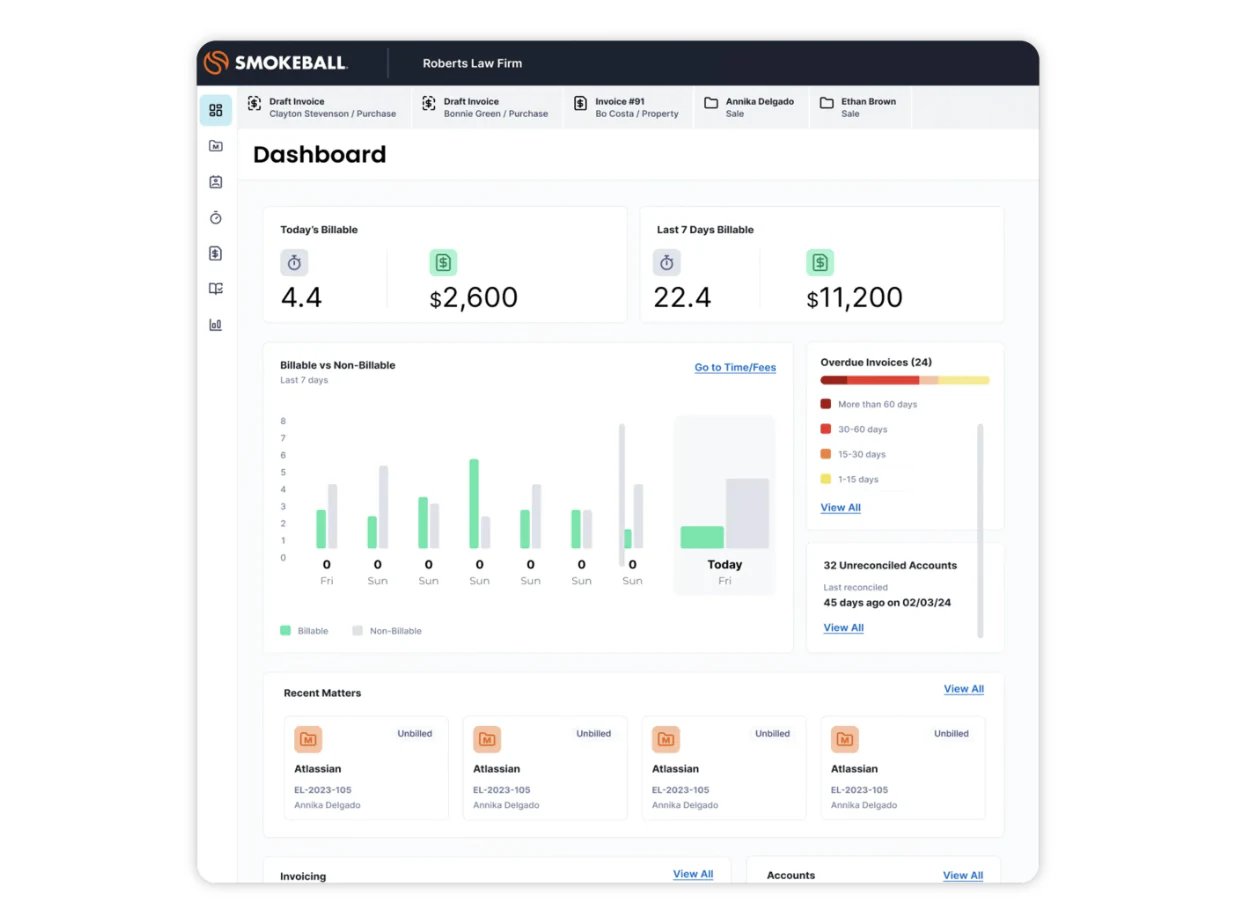
Smokeball is a cloud-based practice management system built for small to mid-size firms. It combines a browser-based client portal with secure messaging, document automation, calendar integration, and billing tools, all in one place.
Smokeball best features
- Secure messaging and file sharing: Clients communicate through the “Communicate” app, with secure chats, document uploads, and optional SMS notifications.
- Instant portal updates: Any document added to a matter appears automatically in the portal, no manual steps required.
- Document automation: Create pre-filled legal documents to speed up drafting and reduce errors.
- Calendar sync: Integrates with Outlook or Microsoft 365 to manage deadlines and meetings, and sends daily digests
Smokeball pros and cons
Smokeball pros
- Includes portal, document creation, billing, lead tracking, and OCR in one suite
- Secure, encrypted communication with activity tracking
Smokeball cons
- The portal works only in Chrome via browser extension, with no mobile app or multi-browser access.
- Layout is fixed to messaging and documents, with no custom pages or branding.
Pricing
Smokeball’s official pricing page shows that pricing is tailored to each firm and requires contacting the vendor for a personalised quote. Basic cost information on the site indicates that Smokeball’s legal practice management software starts at about $149 per user, per month at the entry level for core practice functionality, with full Prosper-level features included in higher-end plans.
4. Casepeer: best for personal injury firms that want CRM, intake, and client SMS built in
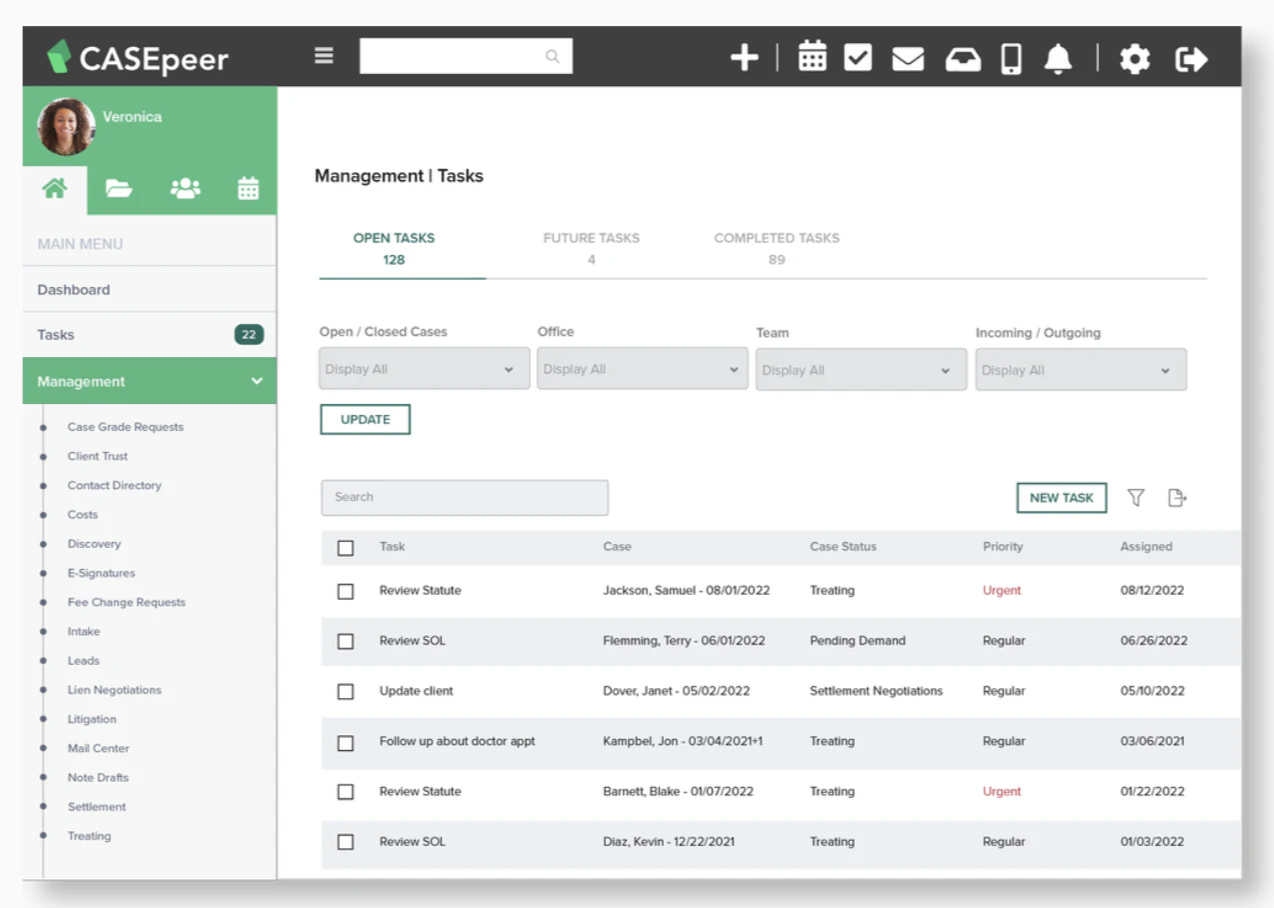
Casepeer is a cloud-based case management platform tailored for personal injury practices. It includes secure client portals, SMS/email communication, case timelines, CRM, and intake tools, all specifically designed for PI workflows.
Casepeer best features
- Secure portal per matter: Clients receive updates, documents, and reminders through a portal tied to their case.
- Integrated SMS and email: Send text and email updates directly from the platform, which is great for personal injury client care.
- CRM and intake forms: Capture leads, manage client data, and automate intake workflows.
- Case tracking and timelines: Monitor progress, deadlines, costs, and treatment schedules with visual timelines and calendar integration.
Casepeer pros and cons
Casepeer pros
- All-in-one platform with CRM, intake, and client updates included
- Convenient SMS communication is built in
- Advanced reporting and trust tracking for PI firms
Casepeer cons
- The portal and workflows are optimized for personal injury, less suited to other legal areas.
- No customization of portal branding or layout.
Pricing
- Basic ($79/user/month): case and contact management, task management, and a client portal for core PI workflows.
- Pro ($119/user/month): everything in Basic, plus client intake management, reporting, key integrations, and 8am IQ (legal AI).
- Advanced ($149/user/month): everything in Pro, plus advanced reporting, intake investigator portal, scheduled texts, data sync, and API access.
5. Caret Legal: best for firms that need built-in document automation and billing with a simple portal
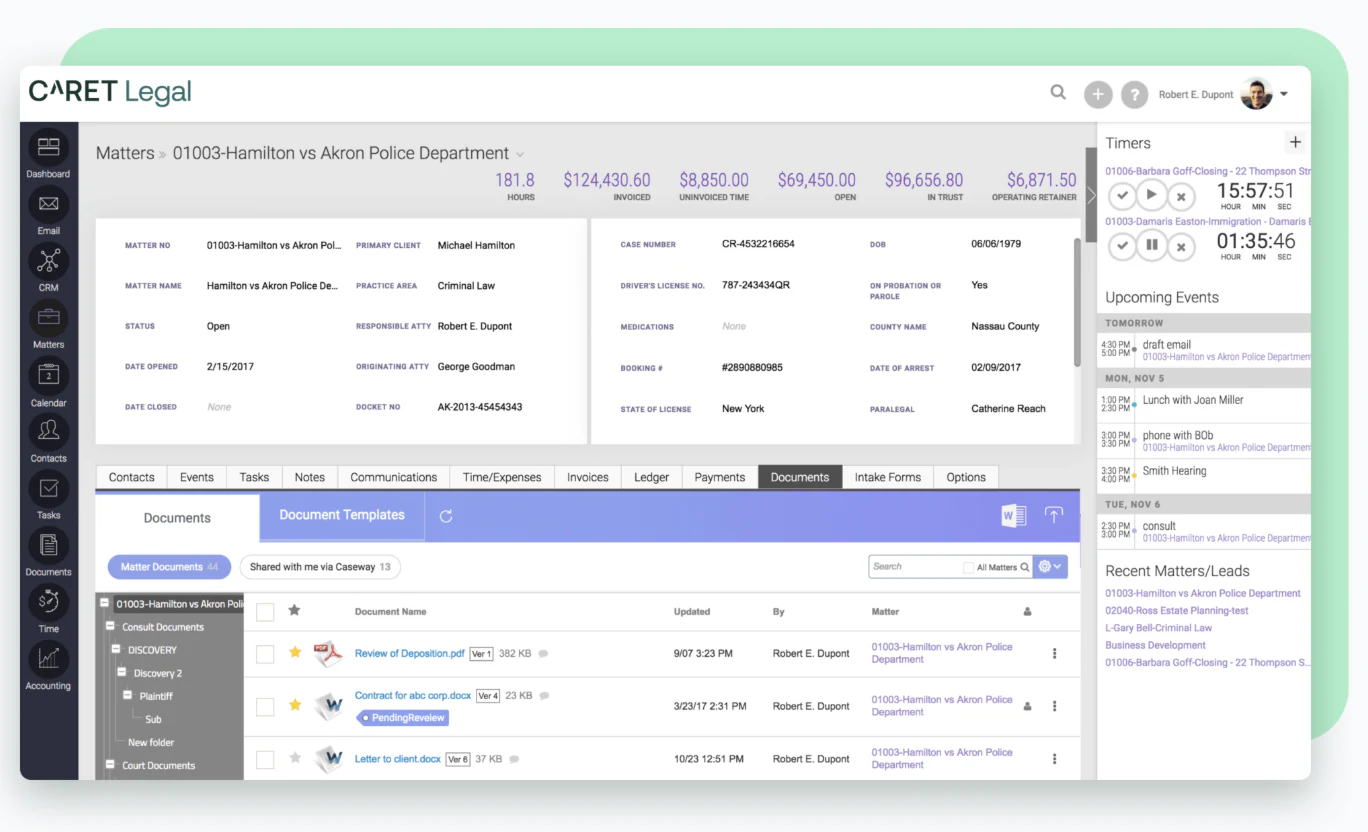
Caret Legal (formerly Zola Suite) is a cloud-based legal practice management system with time tracking, accounting, document automation, and a basic client portal. It’s designed for small to mid-size firms that want a secure way to share documents and invoices with clients, without needing external tools.
Caret Legal best features
- Standard and Signature portals: The Standard portal includes secure document sharing, invoicing, and messaging. The Signature portal adds branded login pages, mobile app access, and biometric login options like Face ID or Touch ID.
- Built-in accounting and payments: Track billable hours, send invoices, and manage payments with integrated accounting features.
- Document automation: Use HotDocs to streamline repetitive documents and reduce manual entry.
- Calendar and event tracking: Create recurring events, invite clients or staff, and track deadlines all within Caret Legal’s calendar system.
Caret Legal pros and cons
Caret Legal pros
- Easy for non-technical teams to use and set up
- Strong document automation for repetitive legal forms
- Includes built-in time tracking and accounting
Caret Legal cons
- Client portal is limited, with no support for custom pages or layouts.
- OCR and document scanning features can be inconsistent.
Pricing
CARET Legal does not publish fixed plan prices on its website. You need to request a quote to get exact per-user, per-month pricing. A demo or trial is available upon request.
6. Lawmatics: best for firms that want built-in CRM and marketing with a modern client portal
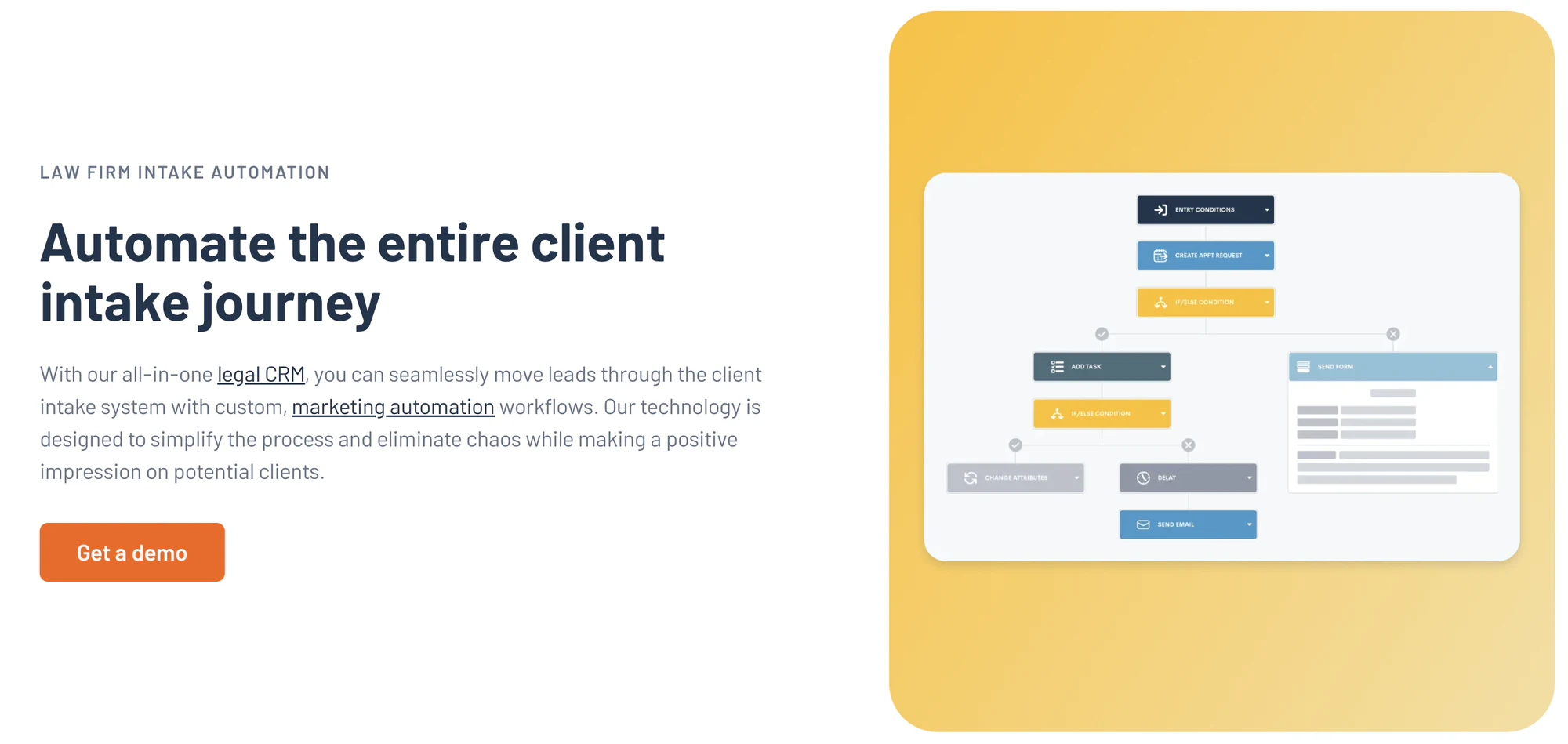
Lawmatics blends legal CRM, client intake, and automation into one platform, with a secure client portal layered on top. It’s especially useful for firms that want to streamline onboarding, improve communication, and run email or SMS campaigns from the same tool.
The client portal is included in the Pro plan and lets clients log in to view documents, pending forms, signatures, meetings, and case-related updates, all styled with your branding.
Lawmatics best features
- Modern client portal: Clients can view case files, e-signature requests, appointments, and forms in one secure place.
- CRM and intake forms: Create branded, logic-based forms for onboarding or collecting client info.
- Calendar and scheduling: Let clients book meetings directly. Lawmatics uses its own native calendar tool (not integrated with Google/Outlook).
- Marketing automation: Set up email and SMS workflows, nurture leads, and manage the full intake pipeline.
Lawmatics pros and cons
Lawmatics pros
- All-in-one CRM, intake, scheduling, and portal in one tool
- The client portal works well out of the box with no coding
- Built-in marketing automation: send emails, texts, and track campaign performance
Lawmatics cons
- No portal layout customization; the structure is fixed.
- The calendar does not sync with external tools like Google Calendar.
- Pricing starts high and scales quickly with user count.
Pricing
- Custom pricing: Lawmatics does not show fixed plan prices on its official site. You must contact sales or request a demo to get exact cost details.
7. Case Status: best for firms that want mobile-first client updates and engagement tracking
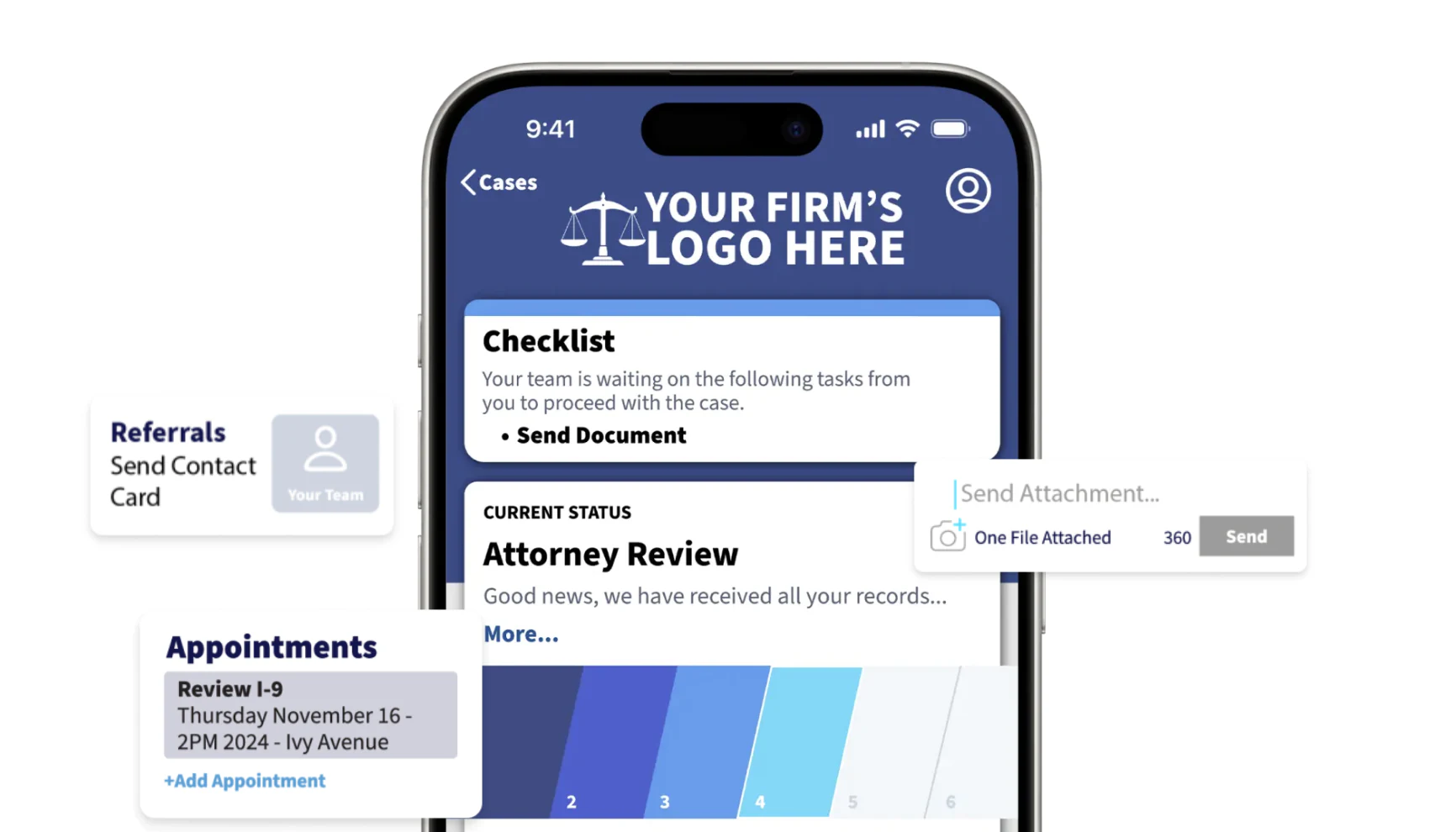
Case Status is a client engagement platform designed to work alongside your existing case management system (like Clio or MyCase). It offers a mobile-first portal, automated client updates, secure messaging, and built-in client feedback tools, all aimed at reducing calls and improving satisfaction.
Case Status best features
- Mobile-first portal and app: Clients can access case updates, documents, and secure messages on iOS, Android, or web, with no downloads required.
- Automated real-time updates: Automatically send milestone alerts, appointment reminders, and status notifications to clients.
- Secure messaging: Two-way messaging lets clients ask questions and get replies without email.
- Client feedback & review prompts: Built-in Net Promoter Score surveys and review requests help capture satisfaction and generate referrals.
- Integration-friendly: Works with major legal systems like Clio, MyCase, and Filevine for seamless data syncing.
Case Status pros and cons
Case Status pros
- Decreases client calls and emails by up to 90% thanks to automated updates.
- Mobile portal increases client engagement, with reported adoption rates between 70 and 85%.
- Collects feedback and helps drive online reviews, all within the client experience.
Case Status cons
- Doesn’t replace your main practice management platform: you still need Clio, MyCase, or similar.
- Lacks native features like billing, document assembly, or detailed case workflows.
- Portal customization is minimal. It reflects firm branding but is structured by the app’s design.
Case Status pricing
- Case Status uses custom, quote-based pricing. You must contact the vendor for exact costs, and static prices are not published.
8. MyCase: best for firms that want an all-in-one case management system with a built-in client portal, billing, and communication
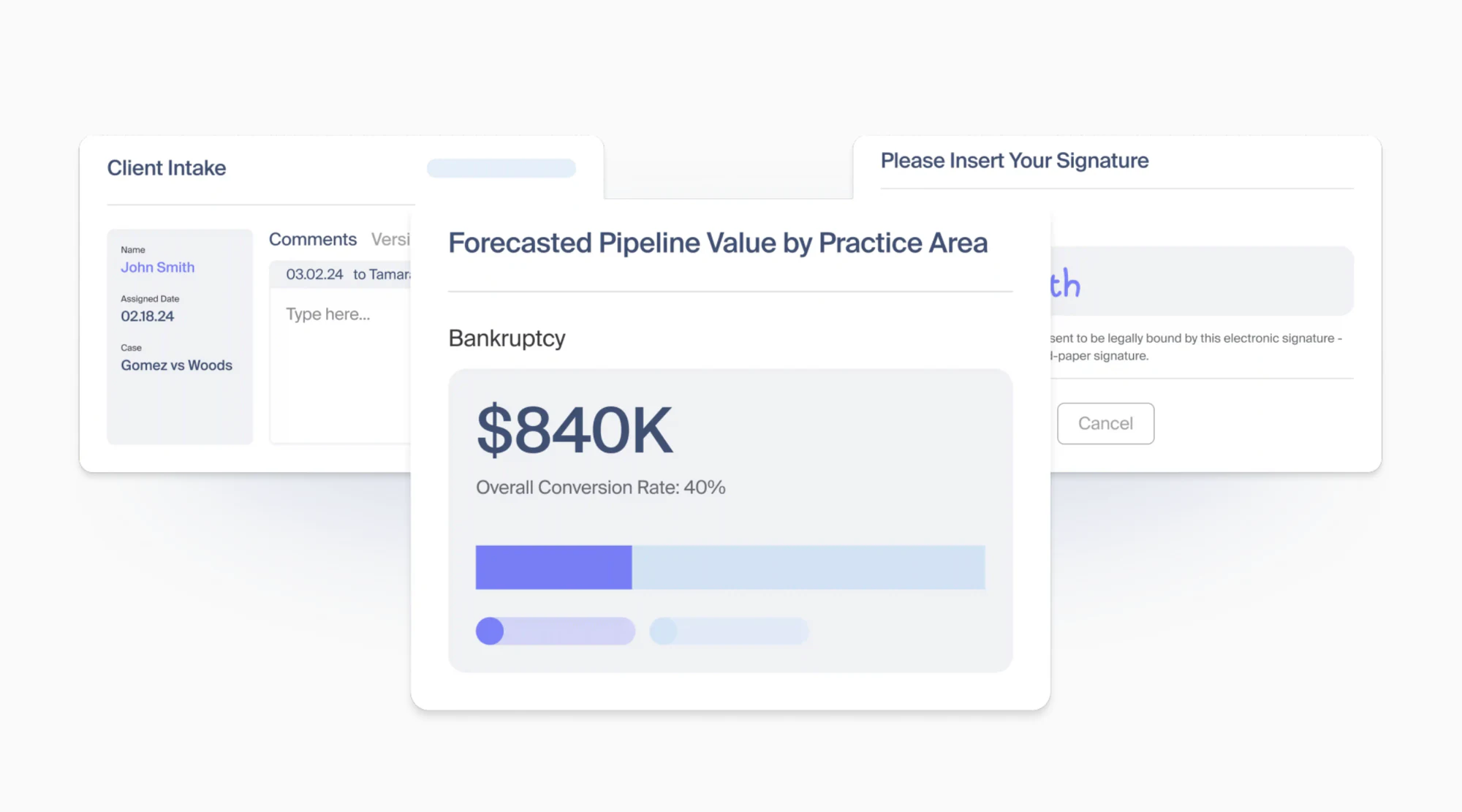
MyCase brings your entire legal workflow into one platform, from case files and calendar events to billing, secure messaging, and a client portal. It’s designed for law firms that want to reduce switching between tools and keep everything organized in one place. The client portal gives your clients secure access to case updates, invoices, documents, and appointments, all from a web browser or mobile app.
MyCase best features
- Secure client portal: Clients can log in to view case updates, messages, documents, invoices, and calendar events, all in one place.
- Two-way messaging & texting: Secure chat within the portal and unlimited text messaging, including image support, for more direct communication.
- Billing, invoicing & payments: Time tracking, task-based billing, invoices, and online payment processing (via LawPay integration) are included in all plans.
- Calendar and task management: Track court dates, appointments, tasks, and deadlines, with reminders for clients and staff.
- Document management: Unlimited secure storage, full-text search, document templates, and automation tools in higher tiers.
MyCase pros and cons
MyCase pros
- All-in-one suite: practice, billing, communication, and portal are integrated
- Highly user-rated for client portal and usability, 90%+ positive reviews
- Unlimited document storage and text messaging included
- Mobile browser and app access for clients and staff
MyCase cons
- Limited customization: portal layout and branding are fixed.
- Reporting is basic compared to specialized tools.
- Some users report a clunky experience during call/email logging and occasional issues with calendar syncing.
Pricing (monthly, billed annually)
- Basic: $39/user: includes case management, client portal, billing & payments, calendar, basic documents.
- Pro: $89/user: adds intake forms, unlimited e-signature, advanced billing, AI summaries, and integrations.
- Advanced: $109/user: adds desktop file sync, full-text search, document automation, and open API.
Notes
- Monthly billing is available at higher rates.
- No free plan, but a free trial is offered.
What a flexible portal looks like in practice
Professional services firms outside legal have already made this switch, and the results show what's possible when a portal replaces email and spreadsheets. Accounting firm TASC used Softr to build a document collection portal for 80+ clients in 20 hours, with automated recurring requests and a dedicated client login instead of chasing files by email.
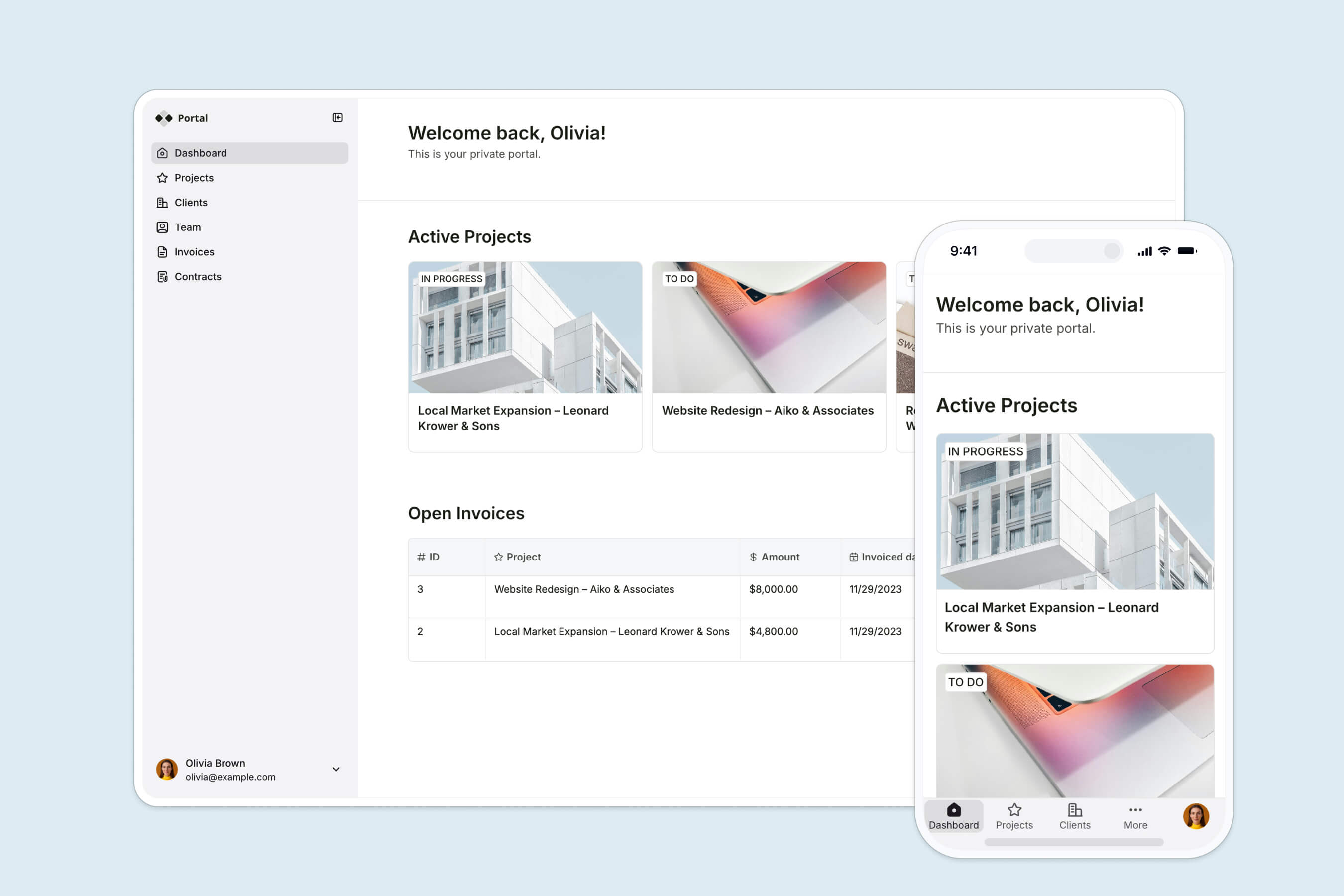
"The learning curve is not steep, and there are loads of new features which make my creations come to life better than I anticipated. Our web portal for individual clients and enthusiasts could not have been built and launched so quickly if it were not for Softr." - Ken N., Director, G2 review
A similar accounting firm, Officeheads, built a client portal serving 50+ SMB clients across 8 workflows, from live financial dashboards to document downloads, eliminating the repetitive email questions that used to eat up their team's time. The same approach works for a law firm: one login, one place for case updates, documents, and invoices, with permissions that keep each client's file private to them.
Find client portals for law firms that fit your needs
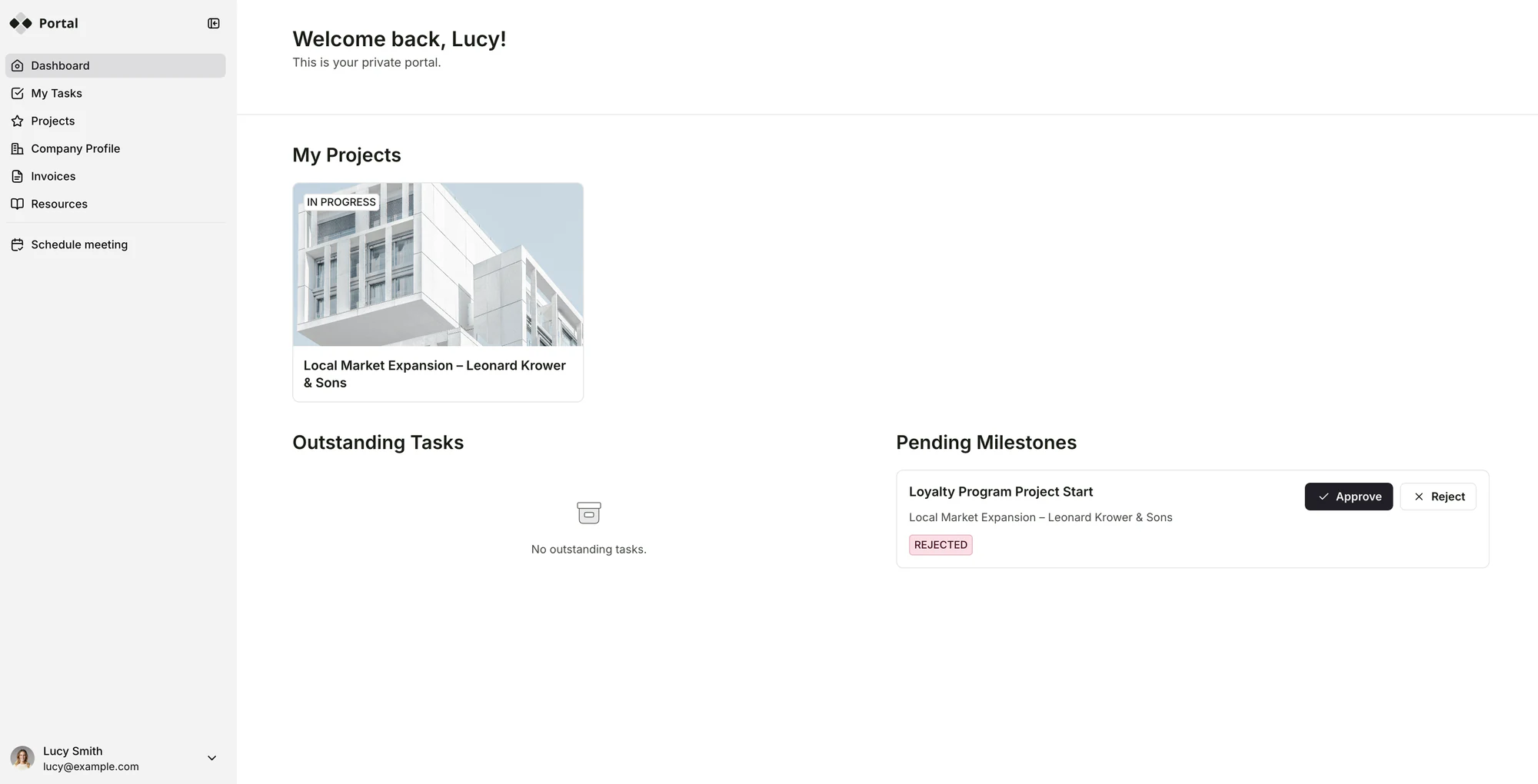
The most effective client portals for law firms do more than just share documents: they improve communication, protect sensitive information, and give clients real-time visibility into their cases.
But there’s no single client portal that works for every law firm. Some teams need built-in SMS and intake tools, while others want a tightly integrated billing system or CRM. The best fit depends on how your firm operates and which features will truly simplify client access, communication, and case tracking.
If you’re looking for something flexible, real-time, and easy to manage, Softr is a strong choice. Describe your portal to the AI Co-Builder to get a working starting point, then fine-tune user groups and permissions so each client only sees their own case. Connect it to tools your team already uses, or manage everything in one place with Softr's built-in database.
It's quick to set up with a template and even easier to adapt as your firm grows.
Explore the Legal Case Management template or our Client Portal template, and start building your portal today. No code required.
Frequently asked questions
Do law firms need a dedicated legal client portal, or can any client portal software work?
How much does a client portal for a law firm typically cost?
Can I connect a client portal to case management software I already use, like Clio or an Airtable base?
How do I keep client data secure and confidential in a legal portal?
Can I build a law firm client portal without hiring a developer?