

[.blog-callout]
TL;DR
- We tested the 15 most popular Airtable integrations across portals, automation, CRM, scheduling, and marketing use cases.
- Softr is the strongest option for turning Airtable data into a secure client portal or internal tool, thanks to granular permissions and app-user pricing that doesn't punish you for adding more people.
- Zapier and Make cover general-purpose automation between Airtable and thousands of other apps, while tools like HubSpot, Slack, and Stripe cover more specific workflows.
- For each integration, we cover setup, key features, best use cases, and pricing. [.blog-callout]
Airtable has helped millions of teams organize their data by combining the flexibility of a spreadsheet with the structure of a database.
But Airtable alone can only take you so far. The moment you need a client-facing portal, an automated workflow, or a connection to your CRM and marketing tools, you need an integration on top of it.
With so many options available, we tested the 15 most popular Airtable integrations to give you an honest breakdown of:
- The installation and setup process;
- Key features;
- The best use cases;
- Pricing.
Let's get started.
Types of Airtable integrations
Airtable integrations are connections between Airtable and external services or applications that let data flow between both tools.
The type of integration you need depends on the problem you're trying to solve.
If you're a client-facing team looking to build a secure interface for customer data, you want a client portal software. If you're trying to guide team members through action steps or automate process flows, you want a tool that manages workflows instead.
Once you know what you want to achieve with your Airtable data, you can start narrowing down your options. Common categories include:
- App builders like Softr, for turning Airtable data into portals and internal tools;
- Marketing software like HubSpot;
- Communication channels like Slack;
- Scheduling tools like Calendly.
Here's how the 15 most useful Airtable integrations stack up.
{{cta-1}}
Best Airtable integrations in 2026
As we go through the best 15 Airtable integrations, we'll look at how each tool extends what Airtable can do on its own, whether that's building a portal, automating a workflow, or keeping your CRM in sync.
Softr
Best for: client portals and internal tools
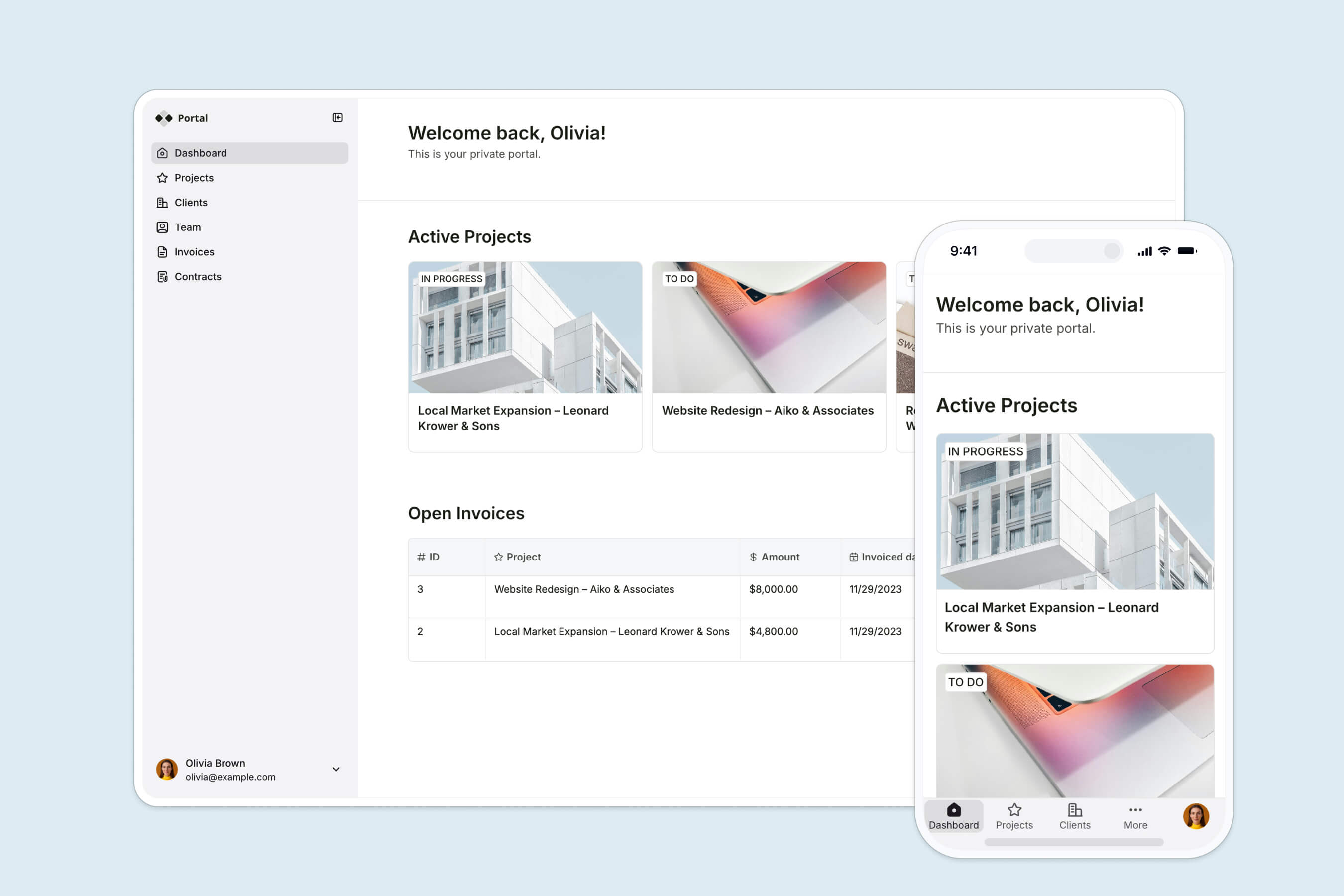
Softr is an AI app builder that turns your data into secure client portals, internal tools, and CRMs without requiring code. You can build on Softr Databases, our native, relational database, or connect an existing Airtable base and keep working from there.
Softr stands out for how it handles the parts most teams don't want to build themselves: user authentication, granular permissions, and hosting all come built in, so the app is secure and usable by real users from day one, not just a demo.
Installation and setup
Getting started with Softr takes three paths: describe your app to the AI Co-Builder and it generates the database, pages, and user groups for you; start from a pre-built template; or build from scratch manually.
To connect an existing Airtable base, go to the data tab in your app's studio and add Airtable as a data source. You'll need a Personal Access Token from your Airtable account to authenticate the connection. Once linked, Softr pulls your tables and fields directly, and you can start displaying, filtering, and managing that data through blocks in your interface.
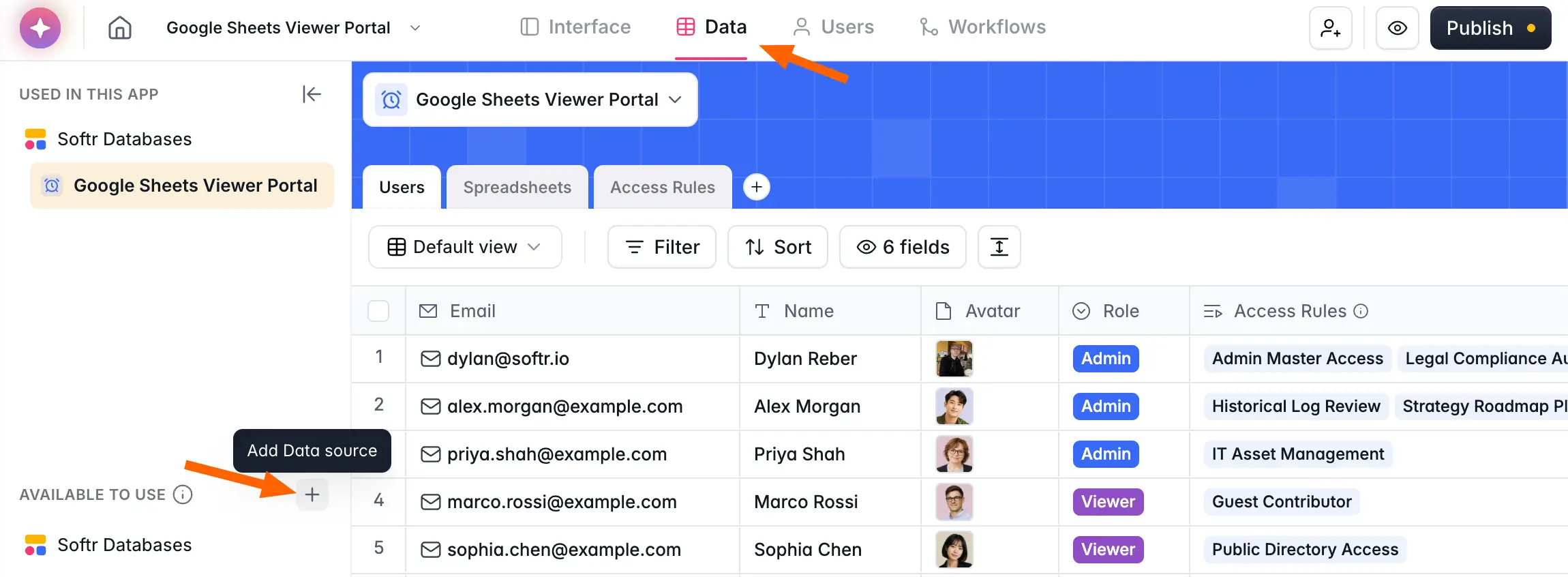
If you'd rather consolidate everything in one place, Softr can also import your entire Airtable base, tables and fields included, directly into Softr Databases.
Key features
- AI Co-Builder: describe the app you need and the AI Co-Builder generates the database, pages, blocks, and user groups for you, or use it inside the editor to add blocks and configure actions in plain language;
- Dynamic, permission-aware pages: build pages that automatically update based on your Airtable (or Softr Database) records, filtered per logged-in user;
- Granular user groups and permissions: control exactly who can view, edit, or delete specific records, down to the row level;
- Vibe Coding block: for the rare custom UI need that pre-built blocks don't cover, generate a secure, database-connected component from a plain-language prompt;
- Forms and action buttons: build data entry forms and action buttons that update records or trigger Softr Workflows.
Use cases
- Client and vendor portals: businesses and agencies can create custom portals where external users view and interact only with the data relevant to them;
- Internal tools: teams can build internal tools such as CRMs, inventory trackers, and employee directories on top of their existing Airtable data.
User experience
Teams consistently point to two things: how easy Softr is to pick up without a technical background, and how well it plugs into the data they already have in Airtable.
"I find Softr very intuitive and easy to navigate, which is great for someone who is not a programmer by nature. It integrates very nicely with Airtable and other databases we are already using, making it nice that it just sits on top of the systems we have." - Natalie S., Director of Operations
Because the connection to Airtable is live, records update in your app as soon as they change in your base, with no manual syncing required.
Pricing
Softr has a free plan that includes 5 app users and 5,000 database records, enough to test a real use case. Paid plans start at $19/month (Basic) and go up to $99/month (Pro) and $329/month (Business), with higher tiers adding more app users, database records, workflow actions, and integrations. Enterprise (custom pricing, contact sales) is available for enterprise needs.
Zapier
Best for: Automated workflows
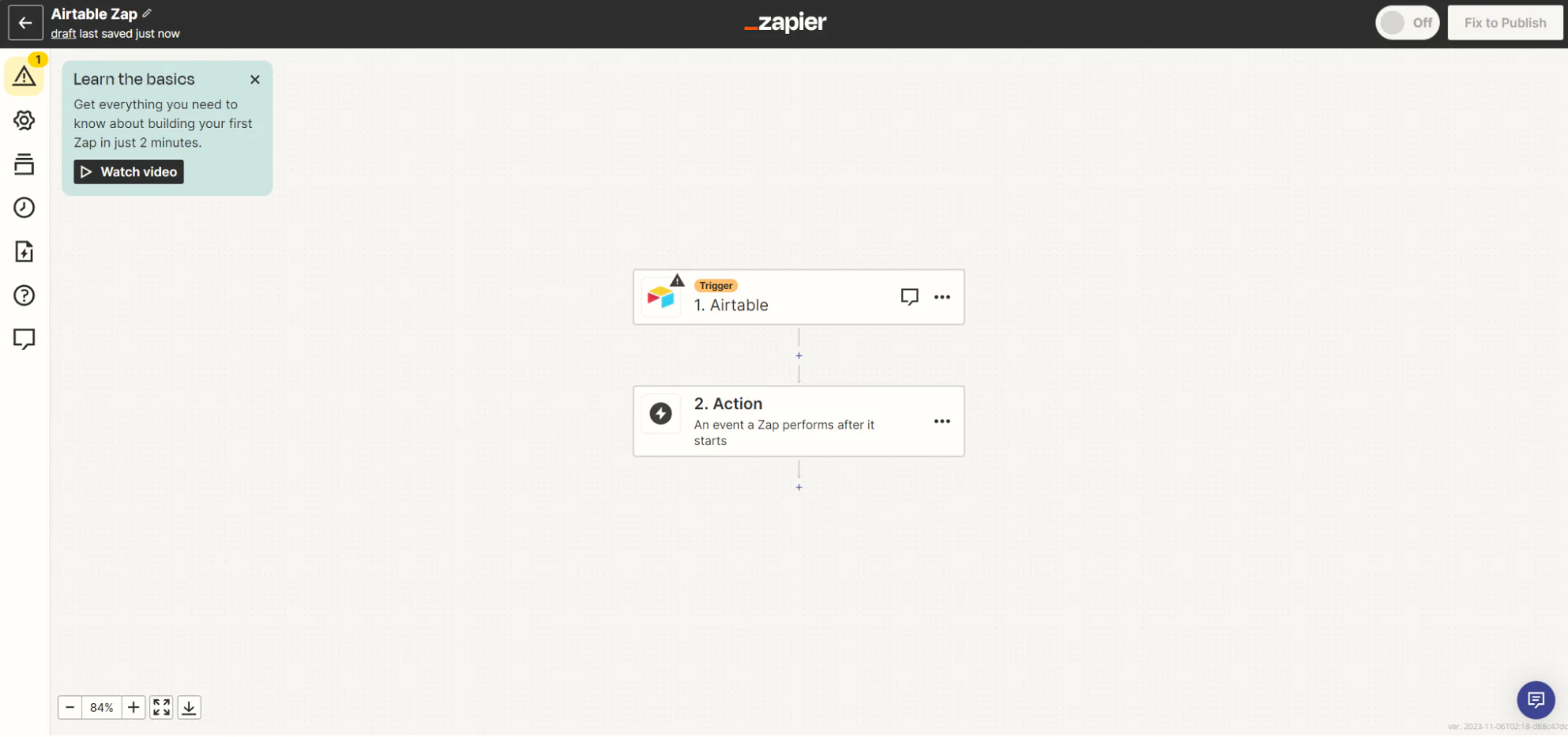
Zapier enables a seamless connection between Airtable and over 3,000 other applications.
It's designed to automate repetitive tasks without code, enhancing the capability of Airtable by forming automated workflows known as "Zaps."
Each Zap consists of a "Trigger" and an "Action" (an event in one app that triggers an action in another).
For instance, creating a new record in Airtable can trigger a message in Slack.
This integration is essential for users looking to extend Airtable's functionality, automate workflows, and create a centralized workspace where data from multiple sources can interact and trigger actions across various apps, all without leaving Airtable.
Installation and setup
Installing and setting up Zapier with Airtable is a straightforward process.
Initially, you start by creating a Zapier account if you don't have one. Once the account is set up, you click on the "Make a Zap!" button, choose Airtable as the trigger or action app, and authenticate your Airtable account following the OAuth procedure.
The setup requires specifying the trigger and action apps and defining the conditions under which the trigger should initiate the action. This setup lays the foundation for automated workflows between Airtable and other apps, opening a realm of automation possibilities.
Key features
- Multi-step Zaps: you can create workflows where a single trigger can initiate multiple action steps in sequence, thus enhancing the complexity and efficiency of operations;
- Filters and formatters: these features allow you to control when your Zaps run and format the data in a way that's required for the action app;
- Custom logic with paths: enables branching logic in workflows, allowing different actions based on various conditions;
- Record triggers: ability to trigger Zaps based on new or updated records in Airtable, which is pivotal for real-time data processing and automation.
Use cases
- Automating workflows: creating complex workflows that trigger actions in other apps based on events in Airtable;
- Real-Time Updates: triggering actions in other apps based on new or updated records in Airtable;
- Data Formatting and Transfer: Automatically formatting and transferring data between Airtable and other apps, ensuring data consistency and saving time. These use cases significantly ease the automation of repetitive tasks, streamline data management, and enhance cross-app interactions.
User experience
Zapier's no-code interface makes the setup of Zaps relatively straightforward, backed by comprehensive documentation and support for troubleshooting issues.
The ability to create multi-step automated workflows with ease makes Zapier a popular choice for extending Airtable's functionality over other automation platforms.
The vast array of apps that can be connected to Airtable via Zapier greatly expands what teams can achieve, making the integration valuable for anyone looking to automate and streamline their operations.
Pricing
Zapier offers a Free plan for basic automation needs. As automation needs grow, you can upgrade to Starter ($19.99/month), Professional ($49/month), Team ($69/month), or Company (custom pricing) plans. Each tier offers additional features and capabilities, catering to individuals and organizations of different sizes and automation requirements.
HubSpot
Best for: Lead management
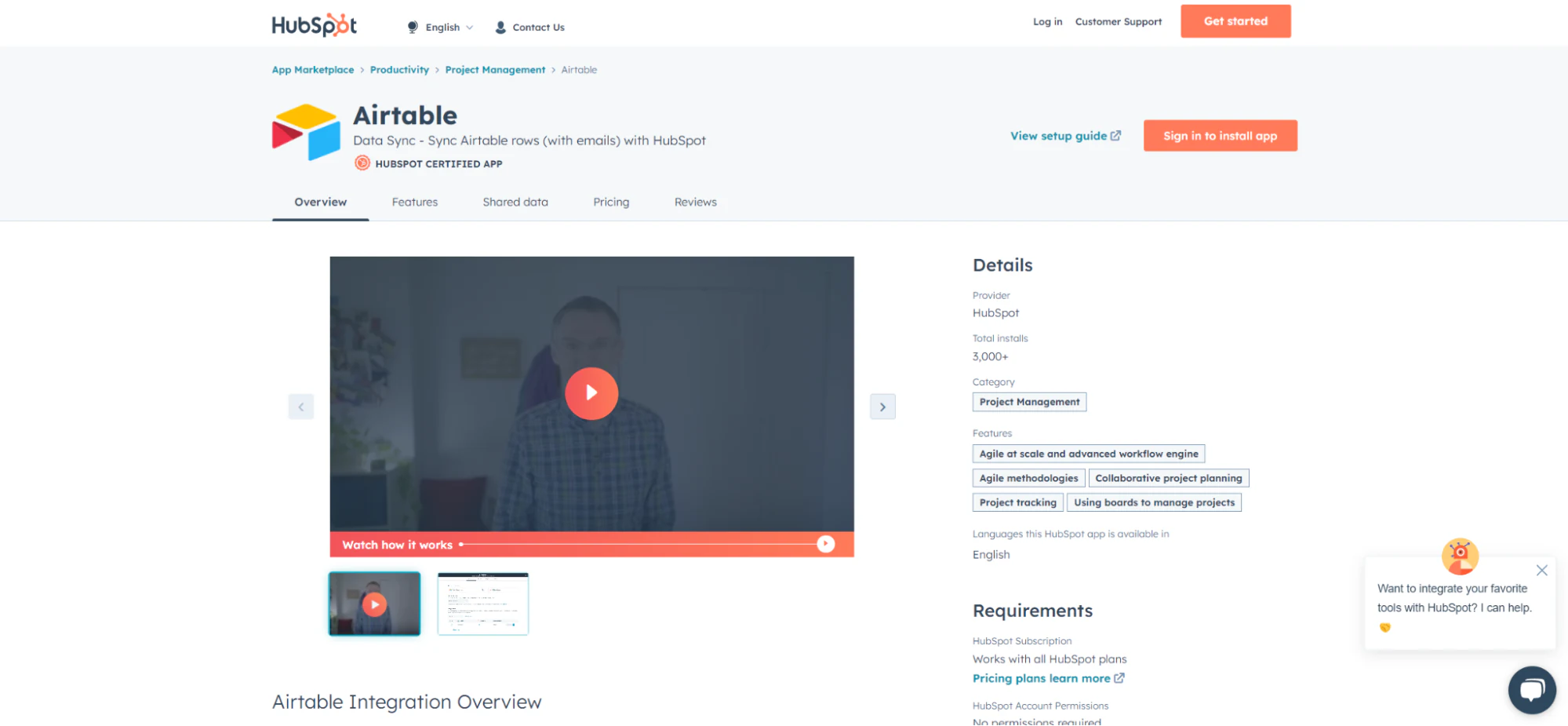
HubSpot, a renowned CRM software product, offers two primary tools for Airtable integration: Workflows and Data Sync.
Workflows automates processes based on specified conditions, allowing for actions in Airtable (like record creation) upon triggers in HubSpot.
Data Sync facilitates a two-way sync integration between the platforms, implementing new datum to ensure your reports are accurate and reduce manual data entry.
This custom integration empowers businesses to leverage both platforms' strengths, achieving a seamless data flow, enhanced data management, and automation.
This has a powerful impact on efficiency and productivity.
Installation and setup
Setting up this integration involves establishing a simple connection between HubSpot and Airtable.
Log into both accounts, navigate to the Airtable integration page on the HubSpot app marketplace, and click "Connect Now."
For adding data to Airtable using HubSpot workflows, you'll need a Personal Access Token from your Airtable account.
From there, you can set up workflow actions in HubSpot to create new rows in Airtable, specifying the Airtable base, table, and the data to be added from HubSpot.
Key features
- Workflows: enables automation based on triggers and actions between HubSpot and Airtable, e.g., creating a record in Airtable when an event occurs in HubSpot;
- Data Sync: a beta feature that allows seamless data synchronization between HubSpot and Airtable, which is useful for syncing contacts and company information, ensuring data uniformity across platforms;
- Automated data entry: reduces manual data entry by automatically syncing data between the platforms, saving time and minimizing errors.
Use cases
- Contact syncing: synchronizing contacts between HubSpot and Airtable;
- Company information syncing: ensuring company information is updated across both platforms;
- Automated Workflows: creating automated workflows to streamline processes like lead management, data updates, and other operational workflows that can be triggered based on events in either platform.
User experience
This Airtable sync integration offers a streamlined user experience by automating repetitive marketing tasks and ensuring consistent data across platforms.
The setup process is straightforward, and the ability to automate CRM data transfer between HubSpot and Airtable is really useful, making data management more efficient and less error-prone than manually exporting contacts.
The two-way data sync feature is useful for maintaining data uniformity and ensuring you don't accidentally confuse historical data, while reducing manual data entry on an ongoing basis.
Pricing
The HubSpot Airtable integration requires a subscription to HubSpot's Operations Hub Starter plan.
This plan is priced at $20 per month or $240 annually, making it a relatively cost-effective choice for individuals or businesses wanting to integrate HubSpot with Airtable to automate their operations.
Calendly
Best for: Streamlined schedules
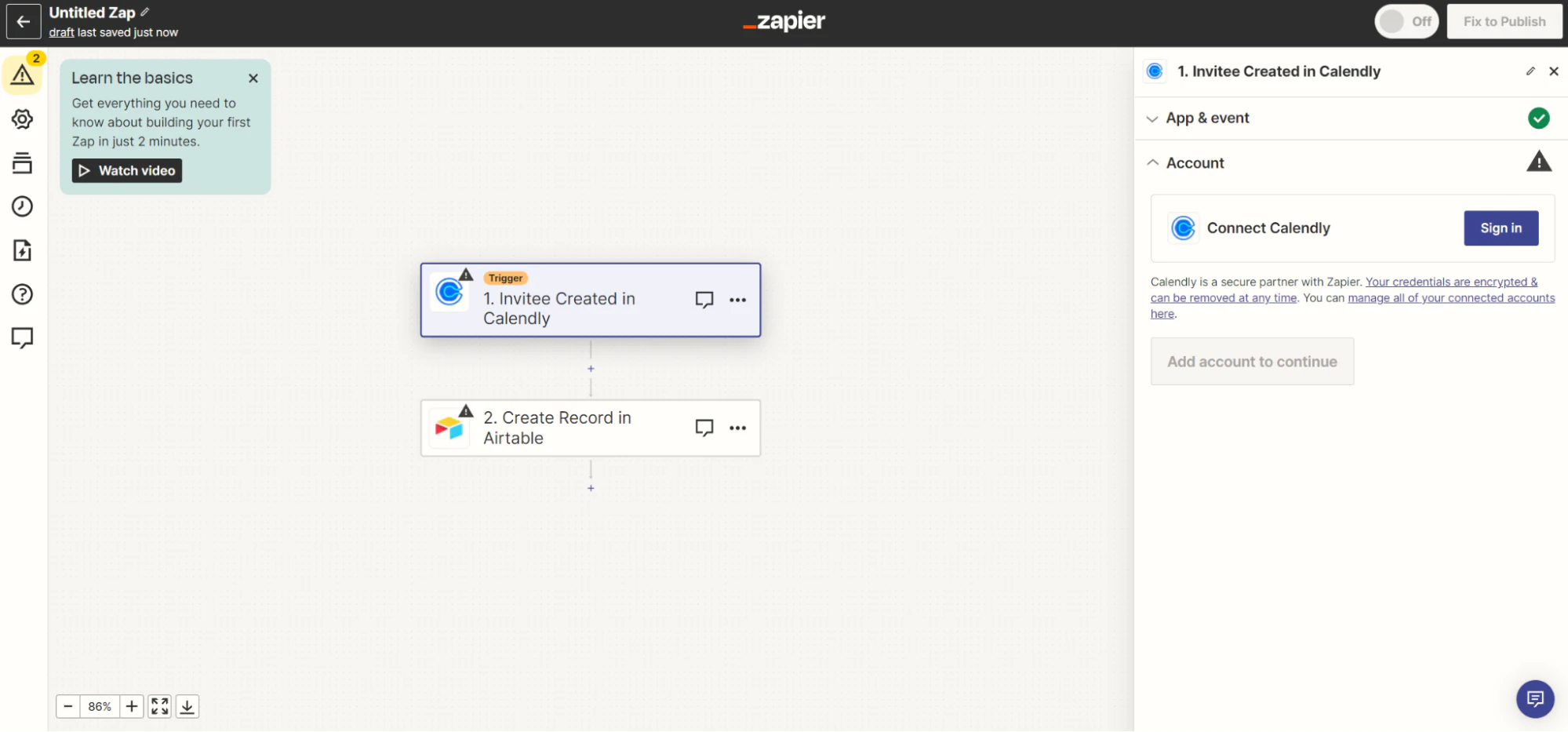
Calendly is an appointment scheduling tool that integrates with Airtable to automate and streamline scheduling.
When someone schedules a new meeting in Calendly, a new record can be created in Airtable, capturing details like meeting time, date, duration, and attendee information.
This integration can be facilitated using Zapier, Make, or Magical, which let you set up triggers in Calendly to initiate actions in Airtable.
This integration significantly reduces manual data entry and helps in maintaining an organized schedule.
This is especially beneficial for businesses managing appointments, interviews, or events through Calendly and tracking these engagements in Airtable for further processing or analysis.
Installation and setup
The setup process is relatively straightforward with platforms like Zapier or Magical.
For instance, with Zapier, the setup involves authenticating Calendly and Airtable, picking a trigger from one app, and choosing the resulting action in the other app, with an option to select the data to be transferred between the apps.
Key features
- Automated record creation: creates a new record in Airtable from newly scheduled meetings in Calendly;
- Data transfer: transfers meeting details such as time, date, duration, and attendee information from Calendly to Airtable;
- Custom labels: allows creation of custom labels to move additional types of information between the platforms;
- Workflow automation: facilitates automation of workflows, saving time and minimizing manual effort in managing and tracking appointments or attendees.
Use cases
- Interview scheduling: automates the process of scheduling interviews and updating the records in Airtable;
- Event management: helps in tracking and managing events by creating or updating records in Airtable based on new or updated event schedules in Calendly;
- Appointment tracking: automates the tracking of appointments, making the process more efficient and organized
User experience
This particular integration is genuinely useful for reducing manual data entry.
Platforms like Magical and Zapier make the integration process user-friendly and provide options for transferring specific data between Calendly and Airtable, giving teams more control over the data synchronization process. The visual workflow integration offered by Make further simplifies the setup process and enables easy data transfer between the platforms.
Pricing
Calendly offers a variety of pricing plans starting at $8 to $16 per user per month when billed annually, or $10 to $20 per user per month when billed monthly, alongside a free version and a 14-day free trial.
The plans are tiered into Free, Standard, Teams, and Enterprise.
Asana
Best for: End-to-end project management

Asana can be integrated with Airtable to create a more organized and collaborative workspace for project and task management.
This integration allows for seamless organization of project tasks, where new tasks in Asana can be created and added to Airtable.
This makes it easier to manage tasks, find them via search, and share documents with team members, reducing the hassle of digging through a cluttered desktop.
By integrating Airtable and Asana, you can unlock a workflow that centralizes data, improves collaboration, and boosts productivity.
This integration transforms work processes by syncing tasks and tables between Asana and Airtable, based on specific triggers or tags assigned to Asana tasks that allow for automated updates in Airtable, and vice versa. It reduces time spent on manual data entry and helps delegate work across your team more efficiently.
Installation and setup
The integration setup can be set up through platforms like Zapier, Unito, Make, or Efficient App, which provide visual or automated workflows for connecting Airtable and Asana. For instance, with Make, users can visually integrate Airtable and Asana into any workflow without requiring coding expertise.
On the other hand, Unito provides a guide for syncing tasks and tables between the two platforms, and Efficient App enables the automatic triggering of an Asana project template or task straight from Airtable.
These platforms provide varying levels of ease and automation for the integration setup, catering to different user preferences and technical expertise.
Key features
- Automated task creation: creates new records in Airtable based on new Asana tasks;
- Data synchronization: synchronizes tasks and tables between Asana and Airtable, maintaining updated information across both platforms;
- Visual integration: platforms like Make offer visual integration to set up workflows between Airtable and Asana, making the setup process intuitive and straightforward;
- Automated workflows: through platforms like Efficient App, users can automatically trigger Asana project templates or tasks straight from Airtable, optimizing work delegation and reducing time spent on task management.
Use cases
- Project management: centralizes project tasks and documents, making project management more organized and collaborative;
- Automated updates: automates updates between Asana and Airtable, ensuring real-time synchronization of tasks and project data;
- Workflow optimization: provides automated workflows to streamline project processes, saving time, and resources.
User experience
This integration creates a streamlined workflow where tasks and documents are organized and easily accessible.
The visual integration provided by platforms like Make simplifies the setup process, making it accessible even for those with limited coding skills.
The ability to automatically trigger tasks and updates between Asana and Airtable boosts productivity and keeps project data updated and synchronized, providing a hassle-free experience.
Pricing
Asana provides a free version for teams of up to 15 people, while its Premium plan is priced at $10.99 per user per month when billed annually or $13.49 per user per month when billed monthly.
They also offer Business and Enterprise plans for larger teams and additional features.
GitHub
Best for: Advanced product data management

The integration between Airtable and GitHub significantly streamlines the workflow by syncing data between the two platforms.
This integration lets you add Airtable records as GitHub issues, sync new GitHub commits to an Airtable base, or add new GitHub pull requests to an Airtable base, enabling seamless tracking and management of GitHub activity within Airtable.
It's a boon for data researchers as it automates the extraction and storage of new and historical data from GitHub projects into Airtable, which significantly streamlines their workflow, allowing easy tracking, management, and analysis of project data in a structured manner.
Installation and setup
This Airtable integration is easy to set up, especially when using platforms like Zapier.
The setup process includes authenticating Airtable and GitHub, picking one of the apps as a trigger to kick off automation, choosing a resulting action from the other app, and selecting the data to be sent from one app to the other.
Airtable also offers a native integration to GitHub that doesn't require the use of third-party platforms like Zapier. However using this integration requires you to be on GitHub Enterprise Cloud or GitHub.com, it does not work with GitHub Enterprise Server.
Key features
- Automated data sync: this integration allows for automated sync integration for file content and data between GitHub and Airtable, such as adding new GitHub commits and pull requests to an Airtable base;
- Automated issue creation: enables the creation of new Airtable records as GitHub issues;
- Data extraction and storage: automates the extraction and storage of data from GitHub into Airtable;
- Workflow automation: facilitates the creation of powerful automated workflows to sync data between the apps.
Use cases
- Bug tracking: helps in recording development bugs with GitHub and managing them efficiently;
- Project management: streamlines project management processes by syncing project-related data between GitHub and Airtable;
- Data analysis: provides a structured and organized manner for data researchers to analyze GitHub data.
User experience
Developers find this Airtable integration useful for simplifying the process of tracking GitHub activities within Airtable.
GitHub's built-in project management and task-tracking capabilities are limited, so the integration offers a viable solution by plugging the data into Airtable.
The straightforward setup process, especially with platforms like Zapier, makes it very user-friendly to get started. The automated workflows save a lot of time and reduce manual effort, especially for programmers, data analysts, and quality assurance professionals.
Pricing
This particular integration is available to all users of Airtable and GitHub, is not restricted to any specific plan type or subscription tier. GitHub offers a range of plans to suit different user needs.
The Free Plan at $0 per month provides basic features for individuals and organizations. For advanced collaboration, the Team Plan is available at $4 per user per month, or $3.67 per user per month for the first 12 months if paid yearly.
GitHub Pro, priced at a reduced monthly rate of $4, includes additional features like 2GB of Packages storage. Other plans range from $40 to $210, providing a variety of options based on user requirements and budget.
Salesforce
Best for: Sales pipelines

The Salesforce integration with Airtable facilitates the synchronization of data between both services, making it simpler to manage contact data, and deal flow, and create customized data pipelines.
This integration can be realized through Zapier, Airtable Sync, and Airtable Automation, allowing for the automatic importing of Salesforce reports into Airtable.
You can also create or update Salesforce records directly from an Airtable base using Airtable Automations. The integration supports real-time data viewing and actions like invoice creation without the need to switch applications, improving operational efficiency and data management across both platforms.
Installation and setup
Setting up the integration involves several steps, starting with logging into Airtable, creating a workspace if not already done, and initiating a new synced table.
From there, you'll select or link a Salesforce account, choose a report, and pick a unique ID column within that report for synchronization.
After these steps, you have to select fields to sync and choose between syncing all fields or only specific ones from Salesforce. The process ensures that data from Salesforce is accurately reflected in Airtable, allowing for efficient data management and automation across the platforms.
Key features
- Multi-step data sync: this Airtable integration supports multi-step data syncing, ensuring that a single trigger can initiate multiple actions in sequence;
- Real-time data access: users can access real-time data and perform actions like invoice creation directly from Airtable without having to switch apps;
- Record management: allows users to create, read, update, and delete records, enabling automated workflows based on the data types used in both programs;
- API integration: an additional feature is the possibility of integrating both platforms' APIs for real-time data insights, fostering improved communication and a superior business experience.
Use cases
- Account management: maintain healthy account relationships and close deals confidently by synchronizing crucial work information across your tool stack;
- Information labelling and transfer: label and transfer specific data like Record Name, Created Time, or Last Modified Time from Airtable to Salesforce seamlessly;
- Case tracking: compile and track Salesforce cases in an integrated, customizable Airtable database without the need for creating complex reports.
User experience
The Salesforce integration with Airtable is easy to set up and takes little ongoing effort to maintain. However, it can be used to create pretty complicated user flows depending on your preference, which is appreciated by more advanced users. Unfortunately, the integration is only available in Airtable Business and Enterprise, which limits its accessibility.
Pricing
The pricing for using the Salesforce integration with Airtable hinges on the subscription to Airtable's Business or Enterprise plans, starting at $45/user/month. Additionally, Salesforce's pricing starts at $80/user/month for the Professional Edition, extending to $165 and $330 for the Enterprise and Unlimited Editions respectively.
Zendesk
Best for: Customer support

The Zendesk integration with Airtable is designed to streamline customer support processes.
By leveraging Airtable Sync, users can create Zendesk tickets directly from an Airtable base or form, and new Zendesk tickets can be automatically added to Airtable, making the management of customer support tasks more organized and efficient.
The integration can also be enhanced through third-party tools like Magical, which facilitates the transfer of information from Airtable to Zendesk with ease, contributing to better data management and customer support.
Installation and setup
Setting up the sync between Zendesk and Airtable involves a few steps.
Initially, a new synced table has to be created in Airtable, followed by connecting to Zendesk, selecting a view to sync from Zendesk, choosing the fields to sync, and creating the synced table in Airtable.
The syncing can be set to manual or automatic, with automatic syncing stated to occur around every 5 minutes. The setup allows for a seamless flow of information between Zendesk and Airtable, aiding in efficient customer support management.
Key features
- Automated ticket creation: automatically create Zendesk tickets from new or updated records in Airtable, so that tracking customer inquiries is effortless;
- Data synchronization: with Airtable Sync, sync ticket information from a specific Zendesk view to Airtable, ensuring data consistency across both platforms;
- Information transfer: transfer specific data from Airtable to Zendesk seamlessly using third-party tools like Magical;
- Customizable syncing options: choose specific fields from Zendesk to sync with Airtable, and set syncing frequency as per requirements.
Use cases
- Customer support management: manage and organize customer support requests efficiently by creating Zendesk tickets directly from Airtable;
- Real-time data syncing: ensure real-time data consistency across both platforms for better customer service and decision-making;
- Enhanced workflow automation: automate repetitive tasks in customer support processes, saving time and reducing manual errors.
User experience
It's worth noting that the syncing frequency between Zendesk and Airtable is around 10 minutes, although the documentation mentions a 5-minute interval.
Many users desire a way to decrease this interval to 5 minutes for more timely data synchronization; however, this requires building a custom syncing process using third-party integrations to achieve quicker data syncing, which can get a lot more complicated.
Pricing
Zendesk offers a range of pricing options starting at $19 per agent per month. Other plans include pricing at $55 and $115 per agent per month, catering to different organizational needs.
The cost of integrating with Airtable may also depend on Airtable's subscription plan, although this integration is available even to the free plan users.
Dropbox
Best for: File content sharing

Dropbox integration with Airtable facilitates seamless file sharing and management.
Using third-party services like Bardeen, you can automate the process of uploading files to Dropbox with new or updated Airtable records, improving project management and collaboration.
This integration helps create structured workflows to handle project files, keeping all project-related information centralized and accessible, which leads to better project tracking and team collaboration.
Installation and setup
Setting up the Dropbox integration through Bardeen involves a three-step process: installing the Bardeen extension from the Chrome Web Store; finding a pre-built automation or using artificial intelligence to build one; and running the automation.
Besides Bardeen, other tools like Zapier, Magical, Make.com, SyncSpider, Pabbly Connect, Microsoft Power Automate, IFTTT, Integrately, Albato, and Pipedream can also be used to establish the integration between Dropbox and Airtable. The process usually involves some variation of authenticating with the two apps, choosing the preferred trigger and action, and configuring the terms of the data exchange.
Key features
- Automated file uploads: automate the upload of files to Dropbox with new or updated Airtable records, and create Airtable records for new folders in Dropbox;
- Easy file management: quickly transfer information such as file name and type from Airtable to Dropbox and vice versa, simplifying file management across platforms;
- Centralized data: centralize all project-related information by storing project files from Dropbox to the associated records in Airtable, aiding in project tracking and team collaboration;
- Streamlined workflows: create streamlined workflows to handle multiple projects with numerous team members, ensuring a smooth flow of information and enhanced productivity.
Use cases
- Project management: manage numerous projects efficiently by centralizing all project-related files and information;
- Data research: automate the storage of research data in Airtable and saving associated documents in Dropbox, saving significant time for actual research work;
- Automated workflows: create complex workflows that trigger actions in Dropbox based on events in Airtable, enhancing workflow automation.
User experience
This integration is particularly useful for creative professionals and data researchers in automating the process of storing project file content and research data.
Setting up and running the automations is an entirely no-code process with tools like Zapier or Bardeen, saving users time and effort in managing files across the two platforms.
Pricing
Setting up this Airtable integration requires you to be subscribed to Dropbox, Airtable, as well as your preferred API platform like Zapier or Bardeen.
Dropbox offers various plans, including the Essentials plan at $9.99 per month for 2 TB of storage, and the Business Plus plan at $18 per month for 3 TB of storage. Other plans range from $11.99 to $83 per month, catering to different user needs and offering varying features and storage capacities.
Zoom
Best for: Storing meeting agendas and notes
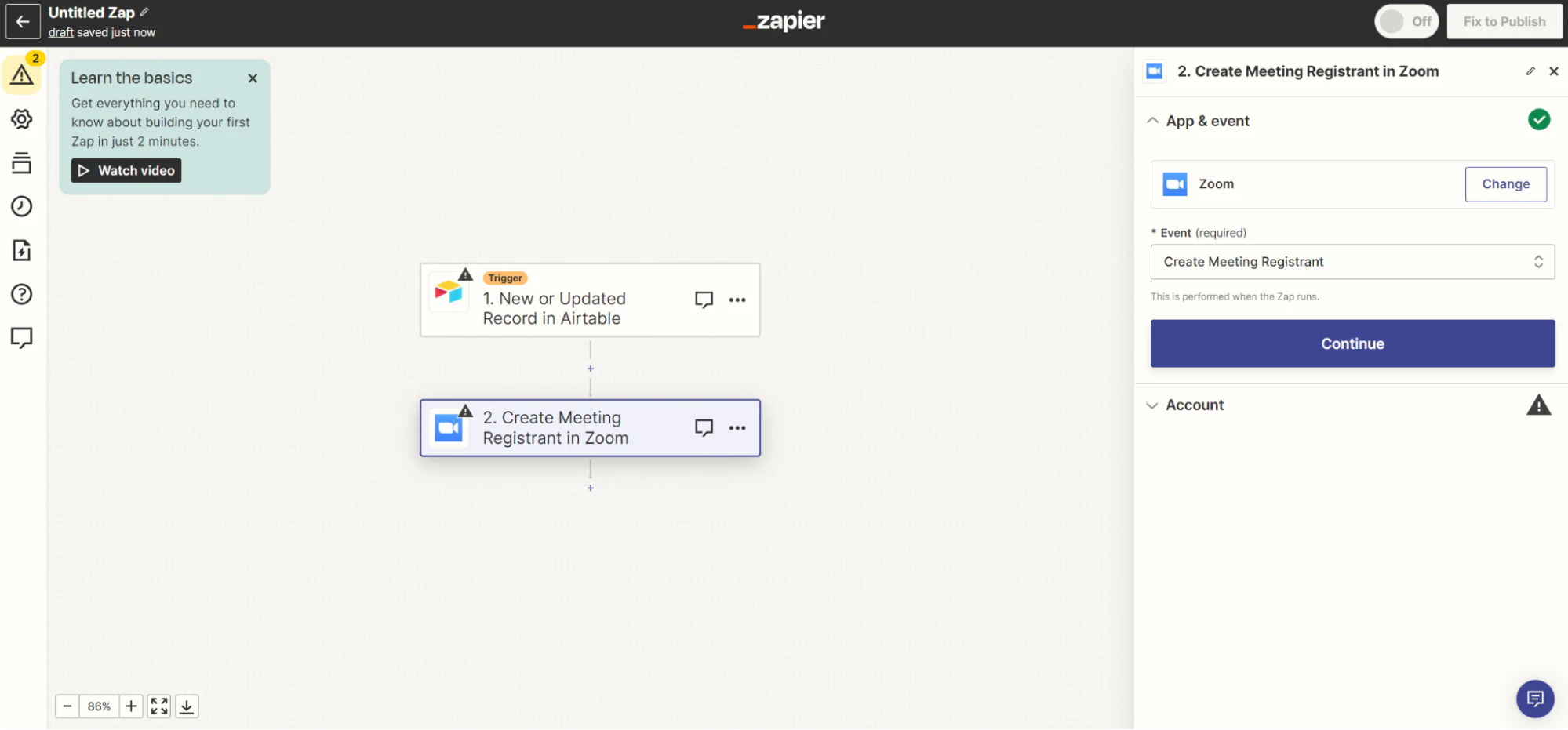
Integrating Zoom with Airtable through platforms like Zapier, Magical, or Bardeen enhances workflow automation by connecting video conferencing capabilities with database and collaboration tools.
You can automate actions such as creating Zoom meetings or webinars from new Airtable records, or adding new Zoom meetings to Airtable as records.
This integration is pivotal for users who need to manage busy schedules, meeting agendas, or project timelines, offering a streamlined process to handle meeting data, attendees, and follow-up actions. It also enables real-time updates, ensuring that any changes in meeting schedules are automatically reflected in Airtable, providing a centralized workspace for teams to coordinate and manage their meetings and related data.
Installation and setup
Setting up the integration through Bardeen involves installing the Bardeen extension from the Chrome Web Store, finding the pre-built automation, and then running the automation to connect Zoom with Airtable.
Alternatively, through Zapier, users authenticate Airtable and Zoom, pick an app as a trigger, choose a resulting action from the other app, and select the data to be sent between the apps. The setup process is designed to be user-friendly, allowing for a swift configuration of automated workflows between Zoom and Airtable.
Key features
- Automated meeting scheduling: automatically create Zoom meetings for new Airtable records or update Airtable records with Zoom meeting details;
- Real-time updates: ensure that changes in meeting schedules or attendee lists are immediately reflected in Airtable;
- Centralized data management: centralize meeting data, agendas, and attendee information in Airtable, making it accessible for team members and enhancing project coordination;
- Automated data transfer: automate the transfer of data from Zoom meetings into Airtable, saving manual work of data entry, particularly useful for frequent meetings and tracking shared information
Use cases
- Meetings management: manage meeting schedules, agendas, and attendee lists efficiently.
- Project coordination: enhance project coordination by centralizing meeting data and related project information.
- Automated workflows: create automated workflows that trigger actions in Zoom based on events in Airtable, enhancing workflow automation and team collaboration.
User experience
Setting up and using this integration with no-code platforms like Bardeen and Zapier is refreshingly easy, thanks to user-friendly interfaces for configuring automated workflows. It requires zero programming knowledge and almost no ongoing maintenance. As long as you have access to both Zoom and Airtable, the rest of the process is straightforward.
Pricing
You don't need any specific paid plan for Airtable, Zoom, or Zapier to use this integration.
However, Zoom's pricing begins at $12.49 per user per month for Zoom One. Other plans include Zoom Pro at $15.99 monthly, and Zoom Business at $19.99 monthly. Pricing for Zoom Business Plus and Zoom Enterprise requires contacting their sales team.
Mailchimp
Best for: Lifecycle email marketing
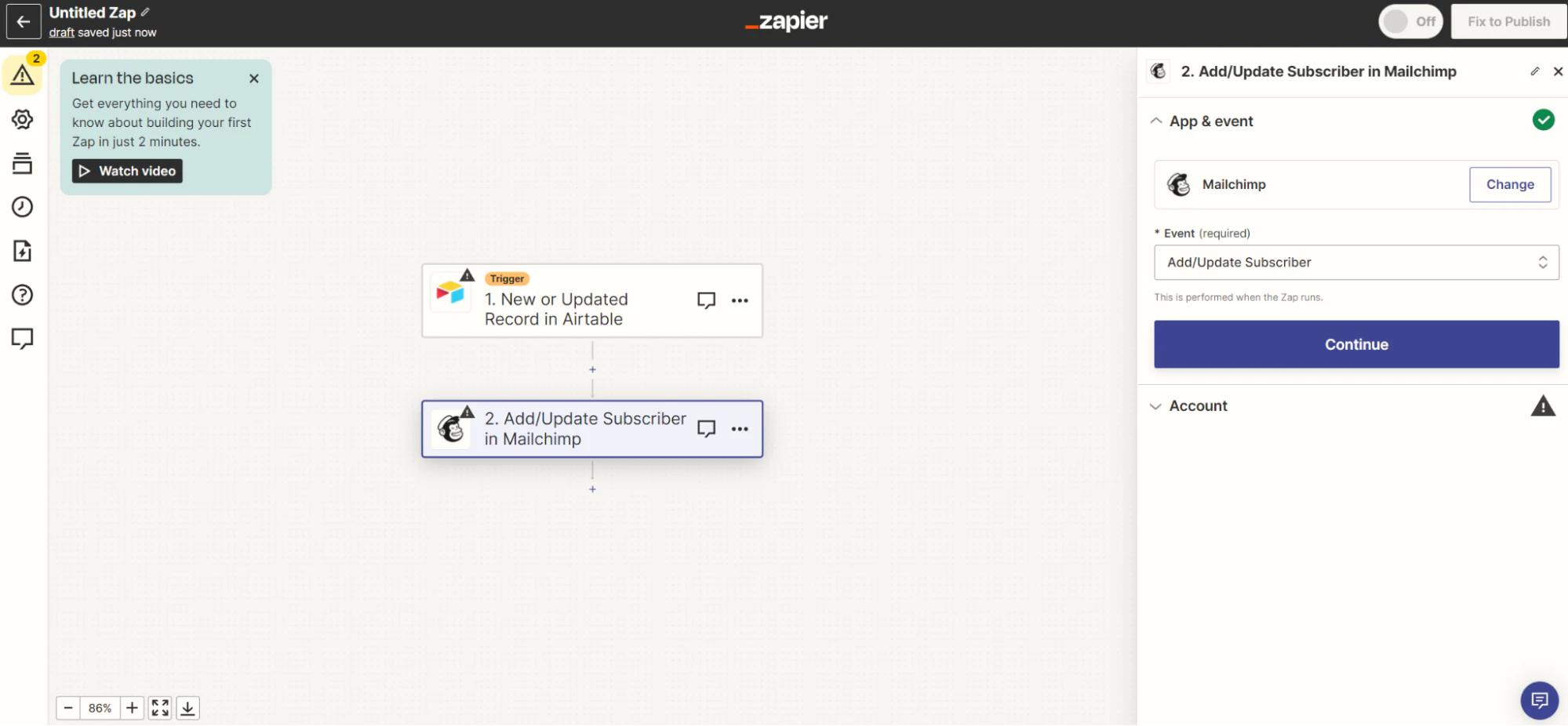
Integrating Mailchimp with Airtable streamlines email marketing by syncing data seamlessly. This powerful combination lets you manage databases in Airtable's spreadsheet-like interface and leverage Mailchimp for bulk marketing campaigns.
With tools like Zapier and Outfunnel, setting up triggers in Airtable to reflect changes in your Mailchimp email lists becomes very easy. The real-time data synchronization makes marketing efforts more efficient and data-driven, which is particularly useful for teams managing dynamic email lists that need to stay aligned with their existing databases.
Installation and setup
For the Airtable Mailchimp integration, prerequisites include an Airtable account with email data and an active Mailchimp account.
With services like Hevo Data, the process involves selecting your data source, providing credentials, and choosing the destination for the data. With Zapier, you have to log in to both services to connect them to Zapier, set up your events and triggers, and select the data you'd like to transfer between the two platforms.
Key features
- Centralized data management: keep your marketing data in Airtable and sync it with Mailchimp effortlessly;
- Automatic synchronization: set up automated workflows to sync Airtable records with Mailchimp audiences in real-time;
- Customized data transfer: with Magical, select specific Airtable fields to transfer to Mailchimp audiences;
- Scalable integration: use tools like Hevo Data for integrating large datasets without manual effort, ensuring data consistency and reducing time spent on repetitive tasks.
Use cases
- Dynamic email lists: keep your Mailchimp email lists updated in real-time with changes in Airtable databases;
- Targeted campaigns: use Airtable to segment data and create targeted marketing campaigns in Mailchimp;
- Data integrity: maintain data consistency across platforms, reducing errors and ensuring accurate marketing communications.
User experience
This Airtable integration greatly reduces manual data entry and the potential for errors, allowing marketers to focus on strategy rather than data management. Although some manual steps are necessary, such as matching data fields during the import process, the overall experience is geared towards efficiency and ease of use.
Pricing
This integration may not incur additional costs, but depending on the volume of data and required automation level, third-party services like Zapier or Hevo Data may bring subscription fees.
These costs would be in addition to the respective Airtable and Mailchimp plan prices. As for Mailchimp, the Free plan allows up to 500 contacts and 1,000 monthly emails. The Essentials plan starts at $13/month, the Standard plan at $20/month with advanced automations, and the Premium plan from $350/month for access to all features.
Slack
Best for: Communicating updates

Integrating Airtable with Slack enhances team coordination and workflow efficiency by centralizing communication and data management.
With this integration, teams can receive notifications within Slack channels whenever updates occur in Airtable databases, keeping everyone aligned on task progress and project developments.
The setup is quick, with a few simple steps required to sync Airtable bases with Slack channels, allowing for real-time alerts and reduced need for manual updates.
This seamless connection between Airtable's robust database functionalities and Slack's communication prowess optimizes collaborative efforts and data accessibility, making it an essential tool for modern workspaces.
Installation and setup
To integrate Airtable with Slack, you begin by visiting Airtable’s Slack integration page and selecting which base you want to sync. After adding Slack and enabling Airtable to post, you choose the Slack channel for notifications and set preferences for update types and frequency. Finally, testing the integration ensures it functions correctly.
Beyond the basic setup, teams can employ best practices like automating notifications and reminders, sharing documents and views directly in Slack, and using Airtable as a central data repository to streamline workflows and enhance collaboration through Slack.
Apart from the native integration, you can also connect Slack with Airtable via a variety of third-party integration tools like Zapier and Make.
Key features
- Real-time notifications: stay updated with instant alerts in Slack for any changes in Airtable;
- Data sharing and collaboration: share records and views easily within Slack, enhancing team collaboration;
- Workflow automation: trigger actions in Slack based on specific events in Airtable, streamlining processes;
- Centralized information management: consolidate data management in Airtable, with powerful search capabilities to quickly access needed information.
Use cases
- Project management: track tasks and communicate updates in Slack;
- Sales and CRM: notify sales teams of new leads and updates to the sales pipeline in Slack;
- HR and recruitment: streamline recruitment processes with notifications and interview scheduling through Slack.
User experience
This Airtable integration cuts down on manual communication and centralizes discussions, making team interactions more efficient.
The ability to customize notifications means teams receive relevant information without the clutter, letting them focus on strategic tasks rather than manually managing data. That said, getting the most out of the integration may require an initial learning curve and setup effort.
Pricing
The integration itself is not an extra cost. However, depending on the plan chosen from both Airtable and Slack, there could be associated fees.
Airtable offers a free plan for individuals and small teams, with paid plans starting at $20/user/month. As for Slack, there is a free version with basic features, with paid plans that provide more capacity and features for professional use. Large organizations may consider Slack’s Enterprise Grid, which is available at a custom price.
WordPress
Best for: CMS and website content
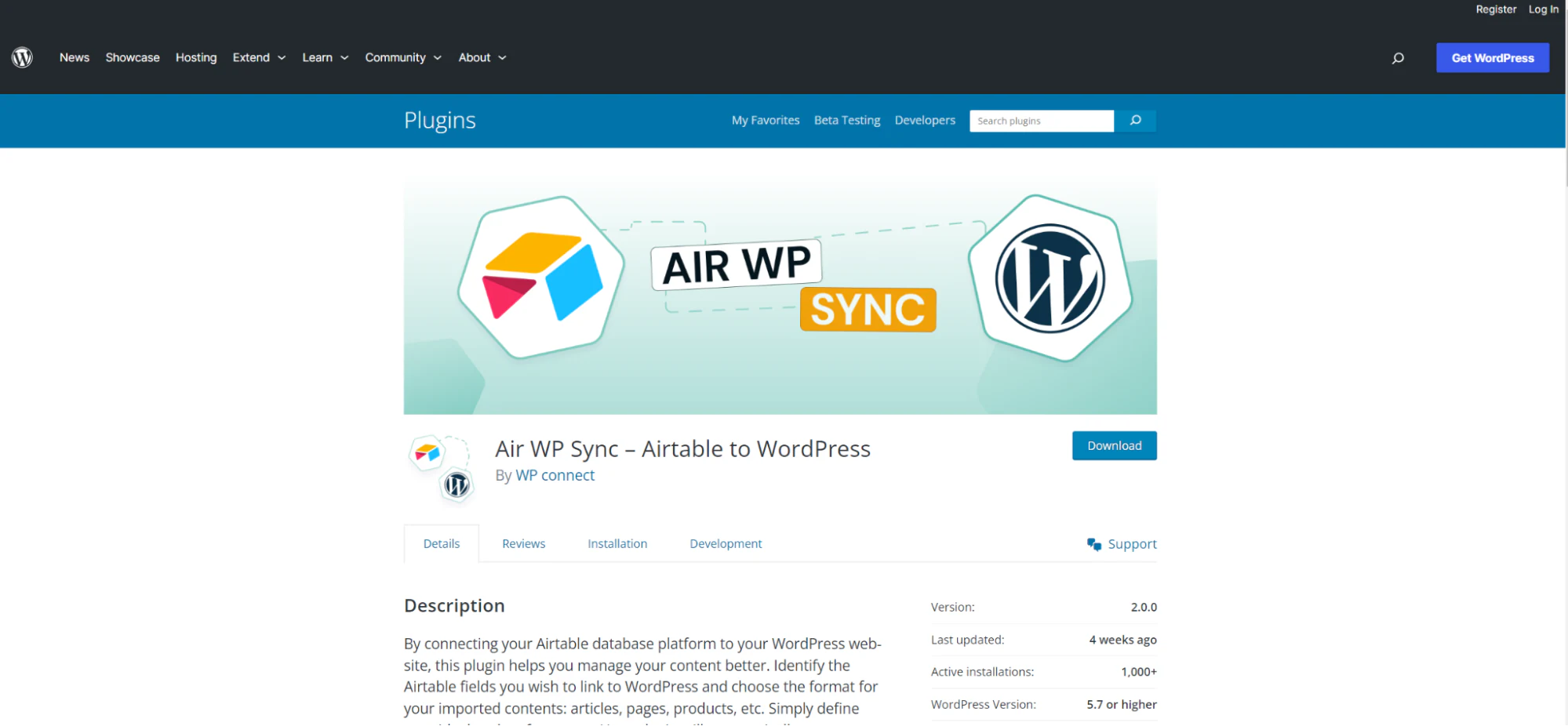
Airtable's integration with WordPress streamlines content management by enabling dynamic and interactive content on websites. This powerful synergy lets you create event calendars, product catalogs, or team directories on WordPress that automatically update from Airtable bases.
With plugins like Airtable for WordPress, the process becomes very user-friendly, allowing for easy configuration and customization. The integration enables efficient data management, improved user experience through customizable views, and streamlined workflows, saving a lot of time and effort on repetitive content management tasks.
Installation and setup
Setting up this integration begins with an Airtable account and installing an Airtable plugin from the WordPress plugin directory. You connect your Airtable account through the plugin settings in WordPress, then define and configure your Airtable feed.
Customizing display options and testing the integration ensures that data from Airtable is correctly displayed on your WordPress website. The step-by-step process involves creating tables in Airtable, connecting the Airtable plugin to your account, creating and configuring a new feed, and customizing the feed's display with shortcode on your WordPress website.
Key features
- Seamless data management: manage and update website content directly from Airtable;
- Dynamic content creation: automatically update WordPress content, such as calendars or directories, based on Airtable data;
- Improved user experience: use Airtable’s views and filters to deliver personalized website content to your website visitors;
- Streamlined workflows: automate content updates, saving time and effort.
Use cases
- Content publishing: Manage blog posts or news articles on WordPress via Airtable;
- Membership websites: Use Airtable to manage member information and automate access control;
- Coupon systems: Automate coupon code distribution for e-commerce on WordPress.
User experience
The Airtable-WordPress integration delivers an efficient content management workflow. It reduces the need for repetitive manual updates, and with customizable options, the content presentation can be tailored to fit the look and feel of any website.
The setup process is straightforward, and the end result is a dynamic site with content that updates automatically in response to Airtable data changes.
Pricing
Airtable's integration with WordPress can be free or paid, depending on the chosen plugins.
Basic Airtable functionality is available for free, while plugins like Air WP Sync offer a free version and a Pro version for added features. Air WP Sync Pro starts at $129/year for a single website license, with higher-tier plans for multiple websites. This cost is in addition to any Airtable subscription fees.
Stripe
Best for: Payments and transaction data
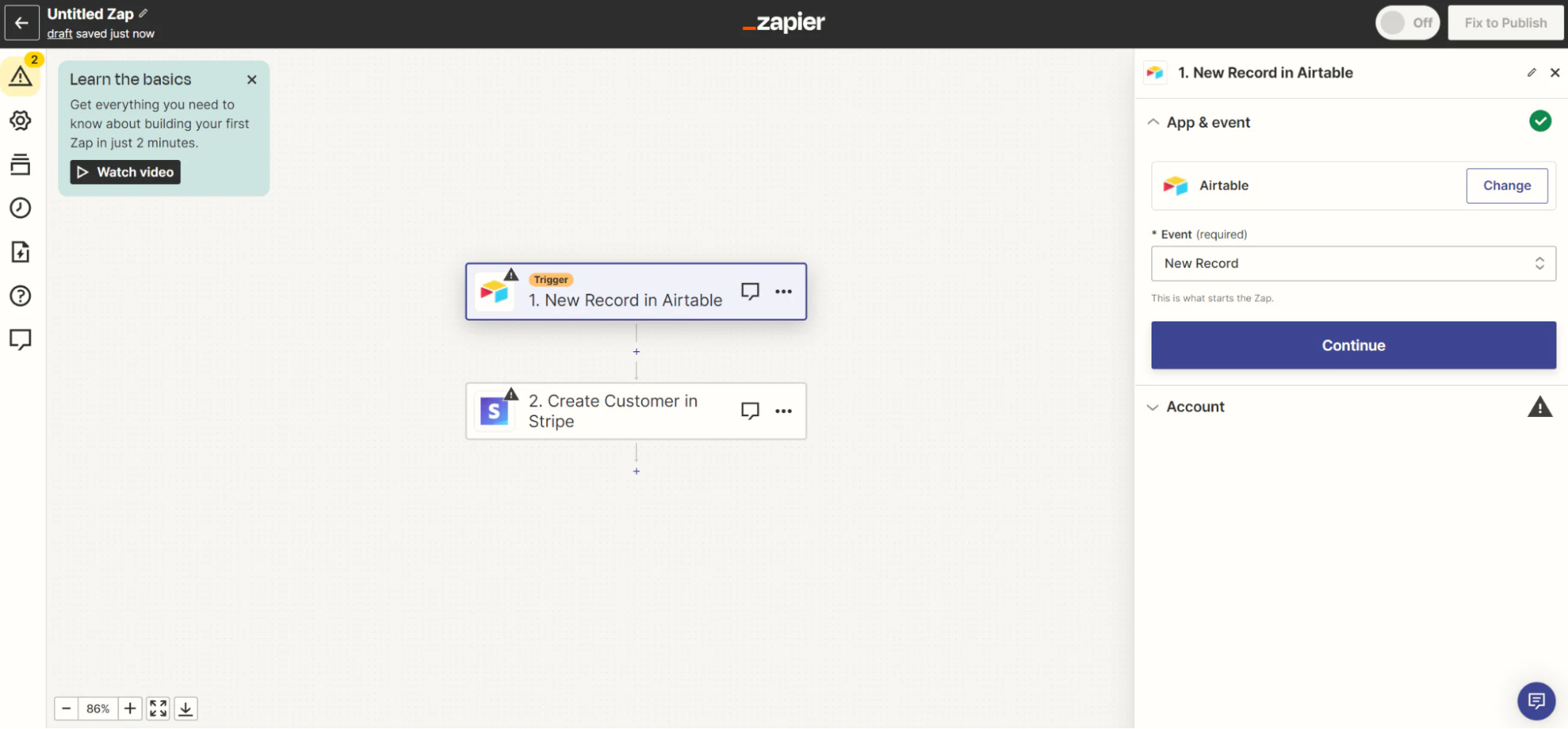
Integrating Stripe with Airtable provides a robust solution for businesses to manage their financial data and payment processing.
It enables seamless updates of Airtable records with Stripe transactions, subscriptions, and invoices, ensuring financial data is always current and accessible.
This integration is highly customizable, allowing for a variety of automated workflows, such as updating records for new charges or creating entries for new subscriptions.
In addition to Zapier, platforms like Data Fetcher and Skyvia provide alternative methods for integrating Airtable with Stripe, offering different features and pricing models that might suit various business needs.
Installation and setup
Setting up the Airtable-Stripe integration via Zapier involves connecting both Airtable and Stripe to Zapier and creating "Zaps," automated workflows that link two services.
The process involves selecting the specific Stripe and Airtable events to trigger actions, like creating or updating records. The setup is user-friendly, guided by Zapier's clear prompts and requires minimal technical expertise.
Key features
- Automated record creation: generate or update Airtable records for new Stripe events, such as payments and subscriptions;
- Custom workflow triggers: set up Zaps for specific Stripe actions, like completed checkout sessions or cancelled subscriptions;
- Real-time updates: sync Stripe financial data with Airtable records as transactions occur.
Use cases
- Sales tracking: automate the recording of new sales data from Stripe into Airtable;
- Subscription management: manage new and cancelled Stripe subscriptions by updating Airtable records accordingly.
- Invoice syncing: keep a synchronized record of issued Stripe invoices within Airtable.
User experience
The Zapier integration is straightforward to set up and makes financial data management more efficient. Online reviews often praise the time saved and the reduction of manual errors through the automated sync of Stripe data to Airtable.
Users can also map data fields precisely and handle larger volumes of data with specialized tools like Data Fetcher and Skyvia. However, there might be a learning curve in setting up the initial integration with these tools and understanding the advanced mapping and synchronization features.
Pricing
Aside from the usual subscriptions to Zapier and Airtable, you'd also need a Stripe account to get this Airtable integration working. Stripe operates on a straightforward pay-as-you-go pricing model.
For online transactions, the standard fee is 2.9% plus $0.30 per transaction. In contrast, for card-present transactions, a slightly lower fee of 2.7% plus $0.05 per transaction is applied. There are no monthly or annual fees for using basic services.
Appy Pie Automate
Best for automation
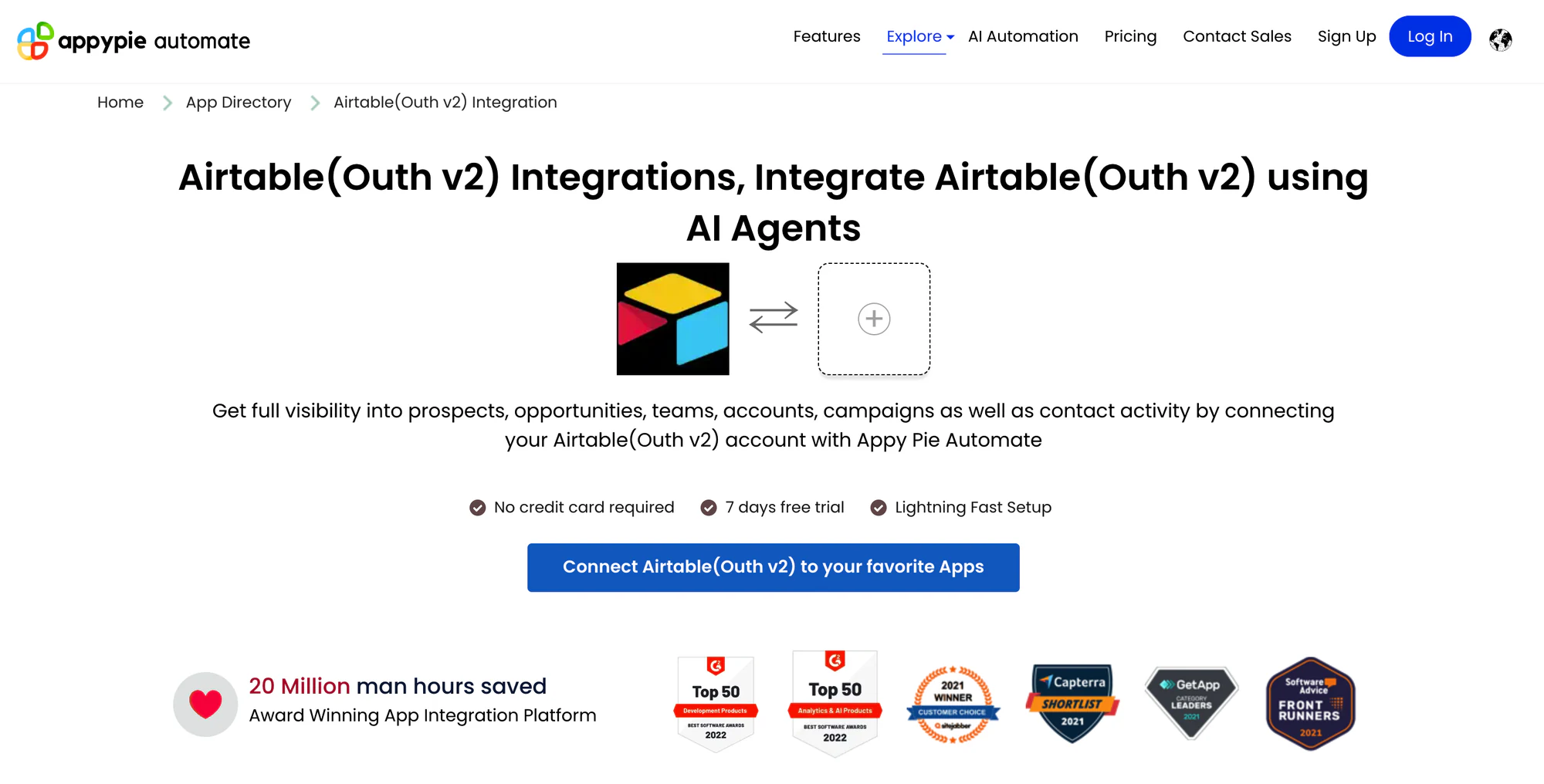
Appy Pie Automate is a no-code platform that enables you to connect Airtable with 100+ apps and software. Following very simple steps, you can create Airtable integrations and make good use of the seamless workflow. Appy Pie Automate is an easy-to-use platform that was designed to be user-friendly for people who have zero coding knowledge.
There is a vast range of applications that can be connected to the apps that you use daily. These integrations are known as “AI Agents”. You can create your AI Agent with Airtable, Google Drive, MySQL, Google Sheets, and many more such apps.
With Appy Pie Automate, you don’t have to work for long hours. You can save time by automating repetitive tasks and streamlining your app’s usage. As a result, you will have more time to focus on the productivity of your business.
Installation and Setup
Setting up an AI Agent can be done in a few simple steps. You can follow the below process to move further:
- Select the Trigger App
- Select the Action App
- Authenticate both the apps and set up the events.
- Test and Activate
By following this process, you don’t have to worry about any coding or a technical process. Appy Pie Automate will cover that for you. All you have to do is, choose the apps you want to connect and put in the required information for the same.
Key Features
Appy Pie's AI Agents are the perfect tool to easily set up Airtable integrations.
Here's why:
- No Technical Expertise Required: With Appy Pie Automate, you don't need any technical skills to integrate Airtable. Its AI Agent simplifies the process, making it accessible to everyone.
- Cost-Effective with a Free Plan: Appy Pie Automate offers a free plan, making this integration affordable and accessible to businesses of all sizes. There's no reason to delay improving your online presence.
- Customizable to Your Business Needs: The integrations can be tailored to fit your branding and specific business requirements. This flexibility ensures that the integration enhances your unique business offering.
- Scalable and Reliable Solution: As your business grows, the integration scales with you. Appy Pie Automate's solution is reliable and secure, ensuring your business data is always protected, no matter the size of your operation.
- No Developer Needed: You can set up Airtable integrations quickly and easily with Appy Pie. There's no need to hire a developer, saving you time and money.
Use Cases
- Data Sync: By integrating Airtable with other applications, you can sync the data between the two platforms. For instance, by syncing the data between Airtable and CRM software, you can keep track of the data. This will ensure that your team has access to the most current information.
- Payment Processing: With Airtable integrations, you can manage customer subscriptions, process payments, and store transaction data directly into your Airtable base. This integration will provide you with an efficient way to handle payments and will keep all your financial data organized in one place.
- Automation: This integration will reduce manual efforts of doing repetitive tasks and will provide you time to focus on productivity. For example, by setting up an Airtable integration, you can automatically create a new record in the Airtable database whenever a new email subscriber joins your mailing list.
- Social Media Management: Integrating Airtable with a social media management platform will help you manage your social media content. This integration will also help you analyze engagement metrics which will help you to make creative decisions for the future.
- Email Marketing: With this integration, you can easily manage your email list and segment your audience based on data in your Airtable database. This integration will help you send targeted email campaigns and personalized content to your subscribers. As a result, this will improve your engagement and conversion rates.
User Experience
Appy Pie Automate makes the workflow pretty easy. With a few simple steps, apps get connected, and the integration can be customized to fit specific needs, freeing up time for other important tasks.
For example, integrating Airtable with Google Sheets keeps data updated automatically: whenever a new record is created in the Airtable database, a row gets added to the Google Sheet. This makes it easy to export Airtable data and keep a backup copy without manual work.
Pricing
Appy Pie Automate has a 7-day free trial, where you can create your AI Agents and customize the connections as per your business needs. As for the billing plans, they have a standard plan of $12 per month, a professional plan of $30 per month, a business plan of $80 per month, and an enterprise plan for which you need to discuss the pricing plan.
Choosing the right integration for your Airtable data
Most of the tools on this list solve a narrow problem: syncing records, sending notifications, or moving data between two specific apps. That's exactly what you want for background automation.
But if your goal is to give a team, a client, or a vendor a proper interface for that Airtable data (something they can log into, filter, and act on without touching a spreadsheet), you need more than an automation tool. That's where a dedicated app builder like Softr fits in: it turns your Airtable base into a secure, permission-aware portal or internal tool, while still letting you automate the workflows around it with Softr Workflows or your existing Zapier setup.
Start by identifying whether you're solving a data movement problem or a data access problem. The right integration follows from there.
Frequently asked questions
What is the best Airtable integration for building a client portal?
Can I connect Airtable to Softr without any coding experience?
Do I need Zapier if I'm already using Softr with Airtable?
Is it cheaper to build a portal with Airtable Interfaces or with Softr?
Can I move away from Airtable entirely after connecting it to Softr?