5 personal CRM tools to organize your work and personal life

You meet people online, take their contact details, and promise to keep in touch. Then life gets in the way and you lose them among a sea of other networking opportunities. A personal CRM, or personal relationship management tool, is a modern searchable replacement for the Rolodex. Here’s how to choose one.
Best personal CRM tools at a glance
| Tool | Best for | Standout feature | Pricing |
|---|---|---|---|
| Softr | Builders who want a CRM shaped around their exact contacts and workflow | Custom fields, database AI agents, and a free AI CRM template | Free plan available; paid plans from $19/month |
| HubSpot CRM | People who already use HubSpot for email marketing | Free-forever plan with unlimited contacts | Free plan available; paid plans scale with usage |
| Zoho CRM | Users who want CRM, email, and docs in one ecosystem | Multi-channel contact history across email, phone, and chat | Paid plans start around $14/user/month |
| UpHabit | Dedicated personal relationship tracking | Reminders and templates for reconnecting with contacts | Paid plans only, no free tier |
| Monica | Open-source fans who want to self-host | Fully open-source codebase you can customize | Free self-hosted option; paid hosted plans available |
What is a personal CRM?
A personal CRM (or PRM) is a relationship management tool that allows individuals, creators, and entrepreneurs to reach out and manage their personal contacts through a specialized web app. Unlike marketing CRMs that connect brands to potential leads, personal CRMs connect you with friends, family, colleagues, customers, or potential clients.
Top features of personal CRM software
Personal CRMs are packed with features that allow you to keep on top of your contact data management. Those features include:
- Access to your online address book with tags and statuses
- Search and filtering functionality to easily find entries within your contacts
- Status labels or tags
- Track answers and actionable tasks
- Keep a log of interactions with your professional network
- Accessible from multiple devices
Why should you use a personal CRM?
Every creator, entrepreneur, or busy individual should use a personal CRM to keep an organized contact management system. Here's why you should start using one:
- Keep track and follow up on your professional networking efforts
- Get all your contacts organized in one place
- Get reminded of important friends, family, and potential clients' milestones (birthdays, anniversaries, graduation dates)
- Keep track of emails, reminders, and touchpoint metrics in the same place
- Take the conversations out of social media and formalize them (or even host in-person gatherings)
What are the benefits of using a personal CRM?
Personal CRMs have multiple benefits, such as:
- Improved contacting efforts and increased networking
- Better relationship building and maintenance
- Increased personal productivity
- Better personal brand perception in your niche
- Less manual and repetitive work
- Increased outreach outcomes
What can you do with a personal CRM?
Personal CRMs can let you do anything that you'd do with a marketing or operational CRM, but with your personal contacts. That means you'll be able to:
- Review and update your contacts, groups, and deals
- Keep a log of interactions with those contacts
- Keep visibility of your personal interactions and agreements
- Reach out to your contacts via different channels
- Analyze the metrics of your interactions (which is especially useful if you're a budding entrepreneur or looking for work)
5 best personal CRM tools that could change your life
Most CRM tools can be used as personal CRMs. Here's a quick side-by-side look, followed by a detailed breakdown of each.
1. Softr
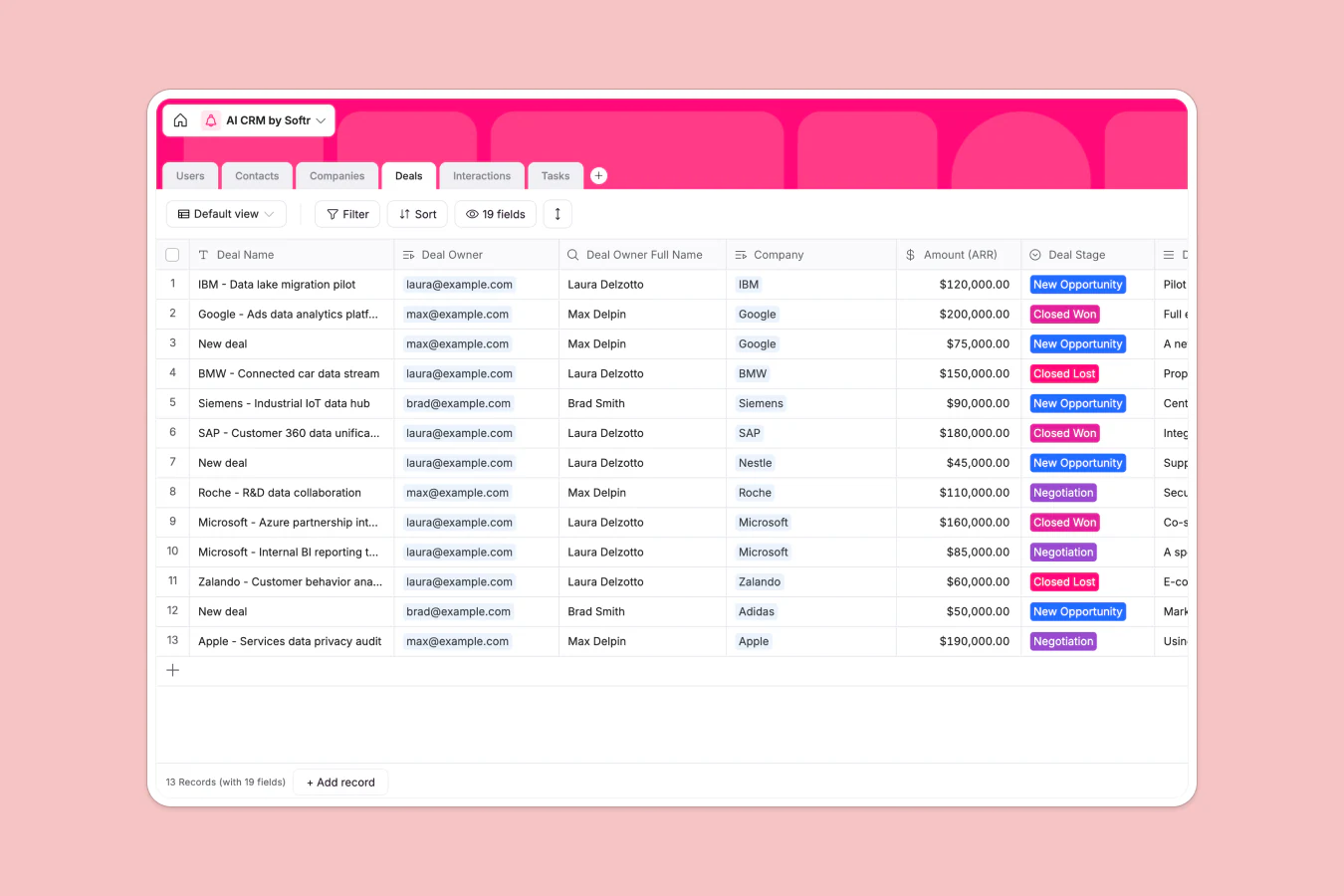
Softr isn't a dedicated CRM tool, but that shouldn't put you off. It's an AI app builder: describe the personal CRM you want and the AI Co-Builder creates a working app for you, complete with a database, contact records, and permissions, in minutes. If you'd rather start with a working example, use the free AI CRM template or the sales CRM template and adapt it for personal use.
Main features:
- Fully customizable interface, database, and permissions, so your personal CRM matches exactly how you track relationships
- Use Softr Databases, Softr's native database, or connect your existing Airtable, Google Sheets, or one of 21+ other data sources
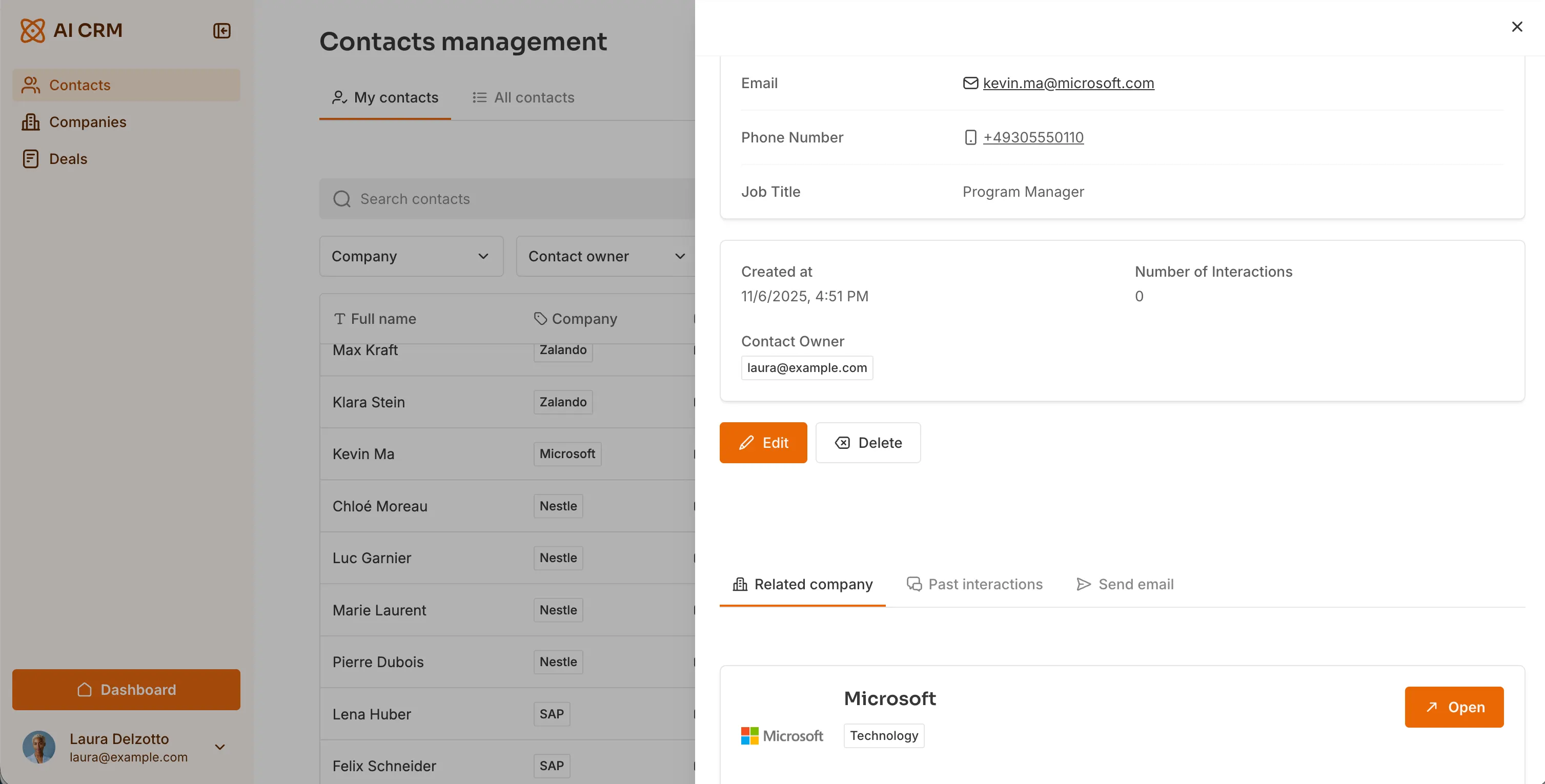
- Set granular access if you want to share your contact list with an assistant or family member without giving them full control
- Database AI agents that can enrich a contact automatically (for example, pulling a company's size or industry from their website) or summarize your interaction history into a short digest
- Accessible on the web from any device: desktop, tablet, or phone
Main drawbacks:
- As a general-purpose app builder rather than an out-of-the-box CRM, you'll spend some time setting up your fields and importing your contacts
- Advanced automation and higher usage limits require moving off the free plan as your contact list and workflows grow
Is Softr a good personal CRM?
Yes, especially if the ready-made personal CRMs on this list feel too rigid or too expensive for what you actually need. Since Softr is a no-code app builder, your personal CRM can be as simple or as detailed as you want, and you won't pay for sales-team features you'll never use.
"In roofing, there were not many good CRM options, except for one that cost thousands of dollars a month. Instead, I used Softr to build our own CRM that rivals the expensive ones. I do not pay for features I will not use, and simply build the ones I want, exactly how I want them." - Verified user, Construction (small business), G2 review
2. HubSpot CRM
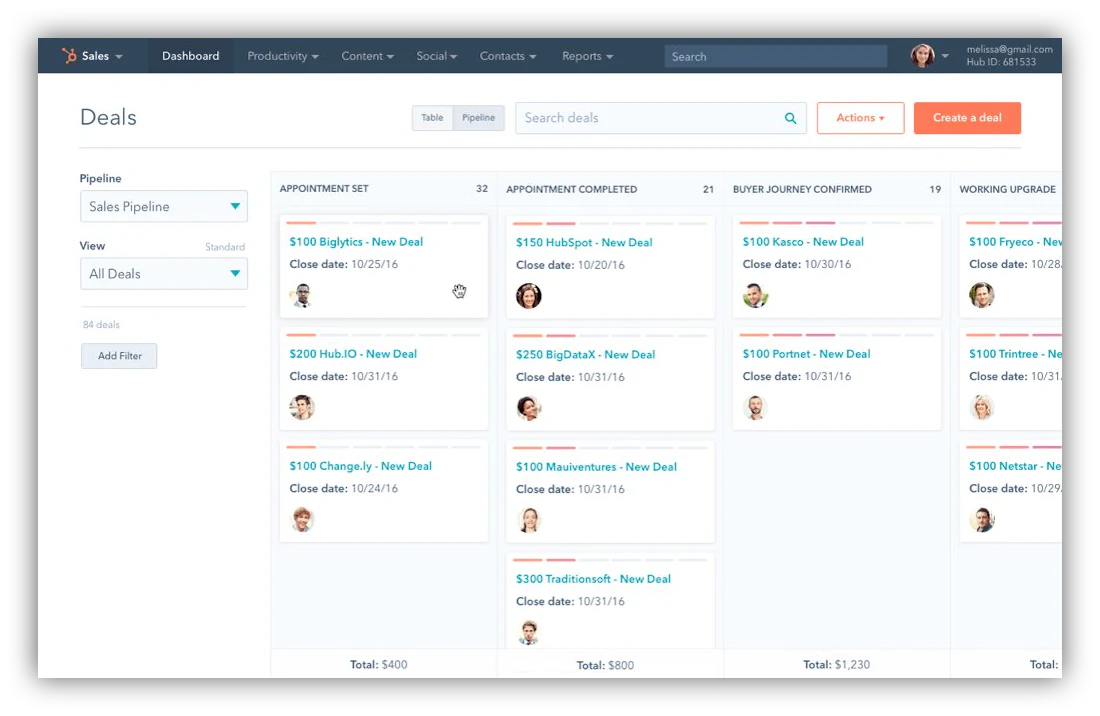
HubSpot is one of the most famous sales CRMs. It lets you automate emails, set reminders, review metrics, and create landing pages all in one place.
Main features:
- Superb email marketing practices, templates, and features
- Easy to use if you've used other CRMs before
- Lets you create customizable dashboards, email templates, and landing pages
- A free-forever version with unlimited contacts
Main drawbacks:
- No customer support on the free plan
- The free plan has a sent-email limit
- Gets expensive as your requirements grow
Is HubSpot a good personal CRM?
Yes, HubSpot can work as a personal CRM, but it's a specialized sales tool and may be more than you need (and pricier than you'd like) for personal use.
3. Zoho CRM
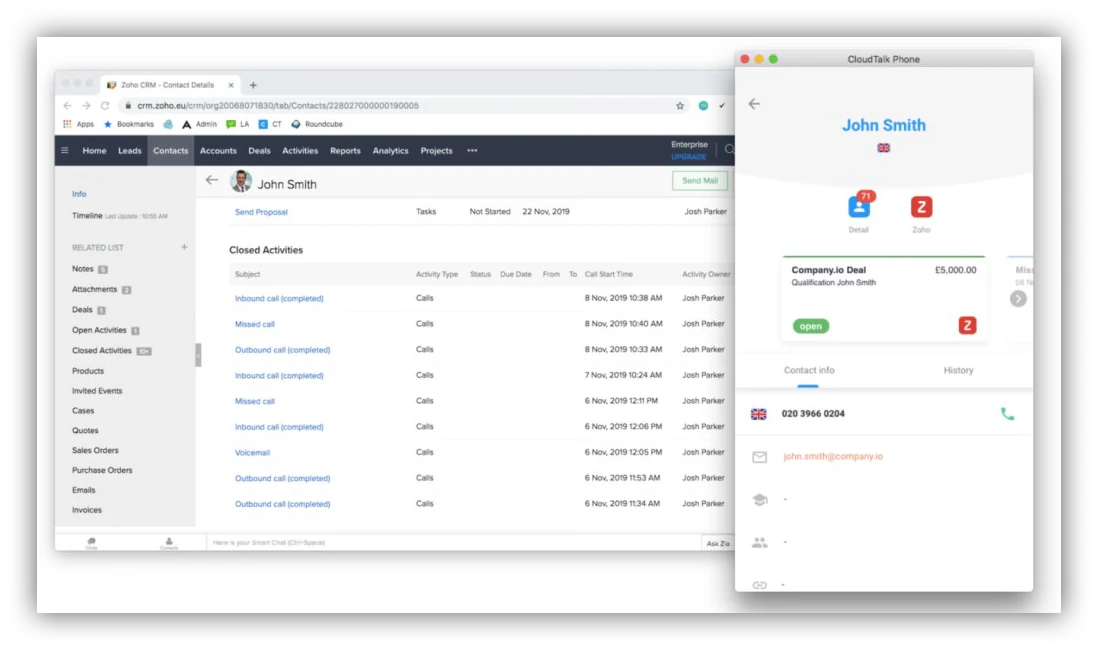
Zoho is one of the most complete web-based tool suites for business. You can pick up different Zoho products like Email, Campaigns, CRM, Projects, and Docs.
Main features:
- Manage your personal email, projects, documents, and contacts using Zoho
- Easy to use
- Connect with your contacts through different channels (phone, email, chat, social media)
- Access to advanced analytics and automation
Main drawbacks:
- Confusing pricing that charges separately for products, features, and extra emails
- Limited storage capacity
Is Zoho CRM a good personal CRM?
Zoho CRM is a solid tool for personal relationship management, but it's better suited to all-in-one enterprise setups than to a simple personal contact list.
4. UpHabit
This CRM is less popular than the others on this list, but it was built specifically for managing personal relationships and saving contact information.

Main features:
- Accessible through web and mobile apps (Android and iOS)
- Templates for online introductions
- Import your Google, Microsoft, and local contact book information
- Reminders to get in touch with others
- Notes and tags on each contact
- Simple data exporting
Main drawbacks:
- Can be expensive compared to other options
- Still a young product, and some features remain in beta
Is UpHabit a good personal CRM?
UpHabit was built specifically for personal networking. If you also need to track deals, leads, or other sales-related workflows, you'll likely want something closer to a sales CRM.
5. Monica
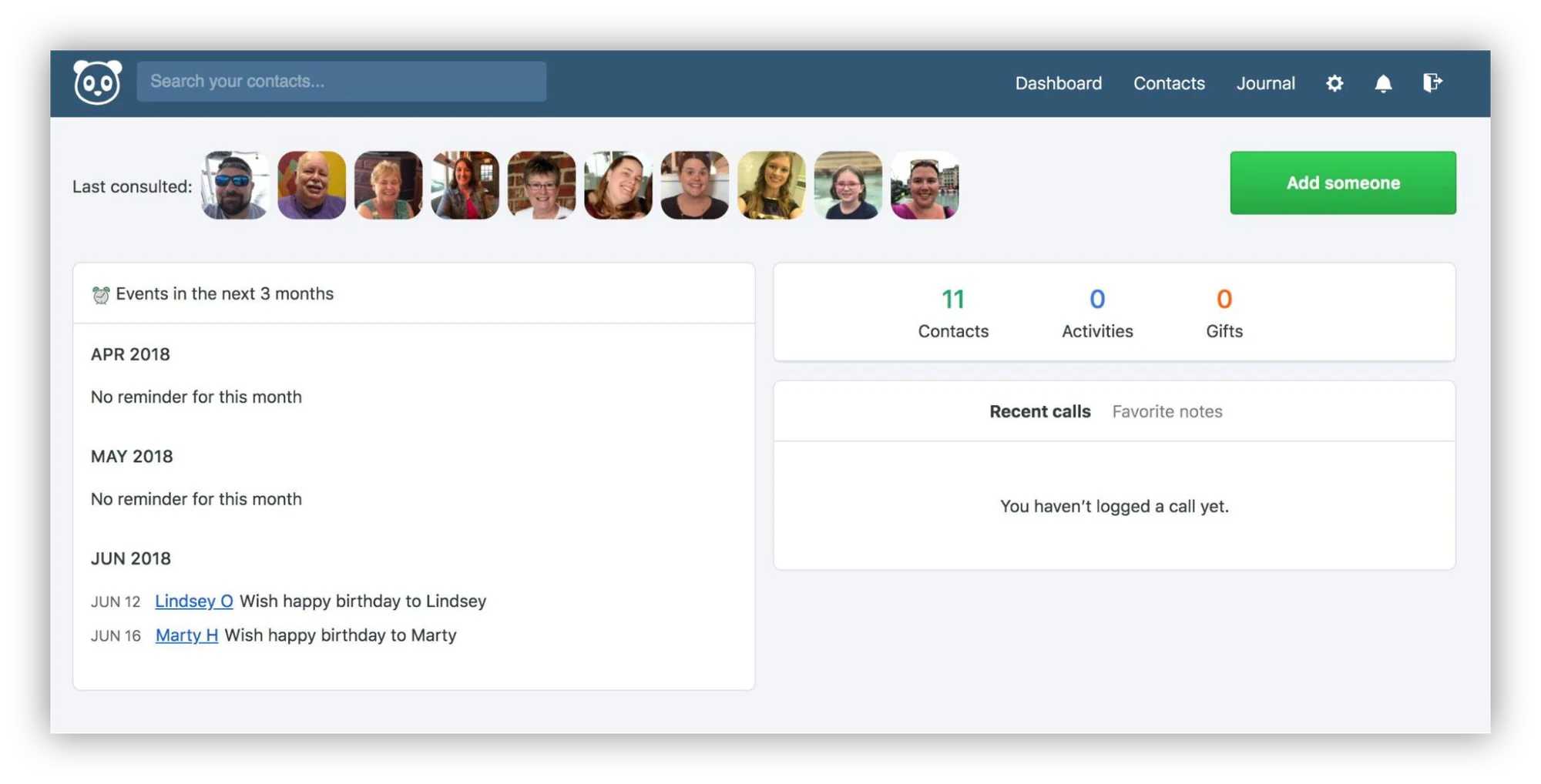
This tool is designed for busy people who don't want their relationships with friends and family to slip through the cracks.
Main features:
- Eye-catching dashboards showing upcoming tasks and events at a glance
- Tag favorite contacts
- Note-taking feature you can review easily during phone calls
- Automatic reminders and notifications
- Open-source, so you can edit it yourself if you have coding experience
Main drawbacks:
- No bulk contact import
- Only accessible through the web
- Not the best fit if you plan to scale a growing business around it
Is Monica a good personal CRM?
If you're using it purely for personal relationships, Monica is a solid choice. If you later want to use the same platform for professional networking or a growing business, you'll probably need to switch to something more flexible.
How to build a personal CRM to improve your professional relationships
Building a personal CRM with Softr starts the same way as any other app: with your data.
- Describe your CRM to the AI Co-Builder, or start from the free AI CRM template if you'd rather begin with a working example.
- Set up Contacts and Companies as separate tables. Keeping them apart makes it easier to handle multiple people at the same organization instead of cramming several emails into one company record.
- Add an Interactions table with one row per email, call, or meeting, and a timestamp for each. This gives you (or an AI agent) a clean history to summarize later.
- Connect your data source. Use Softr Databases for the fastest setup, or connect an existing Airtable base if that's where your contacts already live.
- Customize the interface: adjust text, layout, and colors, or ask the AI Co-Builder to add blocks like a kanban board for tracking outreach stages.
- Replace the sample data with your real contacts, then invite family members or an assistant and restrict their access if needed.
- Publish your app and start logging your interactions.

A single action button can also trigger a workflow that runs AI analysis over your past interactions with a contact, giving you an instant refresher before your next call.
Do your personal relationships need CRM software?
Every person you meet represents an untapped opportunity: your next partner, best friend, employer, investor, or customer. Don't let a busy schedule get in the way.
A personal CRM helps you organize your contacts and follow through on the relationships that matter. If you're ready to build your own, Softr is a solid starting point. It's affordable, quick to set up, and lets you build a CRM that fits your exact contacts and workflow, no coding required.
Frequently asked questions
What does CRM stand for?
What is the difference between a CRM and a personal CRM?
What are the 4 types of CRM?
Is Softr a good personal CRM tool for freelancers?
How much does a personal CRM cost?